













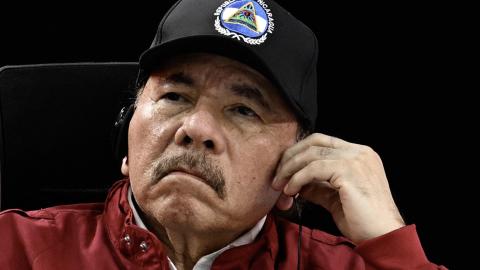
Six weeks after Daniel Ortega vowed that Nicaragua would never again hold elections, the regime-controlled National Assembly unveiled exactly how it plans to convert that threat into constitutional language.
In a narrowing of Ortega’s initial remarks, under the proposed reforms Nicaragua would continue to have elections but without even the pretense of fairness. The proposal would establish extensive grounds for excluding opponents, postpone the next vote, and arbitrarily lengthen the terms of incumbent officials. These reforms are not yet law; Ortega’s wife and co-president, Rosario Murillo, announced that the second assembly will vote on the reforms on January 18, 2027. This leaves Washington and its regional allies a critical window to prepare and act.
An English-language translation of the reforms is attached to this analysis, and the official Spanish-language source can be found here.
What the Reforms Would Do
The proposal would extend Nicaragua’s current six-year election cycles to seven years and move the expected general election from November 2027 to November 2028 to keep the current co-presidents and assembly in office until January 2029. A transitional clause would extend the existing terms of officials in 16 categories—including the Army commander and police chiefs—to seven years, counted from the date of their most recent appointment, election, or ratification.
Other provisions would bar virtually anyone opposed to the regime from seeking public office or holding a leadership role in a political party. The grounds for being included in these bans include having any role in an attempted or completed coup; engaging or having engaged in acts that impair Nicaragua’s sovereign interests; using international funds to organize; inciting foreign interference; calling for military intervention to end the dictatorship; proposing or backing blockades or sanctions against the state, its institutions, or citizens; or being a “traitor to the homeland,” which the regime-altered constitution already defines in predictably sweeping terms.
For candidates, electoral officials, and individual party-board members, the Supreme Electoral Council would be able to determine whether specified conduct occurred and impose unspecified “corresponding sanctions,” without a stated evidentiary standard. Separately, it could deny a party legal status if it formed or has operated with the assistance of foreign funding.
Another proposed article prohibits the “extraterritorial application” of foreign laws and says foreign or international rules deemed threatening have no effect inside Nicaragua. This cannot invalidate US or European sanctions abroad or by itself, but the regime could invoke it to justify domestic retaliation against people or institutions that comply with those sanctions.
Why These Reforms Matter
Taken together, the provisions are an attempt to insure the Ortega–Murillo government against three critical weaknesses.
First, while the reforms cannot cancel foreign sanctions or arrest warrants, they would give Managua a legal veneer with which to reject them and formally retaliate against local compliance. The regime wants this protection because it has grown steadily exposed to international measures over time: Murillo has been under US sanctions since 2018, and Treasury sanctioned two sons and seven Nicaraguan gold firms in April 2026. An Argentine federal judge also issued international arrest warrants for Ortega, Murillo, and a dozen associates in December 2024.
Second, by attacking Nicaraguans who support sanctions, receive funds from international organizations, or seek aid from external powers to remove the regime, Managua is attempting to delegitimize the democratic opposition. Ortega and Murillo seem to know that they would lose a fair election, so they are seeking to write into the constitution an automatic disqualification of any candidate who would pose a real threat.
Finally, the provisions related to term extensions betray an unease around the regime’s looming succession. At 80 and seemingly in poor health, Ortega will almost certainly be replaced entirely by Murillo in the coming years. Murillo already holds office but has never demonstrated an independent electoral mandate; ruling without Ortega would require continued obedience from military commanders, police chiefs, party leaders, and senior economic officials. Longer terms would give those actors a formal stake in continuity while giving Murillo more time to consolidate her hold on power.
How the US and Its Allies Can Respond
Before the planned January vote, Washington should make ratification personally costly for the Nicaraguan legislators and senior officials who vote in favor of or benefit from the reforms. The Treasury Department should prepare targeted asset freezes and pursue companies and intermediaries that conceal or sustain sanctioned officials’ financial interests. For officials already sanctioned, the State Department should seek matching financial and travel restrictions from governments whose jurisdictions those officials continue to use. The administration should also consider offering some officials conditional sanctions relief, visa exceptions, or humanitarian protection if they vote against the reforms or work with the United States to restore democratic rule.
Treasury should also restrict the gold revenues that sustain the regime’s patronage network. It can do this by invoking section 1(b)(i) of Executive Order 13851, as amended by Executive Order 14088, to prohibit Nicaraguan-origin gold imports after a short wind-down. Coordination with Canada and Switzerland to enforce sanctions on the gold industry is crucial because, without matching restrictions, exporters could redirect gold to Canadian buyers and Swiss refiners (documents from two gold mines in Nicaragua show that they send 75 percent of their doré to Swiss refineries). A measure that merely redirects gold exports would leave much of the regime’s income intact. Treasury should therefore review diversion, financing costs, and civilian effects after 90 days.
At the September 17 Organization of American States meeting of foreign ministers, the United States should seek a declaration rejecting the democratic legitimacy of the extended mandates and elections held under the proposed exclusion rules. The US should then schedule a follow-up session before January 18.
In addition to sanctioning figures already designated by the US, Washington should encourage its regional allies to implement travel bans and asset freezes on all officeholders who vote in favor of the reforms or enable their implementation. Shareholders of the Central American Bank for Economic Integration should also oppose new central-government lending while still protecting humanitarian, basic-service, and independently audited projects.
In July, the Office of the US Trade Representative (USTR) imposed a 12.5 percent Section 301 duty on most Nicaraguan goods, with exemptions. The office will also increase duties on goods that do not qualify for Dominican Republic–Central America Free Trade Agreement preferences from zero to 10 percent on January 1, 2027. USTR should open a Section 307 review—the mechanism for modifying an existing Section 301 action—and make ratification a trigger for targeted changes that do not duplicate the July tariff.
Finally, Washington should seek Ortega and Murillo’s negotiated, peaceful departure, but it should not rule out the lawful use of force in advance if the regime responds to any protests with mass violence or undertakes acts of aggression toward the United States or its regional partners. For the status quo to change, the US should make clear that it will meet the regime’s usual countermeasures of hybrid warfare and transnational repression with a heavy and unequivocal response. The Pentagon should visibly prepare options that make that warning credible.
Appendix
Unofficial English Translation of Nicaragua’s Proposed 2026 Constitutional Reforms
Prepared by Gil Guerra
THE UNDERSIGNED FIRST SECRETARY OF THE NATIONAL ASSEMBLY
CERTIFIES:
That on September 1, 2026, during the continuation of the Third Ordinary Session of the Forty-Second Legislature of the National Assembly of the Republic of Nicaragua, Legislative Initiative No. 202610194, entitled “LAW ON PARTIAL AMENDMENT OF THE POLITICAL CONSTITUTION OF THE REPUBLIC OF NICARAGUA,” was discussed and approved both as a whole and article by article, on first consideration[1], pursuant to Article 180 of the Political Constitution of the Republic of Nicaragua and Article 102 of Law No. 606, the Organic Law of the Legislative Branch, as amended. The complete text of the initiative reads verbatim as follows:
THE NATIONAL ASSEMBLY OF THE REPUBLIC OF NICARAGUA
CONSIDERING
SOLE[2]
That throughout its history, Nicaragua, a Blessed, Dignified, and Free Land, has courageously overcome natural challenges and those imposed by the selfish interests of empires, which, through various forms of domination and interference, have sought to infringe the right of our People to live in Dignity, Prosperity, and Well-Being.
Our Revolutionary, Christian, Socialist, and Solidarity-Based State and all Nicaraguans together make an unwavering commitment to fight poverty.
Today, Humanity is living through times of great challenges. Times in which Peace faces constant threats; times in which Peoples observe with concern the resurgence of conflicts, wars, and confrontations that affect coexistence among nations and jeopardize global stability.
Geopolitical tensions, struggles for power, control over strategic resources, the spread of violence, inequalities, economic crises, volatility in energy markets, the imposition of outside interests at the expense of the right of Peoples to determine their own destiny, and the proliferation of “false truths”[3] create an international environment of growing uncertainty that calls for redoubled efforts to preserve and strengthen Stability, Security, and Peace.
In this polarized and unequal world, where political and economic decisions continue to be driven by hegemonic interests that favor the concentration of wealth and power, threats that endanger the Stability, Security, and Peace of Peoples are proliferating, including the following:
- The erosion of respect for and the credibility of International Law, as well as the weakening of mechanisms for defending Peace and the Self-Determination of Peoples.
- The struggle for control over strategic resources, especially oil, gas, and other energy sources, directly affects fuel prices, transportation, food production, and the cost of living for Peoples.
- The imposition of economic and trade sanctions, which affect the development of Peoples, limit opportunities for economic growth, and hinder trade relations and international cooperation.
- The growth of organized crime, including drug trafficking, trafficking in persons, illicit arms trafficking, money laundering, and other forms of crime sponsored and directed by powerful sectors worldwide.
- Inequality in the possession of and access to natural, productive, and technological resources, limiting development opportunities for many countries and communities.
- Food insecurity and difficulties in ensuring sufficient access to food, aggravated by conflicts, climate-related events, and price fluctuations.
In the face of all these aggressions, which present us with a turbulent and uncertain world, Nicaragua reaffirms its historic vocation for Peace, Security, Stability, and the Common Good. Our Pueblo Presidente [People as President] and our Revolutionary State, under a Model of Faith, Family, and Community, remain unwaveringly committed to ensuring all the conditions necessary to continue fighting poverty and to keep building the future of Nicaraguan families.[4]
THEREFORE
In the exercise of its powers,
HAS ENACTED
The following:
LAW No.[5]
LAW ON PARTIAL AMENDMENT OF THE POLITICAL CONSTITUTION OF THE REPUBLIC OF NICARAGUA
Article One:
To reaffirm our principles of Independence, Sovereignty, Self-Determination, and National Dignity, Article 12, Title I, Fundamental Principles, of the Political Constitution of the Republic of Nicaragua, the Complete Text of which was published in La Gaceta, Official Gazette No. 32, dated February 18, 2025, is amended by adding the following paragraph at the end:
“Article 12 …/ The Political Constitution of the Republic of Nicaragua prohibits, and therefore does not permit, the extraterritorial application of foreign laws, only the application of agreements signed on behalf of the Nicaraguan State. No law, regulation, or rule that is issued by another State, group of States, or international organization and that jeopardizes the Independence, Sovereignty, National Self-Determination, Security, and Peace of the People and the Nicaraguan Nation shall have legal effect within the national territory.”
Article Two:
To guarantee Stability, Security, and Peace, Article 47, concerning Political Rights, of the Political Constitution of the Republic of Nicaragua, the Complete Text of which was published in La Gaceta, Official Gazette No. 32, dated February 18, 2025, is amended to read as follows:
“Article 47. Citizens have the right to elect and be elected and to seek public office, subject to the limitations set forth in this Political Constitution.
The following persons may neither stand as candidates for elective office nor hold public offices filled through appointment by the Presidency of the Republic or election by the National Assembly:
- Those who exercise or have exercised direction or leadership, provide or have provided financing, participate or have participated directly or indirectly, or have or have had any type of involvement in the planning, preparation, or execution of an attempted coup d’état or a completed coup d’état;
- Those who engage or have engaged in acts that impair Nicaragua’s Independence, Sovereignty, Self-Determination, Security, and Peace; who incite or promote foreign interference; who call for military intervention; who organize with funding from abroad; who propose, seek, or support economic, commercial, or financial blockades and sanctions against the State of Nicaragua, its institutions, and its citizens;
- Traitors to the Homeland;
- Those who violate or have violated the fundamental principles set forth in this Political Constitution.
Likewise, persons who fall within the foregoing prohibitions may not serve on the governing board of any political party or political organization.”
Article Three:
The term established in the Political Constitution of the Republic of Nicaragua for elective offices and for offices subject to election or ratification by the National Assembly shall be seven years.
These offices are:
- the Co-President [male] and the Co-President [female] of the Republic of Nicaragua;[6]
- Deputies to the National Assembly;
- Deputies to the Central American Parliament;
- Municipal Authorities;
- Regional Authorities;
- Magistrates of the Supreme Court of Justice;
- Magistrates of the Supreme Electoral Council;
- the Superintendent and the Deputy Superintendent General of Banks and Other Financial Institutions;
- the members of the Superior Council of the Office of the Comptroller General of the Republic.
Accordingly, the following articles of the Political Constitution of the Republic of Nicaragua, the Complete Text of which was published in La Gaceta, Official Gazette No. 32, dated February 18, 2025, are amended so that wherever the words “six years” appear, the words “seven years” shall be read instead: Articles 122, 123, 130, 132, 142, 143, 150, 155, 164, and 166, concerning the Organization of the State and the Political-Administrative Division.
Article Four:
The terms of appointment of the Commander-in-Chief of the Military Forces of the Army of Nicaragua and of the Chiefs of the Police Forces of the Republic of Nicaragua shall be seven years.
Accordingly, Law No. 181, Code of Organization, Jurisdiction, and Military Social Security, and Law No. 872, Law on the Organization, Functions, Career, and Special Social Security Regime of the National Police, shall be deemed amended by operation of law wherever they refer to that term.
Article Five:
Items 1, 12, and 14 of Article 152 of the Political Constitution of the Republic of Nicaragua, concerning the Electoral Organ, are amended to read as follows:
“Article 152. The Supreme Electoral Council has the following powers: 1) To organize and direct elections, plebiscites, or referendums called in accordance with the Political Constitution and the law.
General elections for the two Co-Presidents, and for principal and alternate Deputies to the National Assembly and to the Central American Parliament, shall be held every seven years on the first Sunday following November 2 of the applicable election year.
Elections for mayors, deputy mayors, and council members shall be held every seven years on the first Sunday following November 2 of the applicable election year.
Elections for members of the regional councils of the autonomous regions of the Caribbean Coast shall be held every seven years on the first Sunday of March of the applicable election year.
…/[7]
12) To grant or cancel the legal personality of political parties in accordance with the Law.
Not to grant legal personality to political parties when they are formed with foreign funding or any of their officers has violated the fundamental principles of this Political Constitution.
To cancel the legal personality of political parties when the party or any of its officers or candidates receives foreign funding or when they have violated the fundamental principles of this Political Constitution.
…/
14) To verify and impose the corresponding sanctions on all candidates for elective office, officials of the Electoral Organ, and members of the governing boards of political parties who engage or have engaged in acts that impair Nicaragua’s Independence, Sovereignty, Self-Determination, Security, and Peace; who incite or promote foreign interference; who call for military intervention; who organize with funding from abroad; who propose, seek, or support economic, commercial, or financial blockades and sanctions against the State of Nicaragua, its institutions, and its citizens; and on those who violate the Fundamental Principles of the Political Constitution.
…/”
Article Six:
The date on which the Co-Presidents of the Republic take office shall be January 18, in homage to our National Hero and Universal Poet Rubén Darío.
Accordingly, the first paragraph of Article 123 and Article 130 of the Political Constitution of the Republic of Nicaragua, both concerning the Organization of the State, are amended to read as follows:
“Article 123. The elected Co-Presidents shall take office before the National Assembly in solemn session and shall make the pledge required by law before the President of the National Assembly on January 18 of the year following the election.”
…/
“Article 130. Deputies to the National Assembly shall be elected for a term of seven years, beginning upon their installation on January 17 of the year following the election.”[8]
Article Seven:
By mandate and in strict observance of constitutional supremacy, upon the entry into force of this Law, the following is provided:
1. The current terms of the authorities elected by popular vote in the most recent General, Municipal, and Regional Elections are extended to seven (7) years.
2. The term applicable to each of the following is extended to seven (7) years, counted from the date of the most recent appointment by the Presidency of the Republic or of election or ratification by the National Assembly:
- Commander-in-Chief of the Military Forces of the Army of Nicaragua;
- Chiefs of the Police Forces of the Republic of Nicaragua;
- Magistrates of the Supreme Court of Justice;
- Magistrates of the Supreme Electoral Council;
- Procurator General of Justice;
- the members of the Superior Council of the Office of the Comptroller General of the Republic;
- President of the Central Bank of Nicaragua;
- members of the Monetary and Financial Council;
- the Superintendent and the Deputy Superintendent General of Banks and Other Financial Institutions;
- President and members of the Board of Directors of the Production Development Bank;
- members of the Board of Directors of the National Microfinance Commission;
- members of the Customs and Tax Administrative Tribunal;
- members of the National Council of Judicial Administration and Career Service;
- Board of Directors of the Nicaraguan Energy Institute;
- Executive Director of the National Water Authority;
- members of the Civil Service Appeals Commission.
3. In all national legislation currently in force relating to the exercise of public functions, wherever a term of office is stipulated or regulated, that term shall be deemed amended by operation of law and shall be read as a term of seven (7) years.
Article Eight: Publication and Entry into Force
To inform the People of Nicaragua, publication of this first approval in La Gaceta, Official Gazette, is mandated.
Once this Law on Partial Amendment of the Political Constitution of the Republic of Nicaragua has been approved in the second legislature, it shall enter into force as of the date of its publication in La Gaceta, Official Gazette. Publication of the Complete Text of the Political Constitution of the Republic of Nicaragua incorporating the amendments is hereby ordered.
Done at Plaza Juan José Quezada, in the city of León, Santiago de los Caballeros, Capital of the Nicaraguan Revolution, on September 1, 2026.
Deputy Loria Raquel Dixon Brautigam
First Secretary of the National Assembly
- “En lo general y en lo particular” denotes the assembly’s two-stage approval of the initiative as a whole and then article by article. “Primera discusión” is rendered “first consideration” because it refers here to approval in the first of the two legislatures required for a partial constitutional amendment, not necessarily to a common-law “first reading.” ↑
- “SOLE” marks the only recital; Nicaraguan instruments ordinarily label multiple recitals with Roman numerals. ↑
- The source places falsas verdades in quotation marks; “false truths” is intentionally literal. ↑
- Pueblo Presidente is retained in Spanish because it is a regime-specific constitutional formula; the bracketed gloss “People as President” is descriptive rather than a substitute title. ↑
- The law number is blank in the Spanish source, consistent with the instrument’s incomplete two-legislature procedure. ↑
- The source names the Co-Presidency explicitly as a male/female pair, presumably to refer to the current occupants of that office. ↑
- The source marker …/ indicates that intervening items are omitted from the quotation and remain unchanged. ↑
- Article 123 reproduces the current first paragraph except for changing January 10 to January 18. Article 130 changes six to seven years and January 9 to January 17; it also deletes que se contará and makes minor Spanish wording changes that do not require distinct English wording. ↑