














In its competition with China, the United States holds a natural advantage: abundant oil and cheap natural gas. Reliable energy powers factories, data centers, transportation networks, and military operations. It lets the United States combine technological innovation with industrial scale, an advantage that China, dependent on imported oil and gas, cannot easily reproduce.
But China has found a partial answer: the Net Zero movement. For years, a large, influential, and well-funded Western network has campaigned to restrict the production and use of fossil fuels. Many of the same campaigning organizations also oppose nuclear power, the largest source of emissions-free electricity in the United States. Climate advocates seek to persuade the American government to surrender its energy advantage voluntarily. Beijing agrees.
Over the past two decades, therefore, an alliance in all but name has taken shape. On one side stands the Chinese party-state. On the other stands a Western climate community much broader than its activist core: environmental organizations and the philanthropies that finance them, research institutes and international agencies, journalists who cover the transition to renewable energy, officials drawn from the movement’s own ranks, and the investors, asset managers, and financial institutions whose returns depend on the policies the movement secures.
The Net Zero community is not uniform. Its radical wing seeks to end capitalism and usher in a new socialist experiment. Its wealthiest participants intend to profit from the transition to wind and solar. What binds them is not a pact or a chain of command but a convergence of interests. Many, if not most, of them would deny that the alliance with China exists at all.
On the surface, it looks like a relationship of strange bedfellows. China is the world’s largest emitter of greenhouse gases and the largest producer and consumer of coal. Its power system still runs mainly on coal, and it burns more coal than the rest of the world combined. By the climate movement’s own stated goal, the reduction of emissions, China should be its principal target. It is not. The organizations working to avert climate change aim their strongest instruments—divestment, litigation, regulatory pressure, public shaming—at Western energy and industry, and at the governments that decline to restrict them.
Of China, they speak in an entirely different register. The respect accorded to Beijing by Christiana Figueres, who ran the U.N. climate secretariat and midwifed the Paris Agreement, is instructive. In November 2025 she said that in three decades of climate diplomacy, the Chinese had “always under-promised and over-delivered,” a habit she attributed to integrity and humility. John Kerry, then the United States climate envoy and the movement’s most senior American official, put the matter more starkly. At the Glasgow climate conference in November 2021, on the day Washington announced a cooperation agreement with Beijing, Kerry was asked about the forced labor of Uyghurs in Xinjiang, where most of the world’s solar-grade polysilicon is produced. The subject, he said, was “not my lane.” His job was to move the climate agenda forward.
Figueres credits Beijing with integrity. Kerry declines to look at what Beijing does. Neither is an outlier. Between the diplomat who built the climate regime and the envoy who bargained with the world’s largest emitter lies the settled disposition of the Net Zero movement: Contrary to all available emissions evidence, China is the morally serious party, and the West is the laggard. Why?
Several well-publicized cases suggest that one reason China appears to be above Net Zero criticism is that Beijing is playing a major role in funding the climate movement. For example, Neville Roy Singham, an American technology entrepreneur, has reportedly been the subject of a federal grand jury inquiry in New York. Singham sold his consulting firm Thoughtworks in 2017 for $785 million, moved his operations to Shanghai, and began financing a global network of nonprofits and media outlets. In August 2023, The New York Times reported that Singham, working closely with the Chinese government’s media apparatus, financed the spread of its messaging worldwide through nonprofits and shell companies. Singham denied receiving funds or instructions from any government or party, including the Chinese Communist Party.
One recipient of his philanthropy has been Code Pink, the antiwar group cofounded by Jodie Evans, whom Singham married in 2017. In November 2025, Sen. Tom Cotton (R-AR) asked the attorney general to investigate Code Pink under the Foreign Agents Registration Act.
Cotton’s letter noted that, before her marriage to Singham, Evans had demanded that Beijing stop repressing women’s human-rights defenders. After it, she discovered China to be a defender of the oppressed. Code Pink stopped criticizing Beijing’s treatment of the Uyghurs and instead took up its defense, launching, in 2020, a campaign under the slogan “China is not our enemy.” Entities linked to Singham, Cotton’s letter said, had supplied Code Pink with more than $1.4 million since 2017, roughly a quarter of its funding, a figure the letter drew from the Times investigation.
Code Pink also praises China on the climate question. But if Chinese money is shaping American energy policy, the organization under the most serious scrutiny is Energy Foundation China, a California charity that keeps a San Francisco address and a large office in Beijing. By its own account, its China office is registered with the Beijing public-security bureau and supervised by the National Development and Reform Commission, the ministry that writes and administers China’s five-year plans. That self-description, and a report by the national-security group State Armor, was enough to prompt a December 2025 letter from 26 state attorneys general, led by Montana’s Austin Knudsen, asking the Justice Department to investigate the foundation as an unregistered foreign agent. The attorneys general likewise relied on Energy Foundation China’s published statement that the Beijing office is “supervised by” the NDRC.
Energy Foundation China’s chief executive, Zou Ji, is a Chinese national. He previously served as deputy director general of China’s National Center for Climate Change Strategy and International Cooperation, an NDRC agency, and was a member of the Chinese negotiating team in the years leading to the Paris Agreement. He also sits as a special adviser to the China Council for International Cooperation on Environment and Development, the State Council advisory body chaired by a Chinese vice premier. Other senior staff have come out of the Chinese Academy of Sciences, the Beijing Municipal Ecology and Environment Bureau, and the National People’s Congress system. The foundation partners with Chinese ministries and state institutes.
By its own account, its principal business is moving Western philanthropic money into the Chinese policy system. Its major donors include the Hewlett Foundation, ClimateWorks Foundation, Climate Imperative, the Children’s Investment Fund Foundation, the MacArthur Foundation, and similar houses. Energy Foundation China grants that money onward to Chinese government research bodies and universities: the National Center for Climate Change Strategy, the Chinese Academy of Environmental Planning, the Chinese Academy of Sciences, and others.
But it also makes grants in the other direction: to American universities and advocacy groups. Harvard University, the University of California, the Rocky Mountain Institute, the International Council on Clean Transportation, and the Natural Resources Defense Council have all received money. Energy Foundation China says it accepts none from any government or political party. No published investigation has documented otherwise.
The grounds for suspicion, however, are obvious. An American charity, financed by American and European philanthropy, operates in Beijing under the industrial-planning ministry, is led in part by former Chinese officials, disburses Western money to Chinese government institutes, and then writes smaller checks to organizations that work on U.S. energy and climate policy.
That said, most of the money does not lead where the worst suspicions point. The dollar sums moving west into the United States are relatively modest: hundreds of thousands to low millions per American recipient.
Nor does that make the westward grants harmless or the suspicions unserious. A channel built to put large sums of Western money under the control of former Chinese officials in China and under the supervision of the state is a channel that Chinese intelligence could easily abuse. Energy Foundation China has written checks, for example, to the Rocky Mountain Institute, which in 2022 published the gas-stove asthma paper that Consumer Product Safety commissioner Richard Trumka Jr. and Energy Secretary Jennifer Granholm helped turn into a national fight over gas in the home. Destroying the much-deserved reputation of natural gas, which is abundant in the United States, as a low-polluting source of cheap energy has obvious national-security advantages for China.
The Rocky Mountain Institute paid for its work using its pooled funds, which included the $820,000 in EFC grants. However, no public document shows Beijing specifically commissioned the U.S. paper. Even if we assume it did not, the mere possibility still explains why the cozy relationship between former Chinese officials and American philanthropy deserves scrutiny. Hundreds of thousands of dollars may not be enough to buy the Net Zero movement as a whole, but it certainly can generate a study designed to arrive when city councils and federal agencies are already looking for a reason to sideline natural gas. The point is not that such an operation clearly took place. It is that the current arrangement makes one too easy for comfort.
Chinese intelligence did not create Energy Foundation China. It began as the China program of the Energy Foundation, a San Francisco grantmaker launched in 1991 with support from the Pew Charitable Trusts, the Rockefeller Foundation, and the MacArthur Foundation under Energy Foundation founding president Hal Harvey. Harvey later led ClimateWorks as its first CEO, founded Energy Innovation and Climate Imperative, and helped establish the European Climate Foundation; ClimateWorks and Climate Imperative now rank among Energy Foundation China’s major donors. What began as a Western philanthropic initiative became the principal channel through which Western climate money enters China’s policy system. It is not an outpost of the Chinese state inside Western philanthropy. It is an outpost of Western philanthropy inside the Chinese state—or so Western philanthropists prefer to believe.
Following the money is nearly impossible. That’s because large climate philanthropy, in no small measure thanks to the work of Harvey, is organized around regranting. Money passes from an original foundation to a pooled fund, from the pooled fund to a national or regional grant maker, and only then to the organization that does the work. Each entity in the chain is separately incorporated and files its own return, and each return shows a single hop: the immediate donor and the immediate grantee. Nothing in the public record connects the whole chain from the first name to the last.
Arrangements of this kind are both lawful and common enough in American philanthropy, and there are legitimate reasons for the arrangement. A foundation with an enormous endowment and a small program staff cannot manage 400 grants across 30 countries or judge which Indonesian transport group deserves the next check. Intermediaries buy that expertise once and deploy it widely. Pooled funds let a dozen donors act as one, with a single strategy instead of a dozen overlapping ones. And the law requires some of it. An American foundation cannot simply wire money to a Chinese state research institute; it can do so only through a registered entity operating under a state supervisory unit.
The architects of Net Zero’s funding system did not design it to cover the tracks of Chinese intelligence. In practice, however, they created a system in which a trustee whose foundation supplies the first tranche of money has no practical way of learning that the last link is a Chinese government institute—which may then reroute American money back into the United States to buy political influence. Outside auditors cannot trace the money from original donor to recipient.
Chinese intelligence did not suborn the Americans when they staffed an office with former Chinese officials and placed it under the supervision of China’s industrial-planning ministry. No one tricked them into putting funds at the disposal of Chinese bureaucrats.
Where the money trail leads is to the de facto bargain that governs relations between the Net Zero establishment and Beijing. The regranting system that Harvey and his cohort helped build shifted practical discretion from the philanthropies that supplied the money to a professional class of intermediaries who allocate grants, devise strategies, and judge results. They sit on one another’s boards, create one another’s organizations, and validate one another’s work. Like every establishment, they share an ethos.
On China, that ethos can be stated in three words: China is indispensable. In February 2021, at a China Tibet Trans-Himalaya Forum cohosted by China’s Foreign Ministry and Tibet’s regional government, Harvey declared, “America needs China’s leadership if terrible climate change is to be avoided, and China needs America’s.” The belief is sincere. No global emissions strategy can succeed without China. But indispensability gives Beijing leverage over anyone whose authority rests on demonstrating that China can be persuaded to act.
At home, the Net Zero establishment commands an arsenal available only in an open society: lobbying, protest, litigation, shareholder resolutions, disclosure requirements, freedom-of-information requests, legislative pressure, hostile journalism, and public shaming. In China, the party-state will not tolerate these instruments and tactics. No autonomous environmental movement is free to organize against government policy. The courts, press, civic organizations, and corporate sector all remain subordinate to the Communist Party.
The Net Zero establishment therefore enters China disarmed. Its only path forward is to develop a relationship with the state, and it comes to that task as a supplicant, kowtowing and bearing gifts. More than just a practical convenience, access becomes professional capital. The person who can meet Chinese ministers, sit on an official advisory council, or interpret Beijing’s plans to Western donors and governments acquires status, funding, and intellectual authority.
Harvey tacitly illustrated this point in a May 2015 email to Todd Stern, President Barack Obama’s climate envoy, which was later reported in the press. He mentioned that he would soon be in Beijing “meeting the usual suspects, Minister Xie, Su Wei, but also China Development Bank.” In a field that regards China as decisive, the intermediary who can call Beijing becomes the person authorized to explain Beijing.
The parties negotiating the grand bargain are not equals. The Chinese state grants select Western intermediaries access, recognition, and a plausible claim to influence. In return, the intermediaries present the policies of China in terms congenial to Western audiences. Their seat at the table gives to closed and secretive Chinese state bodies the appearance of international collaboration. Their careers become invested in preserving the relationships and appearances on which their authority depends.
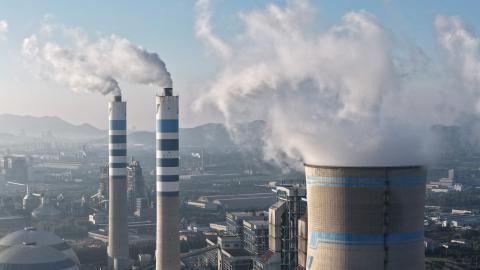
At the heart of the grand bargain is an agreement over Western and Chinese policies defined by simple arithmetic. China adds. The West subtracts. Beijing adds wind, solar, hydroelectricity, and nuclear power to its energy supplies without retiring coal, oil, or natural gas. It expands manufacturing capacity and uses the state to secure supply chains and capture export markets for manufactured goods related to wind and solar energy industries and electric vehicles while still expanding fossil fuel use. In 2024 alone, China began construction on 94.5 gigawatts of new coal-fired power plants, the highest level in a decade, accounting for 93% of all new coal construction on earth.
The Net Zero movement accepts China’s behavior while selling an entirely different prescription at home: close mines; seal wells; shut down pipelines, refineries, and power plants; deny capital to disfavored industries; and compel the adoption of approved replacements, which, by the way, are manufactured in China.
Industrial consequences follow, and they are not subtle. When Western policy subtracts dispatchable power faster than replacements arrive, electricity becomes expensive. Factories that compete on energy cost—steel, chemicals, glass, autos, data centers—shrink, move, or die. Manufacturing costs in Germany, for example, run roughly 40% to 50% higher than in China, with industrial electricity prices being a primary driver: European manufacturers pay about 20 cents per kilowatt-hour while Chinese competitors pay about 6 to 8 cents.
Electricity in the West is becoming not only more expensive but also less stable and more prone to disruptions due to the hybrid systems established with large amounts of unreliable, albeit renewable, energy. In April 2025, a cascade of failures rooted in the physics of renewable-heavy energy grids triggered the Iberian blackout, a power cut to 55 million people across Spain and Portugal.
The Net Zero establishment gives China credit for the renewable energy it adds, even though the new solar and wind farms have not ended its reliance on coal. According to the Energy Institute’s 2025 statistical review, China accounted in 2024 for 55.8% of global coal consumption and 51.7% of global coal production. China now accounts for nearly one-third of global carbon dioxide emissions.
Meanwhile, the establishment condemns Western countries for the conventional capacity they have failed to subtract, even when emissions from those countries fall. The United States has cut its CO2 emissions by 13% since 2010; the European Union has cut its emissions by more than a quarter since 2000; the United Kingdom closed its last coal plant. In the same period, China added more than 3 billion tons of CO2 annually to the atmosphere—an increase larger than the entire current output of the European Union.
The two sides are not pursuing equivalent goals. Beijing uses climate targets to build factories and lock in supply. Western philanthropists, regulators, and banks use them to shut capacity and redirect capital. One side is practicing industrial policy. The other thinks it is saving the planet.
This asymmetry finds institutional expression in the China Council for International Cooperation on Environment and Development. Founded in 1992, CCICED presents itself as a high-level international advisory body. Its charter places it inside the Chinese state. The Ministry of Ecology and Environment directs its operations and daily management and transmits its recommendations to the State Council. Its chair is a State Council leader appointed by the Chinese government, currently Vice Premier Ding Xuexiang, a member of the Politburo Standing Committee. The Chinese government nominates and invites the council’s members and appoints its senior officers. A ministry-led secretariat approves its research projects and budgets.
The council’s membership list reveals how the arrangement works. On the foreign side have sat the leaders of the Natural Resources Defense Council, the World Resources Institute, World Wide Fund for Nature, The Nature Conservancy, ClientEarth, and Environmental Defense Fund International. They have been joined by the presidents of the Rockefeller Brothers Fund and Sequoia Climate Foundation, the chief executive of the Children’s Investment Fund Foundation, the head of the European Climate Foundation, Jerry Brown, senior European officials, and the directors general of major international organizations.
Beijing sends a qualitatively different kind of delegation. Its members include the executive vice minister of foreign affairs; vice ministers of commerce, finance, transport, natural resources, and agriculture; senior officials of the National Development and Reform Commission; a member of the Leading Party Members Group of the Ministry of Industry and Information Technology; a deputy director of the Office of the Central Financial and Economic Affairs Commission; and a member of the People’s Bank of China monetary-policy committee.
On the Western side of the table sit titans of the environmental movement. On the Chinese side sit the ministries of commerce, industry, finance, planning, and the Communist Party. When the Westerners sit down, they think they are bargaining over a planetary emergency. The men across the table are there to manage output, trade, and power.
In the language of traditional Chinese statecraft, the method amounts to “using barbarians to control barbarians.” The state receives carefully selected barbarians with ceremony, grants them titles and audiences, and uses their independent prestige to influence other foreigners. While membership does open a channel into the Chinese state, it also opens a channel from the Chinese state into the institutions those members lead.
Analysts of Chinese influence operations describe the method as “elite cultivation” and its most successful and aggressive result as “elite capture.” The phrase can mean purchase or direct command, but in this setting, something more subtle is at work. The Chinese state fosters dependence through rationed access. The target retains his identity, sincerity, and formal independence. Those qualities give his conclusions credibility that an official Chinese spokesman could never supply. The access-holder becomes the person who supposedly knows what China is “really doing,” and his interpretation of Chinese intentions becomes the West’s interpretation.
In return for this elite cultivation, two things flow back to Beijing that no Chinese official has to request explicitly. The first is a favorable public interpretation of Chinese intentions. The foreigners repackage Beijing’s account as independent expert judgment. The second is restraint. Public criticism of Chinese policy, even limited and respectful, might lead the Chinese to end the relationship.
The plight of Volkswagen reveals the industrial cost of the grand bargain. Germany closed its last nuclear reactors without securing equally reliable and inexpensive replacements. European Union policy pushed consumers toward electric vehicles. The firm that once defined German industrial power has closed or idled plants, posted deep losses on electric vehicles, and agreed to eliminate a total of 100,000 jobs by 2030. Meanwhile, Chinese brands, including BYD, surpassed 9% of new EU car registrations in early 2026.
Volkswagen now competes with Chinese manufacturers supported by lower electricity costs, subsidies, and integrated supply chains. Germany subtracted the power and productive capacity on which its automobile industry rested, then mandated a replacement whose critical supply chains run through China. Beijing burns coal to manufacture the machines Europe can no longer make at competitive cost. This is the European pattern: expensive power, shrinking factories, and a prescribed product supplied by the strategic competitor.
New York State, like many blue states where the Net Zero movement wields significant power, performs the same arithmetic. It enacted a permanent ban on fracking and produces almost none of the fossil energy on which its economy runs. Gasoline, diesel, jet fuel, heating oil, and virtually all its natural gas arrive from beyond its borders.
Meanwhile, state law requires 70% of the state’s electricity to come from renewable sources by 2030 and a zero-emissions grid by 2040. To force the transition, Albany, New York, created the Office of Renewable Energy Siting and Electric Transmission, which may set aside local land-use rules it finds “unreasonably burdensome” in light of the climate targets. As huge wind and solar arrays rise on working farmland across Upstate New York, towns lose the power to protect lands and wildlife that earlier conservationists fought to preserve.
Western New York is among the cloudiest regions in the country. A solar panel there returns a fraction of what the same panel returns in the Southwest, but federal money helps to disguise the cost. The Inflation Reduction Act offered a 30% investment credit for qualifying installations, payable in cash to governments and other tax-exempt entities, plus manufacturing credits for cells and modules assembled in the United States. The original statute set no meaningful foreign-ownership bar. Chinese manufacturers used the opening: They built or expanded American assembly plants to collect the credits while the upstream chain—polysilicon, wafers, cells—remained Chinese.
In July 2025, Congress moved to limit the subsidy. The One Big Beautiful Bill Act barred specified Chinese-controlled companies from claiming the credits and imposed “material assistance” and foreign-entity rules on later projects. But the limits are late and porous. Projects already under construction are largely exempt.
The Cider Solar Farm, under construction on about 2,500 acres in Genesee County, shows how the scheme works on the ground. It is the first major project permitted under the state override authority and the largest solar installation in New York’s history: roughly 500 megawatts and $950 million in financing. It relies on nearly 1 million modules from Canadian Solar, a manufacturer whose supply chain runs through China. Construction began before the new foreign-content rules tightened, so the older investment tax credit still helps finance it. Local farmers and townships have no effective veto.
Whether the modules are made in China or only finished in an American plant with Chinese cells, the result is the same. Western policy makes power more expensive at home and shifts the work to where power is cheap. That place is China. Chinese producers gain a market written into Western law and underwritten, in part, by Western taxpayers.
The emissions do not disappear. They change jurisdiction and they get dirtier. A steel coil, a battery, a solar module, or an electric car once made under Western rules is now made on a grid that still runs on coal and is not bound by the statutes that forced the move. Western countries report a decline on their own books. The atmosphere records the transfer. Subtraction here, addition there, and the carbon counted as progress in Albany or Brussels is burned, less cleanly, in China.
China’s elite cultivation need only turn the homegrown Net Zero establishment a few degrees: away from holding China to the standards it evades, and toward holding the West to the standards China refuses. The closed, one-party state monopolizes access to itself. The Westerners who get that access build careers on the claim that they can move Beijing. Meanwhile, Beijing keeps burning coal. The validators call the result climate leadership because the coal is now used to manufacture the wind turbines, solar modules, and electric cars the West has ordered itself to buy. The validators do not have to take instructions from Chinese intelligence. They must only protect the relationship—and keep imposing at home the constraints China will not accept.
Saikat Chakrabarti, then chief of staff to Rep. Alexandria Ocasio-Cortez (D-NY) and one of the principal architects of the Green New Deal—the sweeping climate and economic program Ocasio-Cortez and Sen. Ed Markey (D-MA) introduced in Congress in February 2019—offered an important clue to the motivations of its architects and backers that year. “The interesting thing about the Green New Deal,” he explained in a Washington Post profile, “is it wasn’t originally a climate thing at all.” It was, he continued, “a how-do-you-change-the-entire-economy thing.”
The text of House Resolution 109, the nonbinding measure that set out the program, confirmed the point. It called for a “national, social, industrial, and economic mobilization” comparable to the New Deal and the Second World War. Its ambitions extended beyond emissions reduction to unionization, wage policy, healthcare, housing, education, racial disparities, Indigenous rights, and economic security.
Those ambitions did not spring from climate science. By the 1970s, an influential part of the environmental movement had expanded from conservation and pollution control into a critique of industrial growth. The Club of Rome, an association of scientists, economists, and former officials founded in 1968 to study the long-term predicament of industrial society, published “The Limits to Growth” in 1972. It warned that growth in population, production, consumption, and pollution could carry the world past its ecological limits. The report was not socialist, but it created common ground with a left that regarded capitalism’s drive for growth as a systemic problem.
Opposition to nuclear power exposed the depth of that common ground. Nuclear generates large quantities of reliable electricity with very low greenhouse-gas emissions and remains the largest source of carbon-free power in the United States. Nevertheless, Greenpeace International declares that nuclear energy has “no place” in a sustainable future and calls for all existing plants to be shut. The Sierra Club and Friends of the Earth have opposed it for decades, and in January 2019 the Sunrise Movement cosigned a letter to Congress classifying nuclear as “dirty energy.”
Nuclear raises real questions of safety, waste, cost, and construction time. But those are not carbon questions, and they hardly make nuclear energy “dirty.” Nuclear plants decarbonize without manufacturing scarcity and, therefore, without putting the grid under political command. That is the true reason why the movement cannot accept it.
Some activists say so openly. The Democratic Socialists of America states the logic explicitly, calling for public ownership of energy, housing, and transportation. Its Green New Deal seeks “democratic control over key economic sectors,” including energy, transportation, and construction. It identifies control over investment and production as the source of capitalist power and presents climate policy as a means of contesting that control. “Beyond addressing the climate crisis,” the organization explains, the program “aims to rebuild the public sector and the labor movement as both a means and an end.”
That label has political utility. It softens some of the opposition to a project for restructuring labor, housing, transportation, investment, race, consumption, and industrial policy. It also encourages the public to judge the project by the standards of an emergency rather than the standards of ordinary politics, where such a program would have to win an argument on its merits. Climate screams “fire” so that socialism can deliver the fireman.
If the fall of the Berlin Wall discredited state ownership as a comprehensive economic program, it did not inhibit the left’s belief in its historical rightness or its quest for centralized state control. In the post-Cold War era, climate politics supplied a new moral rationale and a new set of instruments for these aims. Governments could set emissions targets, prohibit technologies, prescribe how buildings were heated and vehicles powered, and steer investment toward approved industries.
Governments, international organizations, banks, foundations, universities, and environmental NGOs rarely call themselves socialist. Many nevertheless support transferring decisions over energy and investment from markets to regulators, politically guided financial institutions, and transnational bodies. Most major corporations in the West have adopted “ESG” (environmental, social, and governance) principles to guide their investments and hiring practices—as their leaders imagine themselves as part of the elite class that will administer the heights of the new state-owned and -run society.
Few individuals represent this establishment wing better than Mark Carney. Before entering Canadian politics, Carney served as the U.N. special envoy for climate action and finance and helped establish the Glasgow Financial Alliance for Net Zero. GFANZ enlisted banks, insurers, and asset managers to align capital with politically determined emissions goals. To be sure, Carney is more a bespoke-suited technocrat than a campus Marxist, but in practice, the two types are not as far apart as one may assume.
The climate regime does not abolish private profit. It channels profit toward firms positioned to benefit from subsidized markets, mandates, and protected sectors. Administrative complexity—the sheer volume of reporting requirements, disclosure frameworks, and alignment standards—favors large institutions with the lawyers, lobbyists, and capital to navigate and shape the rules, while squeezing out smaller competitors that cannot afford to comply. The largest banks, asset managers, and insurers have helped write the system because it benefits them.
Brussels is among the movement’s most reliable international partners, and its enthusiasm is structural. As a transnational regulatory authority, the European Union’s competence expands whenever a problem is defined as too large for member states to manage alone. Climate policy has produced a sweeping transfer of authority: emissions targets, vehicle rules, building standards, and disclosure requirements written in Brussels and binding in 27 capitals. An institution constituted to move authority upward from nations has a standing interest in emphasizing problems that require it to intervene.
China brings something unprecedented to this convergence. During the Cold War, communism confronted capitalism largely from outside the capitalist world economy. Today, China competes from within it. The Communist Party preserves a Leninist monopoly on political power, directs strategic industries, and retains authority over nominally private firms. At the same time, it draws capital, technology, and markets from the global system it seeks to surpass. Rather than a conventional capitalist economy or a replica of the Soviet Union, China is a communist party-state that has learned to harness capitalism without surrendering political command to the market.
The competition between capitalism and communism now runs through the institutions of capitalism itself. Both the radical and the technocratic wings of the Western climate coalition look favorably on statist solutions. Radical activists see only state power as capable of commanding the transformation of society of which they dream. Banks, investors, and big businesses see scale, state-backed markets, and durable priorities.
Consequently, key elements of the Net Zero movement seek to enlist China in a struggle over the reorganization of Western society. They present Chinese investment in approved technologies as proof that state-directed transformation works, that the future belongs to it, and that Western resistance is backwardness rather than prudence.
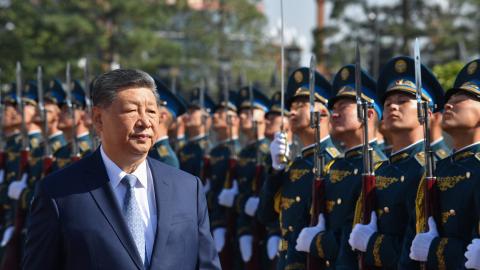
The appearance of China’s leader Xi Jinping at Davos in January 2017 showed how readily Beijing could occupy the role Western institutions now offered it. As Western voters rebelled against the establishment associated with globalization, Xi defended free trade, urged governments to “adhere to multilateralism,” insisted that countries “honor promises and abide by rules,” and said that the Paris Agreement was a hard-won achievement that all signatories should stick to rather than walk away from.
Not even one of these statements was sincere. Xi pretended to accept the role that the Net Zero establishment had been urging on China’s leaders for years: namely, guardian of globalization, multilateralism, and climate cooperation. Western progressives created the role and rewarded the performance. So long as Beijing recited those principles abroad, they ignored the fact that it preserved Leninist control and industrial self-interest at home.
The grand bargain is therefore much more than an alignment of interests. The Net Zero establishment supplies the language through which Chinese industrial policy becomes an engine for transforming the world. The Net Zero activists are deploying China in an internecine Western argument about how to organize society, an argument older than the climate question and unresolved since the 19th century.
In November 2023, Greta Thunberg addressed an Amsterdam march that organizers called the country’s largest climate-and-justice demonstration. Wearing a keffiyeh, she invited a Palestinian and an Afghan speaker onto the stage and told the crowd that there could be no climate justice without international solidarity. A man climbed onto the stage and took the microphone. “I have come here for a climate demonstration,” he said, “not a political view.” He was ushered off, and Thunberg led the crowd in a chant: “No climate justice on occupied land.”
The heckler and the activist disagreed about what climate politics had become. He regarded it as a discrete environmental cause. Understanding the true nature of her movement, she treated it as one front in a wider struggle. Across Europe and North America, climate activism and anti-Zionism have become tightly joined.
This pattern is too broad to dismiss as incidental. The World’s Youth for Climate Justice calls Palestine “part and parcel” of the climate struggle. Greenpeace Canada says that protecting nature is inseparable from supporting Palestinian liberation. Sierra Club Canada has backed an arms embargo on Israel. Climate Action Network International, an umbrella body for more than 2,500 civil-society organizations in over 130 countries, has declared solidarity with the Global Sumud Flotilla and called the blockade of Gaza collective punishment. Oil Change International tracks oil deliveries to Israel and accuses the suppliers of fueling genocide. The Sunrise Movement declares that “climate justice means freedom for Palestinians” and has joined Reject AIPAC, a coalition pressing Democratic politicians to refuse American Israel Public Affairs Committee endorsements and contributions.
Sunrise’s Washington chapter went further. In 2021, Sunrise DC described Israel as a colonial project; demanded the exclusion of the Jewish Council for Public Affairs, the National Council of Jewish Women, and the Religious Action Center of Reform Judaism from a voting-rights rally; and withdrew after the organizers refused. The national organization condemned the chapter’s decision as antisemitic and unacceptable. It nevertheless continued to define Palestinian liberation as a climate-justice cause, from which Jews were to be excluded.
Sunrise is not a fringe outfit. Its cofounder Varshini Prakash sat on the Biden-Sanders Unity Task Force on climate in 2020 and helped develop climate recommendations that informed the Democratic platform. Prakash served on Joe Biden’s presidential campaign and transition teams, helping to shape Biden’s climate policy. In addition, the Sunrise Movement’s cofounder Will Lawrence is running for Congress in Michigan’s Seventh congressional district as the Democratic nominee.
Why have climate and Palestine become the glue that holds this coalition together?
They perform different functions. Climate supplies money and institutional machinery. Palestine supplies ideological and, increasingly, electoral cohesion. Climate gives the coalition’s anticapitalist, antiwar, and anti-Zionist components something they could not command on the same scale: mainstream philanthropy, public funding, and corporate sponsorship. It also provides political authority under a formally universal banner and the ability to engage non-leftist constituencies, including pro-Israel Jews who support climate activism.
Climate-mitigation philanthropy alone now generates staggering sums of money. ClimateWorks Foundation, which tracks giving across the field it helped build, estimated that foundations and individuals directed between $11.7 billion and $18.4 billion to climate-mitigation philanthropy in 2024. Foundation grants alone reached $6 billion—more than double the 2020 total. Those figures count only charitable transfers. Behind them sit subsidies, tax credits, green-bond markets, and the asset-management rules that steer pension and insurance capital. Climate is one of the best-funded permanent dimensions of Western philanthropic life, and it pays for staff, litigation, research, and access on a scale that antiwar or anti-Zionist organizing could never match from their own donors.
Net Zero rules have given many of the same institutions influence over far larger pools of capital held by governments, banks, and pension funds than anti-Zionist groups could generate on their own.
Money explains how the coalition acquires its reach. Ideology explains why its power is directed so reliably toward Palestine. Transnational progressivism divides the political map into oppressors and oppressed. National claims assigned to the oppressed count as liberation; those assigned to the West count as colonialism. On that map, Palestine is the transnational cause par excellence. Within this framework, Israel represents European colonialism and the American militarism that allegedly sustains it.
Palestine energizes the network by putting a face on the enemy. A struggle over the “means of production” is abstract; a campaign against Israel and the supposedly hidden power of its supporters is concrete, and it readily slides into antisemitism. Alex Soros, who succeeded his father, George, as chair of the Open Society Foundations, registered how thoroughly Palestine had displaced the ostensible organizing cause. In a 2025 New York Magazine interview, he complained about Sunrise: “We gave them money, and now all they do is talk about Palestine. It’s ridiculous.”
“Climate justice” supplies the connecting doctrine. Under its banner, environmental, racial, economic, Indigenous, and antiwar campaigns become fronts in a single struggle. An environmental program becomes a general theory of power, and Palestine becomes a climate cause under which climate parties, socialist parties, and Muslim voters can all converge. They may disagree profoundly about the society they want. They agree about the state they oppose: Israel.
In August 2026, Michigan Attorney General Dana Nessel, herself Jewish, urged the state’s Democratic Jewish Caucus to ignore the rising antisemitism in their party, which was dedicated to saving the planet. The Jews, she said, have “a moral imperative to place the needs of the world above even our own self-interest and, yes, even our own survival.” She asked what good it was to defend Israel’s right to exist “if the planet upon which it rests is no longer inhabitable.”
By its own stated criteria, transnational progressivism should cast China as an oppressor for its treatment of the Uyghurs. The case touches every category the movement normally invokes: an ethnic minority with an ancestral attachment to land, mass internment, forced sterilization, and forced labor—forced labor, moreover, in the polysilicon supply chain that produces the solar panels the movement wants on every Western roof. Yet the climate organizations that have made Gaza central to their advocacy have mounted no remotely comparable campaign over Xinjiang.
Nor have these networks mounted a comparable campaign against Beijing’s construction of mega-dams on occupied Tibet’s rivers. The projects are sold as clean power, but they are also instruments of control. Tibetans have no say in their own governance and sit on one of the most seismically active zones on earth. A magnitude-7.1 earthquake near Shigatse in January 2025 cracked five hydropower reservoirs, forcing three to be emptied. A tilted dam wall forced villages downstream to evacuate. Hydrologists warn that China’s grip on the flow can starve fields or drown them, as its Mekong dams have already done to farms and fisheries downstream in Southeast Asia. None of this has drawn a fraction of the moral urgency the movement reserves for Israel. As with carbon emissions, China receives a special dispensation.
The value of that dispensation is difficult to overstate. Genocide is a grave charge, and there is only so much of it a public will hear at one time. For four years after 2018, Xinjiang was the case that Western governments, parliaments, and human-rights organizations were building. Since October 2023, the focus has shifted. Transnational progressivism has directed its marches, campus encampments, divestment resolutions, legal actions, and boycotts at Israel—and Israel alone.
The spotlighting of Israel is especially beneficial to Beijing in the Muslim world. Some 12 million Uyghurs, overwhelmingly Muslim, live in Xinjiang. Hundreds of millions of coreligionists across the Middle East and South Asia might have made their treatment a permanent grievance against China, as Palestine is a permanent grievance against the West. They have not. Dozens of Muslim-majority governments have declined to criticize Chinese conduct in Xinjiang. Several have publicly condoned it.
Beijing recognizes the gift and answers in two registers. First, it repeats the Western climate coalition’s line on Israel in public forums, now in the voice of a permanent member of the U.N. Security Council. In February 2024, Ma Xinmin, legal adviser to China’s Foreign Ministry, told the International Court of Justice that the Palestinians’ “use of force to resist foreign oppression” in pursuit of self-determination was “an inalienable right well founded in international law” and that such armed struggle “should not be considered terror acts.”
Second, Chinese-linked money has arrived at a visible node of the same coalition. As we previously noted, entities associated with Neville Roy Singham have supplied a substantial share of Code Pink’s funding. Code Pink gathers all of the causes of the coalition under one roof: It treats American military power as the primary source of disorder in the world; it joins climate coalitions and insists that the targets of the environmental and antiwar movements are one and the same; and since Oct. 7 it has made Gaza its central cause. Its line on Beijing reversed as that money arrived. It now runs a standing campaign under the slogan “China is not our enemy.”
No one need claim that Beijing directs the Western climate movement. It needs only to reinforce, at a few well-chosen points, a coalition that already points its weapons where China wants them pointed.
During the Cold War, the Soviet Union cultivated Western peace and antinuclear movements that constrained Western governments and left Soviet power untouched. It also sponsored the campaign that produced the U.N. resolution equating Zionism with racism—a line crafted in Moscow and carried at the United Nations by Soviet and Arab clients, then taken up by parts of the Western left. Beijing is the heir to this tradition, working now from inside the world economy rather than from outside it.
The costs fall almost entirely on America and its allies.
British and European industrial electricity is among the most expensive in the world. When the price of power rises, manufacturing contracts, plants close, and the jobs and the tax base move. China keeps adding supply and selling electricity to its factories at prices the West cannot match. Climate policy, as practiced, is a transfer of industrial advantage to China.
The replacement systems are Chinese. China dominates every stage of solar and wind manufacturing, battery cells and their materials, and the processing of critical minerals—and, increasingly, electric vehicles themselves. A transition mandated by Western governments therefore transfers consumer demand to Chinese factories and hands control of supply to Chinese planners. With the outbreak of the Ukraine war, Europe learned from Russian gas the cost of a single choke point. Renewable-energy supply chains have more of them.
They also present vulnerabilities pipelines never did. According to the International Energy Agency, China accounted for about 80% of global manufacturing capacity for solar and battery inverters in 2025. These devices convert solar or battery output into grid power. Western operators have found undocumented communications hardware in some Chinese-made equipment. Chinese military writing treats an adversary’s energy system as an early target. The easiest way to stop a fighter-bomber is not to shoot it down. It is to deny it electricity before it takes off.
The campaign against Israel exacts costs of a different kind. The United States is retrenching, and a power that no longer intends to police every region itself must rely on allies to hold them. An alliance system like the American one is an advantage Beijing cannot match. China has clients, customers, and partners of convenience; it has few allies and none that will fight. Israel is one of the most capable military allies the United States has, and it leads in technologies that will decide the wars of this century: cyber operations, autonomous systems, precision munitions, applied artificial intelligence.
Alliances run on legitimacy. Americans must believe their allies are worth defending, and allies must believe that association with America is honorable. A movement that persuades Western publics that America’s closest Middle Eastern ally is a criminal state raises the political cost of every American commitment. It drives wedges between Washington and Jerusalem; between Washington and European governments facing the same campaigns at home; and among Americans themselves.
A final cost is harder to measure and may be the largest. Beijing cannot manufacture Western credibility. A Chinese state outlet can call China a climate leader indefinitely without moving a single Western legislature, because the audience knows who is speaking. The same claim advanced by an American foundation president, a European research institute, or an international agency carries the authority of institutions trusted precisely because they are not Chinese. The arrangement solves the propagandist’s problem. It separates the message from the messenger.
The remedy does not require rejecting all concerns about the environment. It does require subjecting climate policy to the tests applied to every other domain of national policy. What do the numbers say? Who gains industrially? What does the measure do to the price of electricity and therefore to the factories that remain? Does it reduce dependence on a strategic competitor or deepen it? Would we accept the same arrangement if the subject were semiconductors, pharmaceuticals, or munitions? Most fundamentally: Does the policy achieve the goal it was written to serve? A policy that fails these questions carries both strategic and material costs.
A movement formed by Westerners, financed by Western philanthropy, and validated by Western journalists is accomplishing things for Beijing that no Chinese operation could openly attempt and no Western counterintelligence service is built to detect. Every grant, appointment, and acknowledgment in this account is lawful, disclosed and, on its own, of no necessary consequence. Each grain of sand may be natural and lawful, but the dune is engineered, and it is a strategic threat. Until Western publics treat energy, industry, and alliances as a single question, they will go on mistaking self-harm for public virtue.