02
October 2026
Past Event
Director of the Office of Management and Budget Russell Vought on Revitalizing the Shipbuilding Industrial Base

Please note this event is invite-only.


Event will also air live on this page.


Inquiries: nhuergo@hudson.org.
 

Director of the Office of Management and Budget Russell Vought on Revitalizing the Shipbuilding Industrial Base

Past Event
Invite Only
October 02, 2026
Vought
Caption
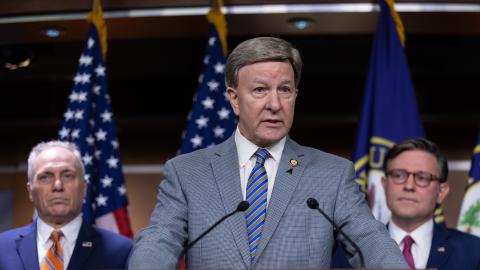
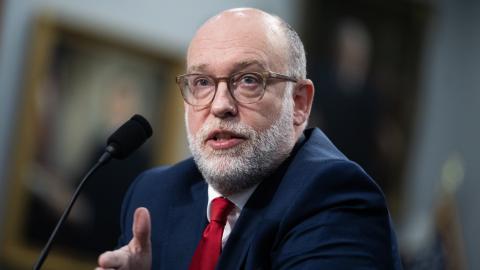
OMB Director Russell Vought testifies during the House Appropriations Subcommittee on Financial Services and General Government hearing on oversight of the Office of Management and Budget, in Rayburn building on Tuesday, June 30, 2026. (Getty Images)
02
October 2026
Past Event

Please note this event is invite-only.


Event will also air live on this page.


Inquiries: nhuergo@hudson.org.
 

Speakers:
Vought2
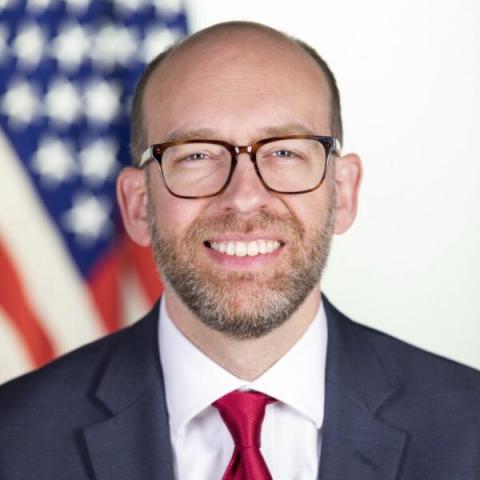
Russell Vought

Director, Office of Management and Budget

heinrichs
Rebeccah L. Heinrichs

Senior Fellow and Director, Keystone Defense Initiative

On August 13, 2026, President Donald Trump signed a national security presidential memorandum that directs the Department of War to pursue a set of critical initiatives to restore United States Navy shipbuilding capacity and competition within the maritime industrial base.

The memorandum allows foreign shipbuilders to build ships for the US Navy, provided they also invest in new American shipyards. It directs the establishment of a fifth naval shipyard, the first to be built in over 80 years, to bolster the Navy’s submarine and aircraft carrier repair capacity. The memorandum also includes improvements that make Gerald R. Ford–class aircraft carriers cheaper and faster to build.

Please join Russell Vought, director of the Office of Management and Budget, for a conversation with Dr. Rebeccah Heinrichs to discuss the Trump administration’s decisive efforts to build the Navy needed for today’s intensifying threat environment.

Event Highlights

Director Russell Vought

  • “We want to bring back and revitalize American shipbuilding in this country. . . . In the first term, I think I would have probably made the assertion that if we got funding right and we had stable funding and projected enough in the future, that it would fix itself. I think we came back both to four years of a lot of dysfunction but also a realization that the problems that we’re facing are generational and have been in the works for some decades, and so it is going to take some big structural bone resetting to get it right, and we’re in the process of doing that.”
  • “We couldn’t be more thrilled with the investment that was agreed to between the two countries. Our South Korean partners know how eager I am to spend some of that money here in this country. You know, I think we have a great example of what it looks like with [the Hanwha Philly Shipyard], which was a shipyard that was saved in the first term by President [Donald] Trump and was really struggling. Hanwha [came] in with major investments. I think we need to make sure that we are opening up the federal government’s contract books for these types of opportunities, and not just kind of prioritizing the primes that we had previously thought of. . . . I think we need to reward those companies that are coming and making the investment here in this country.”
  • “Rebeccah, I mean, there is risk in this, and I think that’s what the president has brought to this. We don’t want to seesaw back and forth between problems with minimal risk that don’t actually fix a big problem facing the country. We want to actually take a solution to the country. We may have risks; we may have challenges with Congress. There may be tensions, you know, there may be more conflict that’s necessary than we would like, but we’re going to come out the other end with having fixed the problem that the American people came to us and asked us to identify. It’s just going to require us to explain ourselves and convince the country, which is why I’m doing things like this.”
  • “I think that to the extent that we have these real symbiotic partnerships, that’s as good a sign of the future as possible; using and bringing back programs and vessels that you know our allies are using and then we’re like why aren’t we using it? Well, it doesn’t quite have the same capability. But I think it’s better than nothing. So, can we think through our requirements and how we’re thinking about these programs to build for speed and to build for capabilities and to have more presence out there? And I think that we can learn a lot from our allies.”

Rebeccah L. Heinrichs

  • “. . . we don’t just want more ships, we want the ability to produce many ships. American readiness isn’t just about the number of things you have. It’s your ability to build more, and the whole point of this is to maintain the peace, secure the American interest, and deter any kind of conflict that may be in the future. And that’s why there’s pressure on the timeline.”
  • “It has been frustrating for me whenever I hear people who I think are rightly concerned
    about the munitions challenges that we have and yet those people are also not willing to fund the president’s defense increases. There have been multiple opportunities to make sure that we are growing our ability to produce these weapons at scale. . . . The secretary of war is still bringing in new contracts for new weapon systems that can do, let’s say 80 percent of what some of these exquisite weapons systems can do for 30 percent of the price. That’s all great. They still need to be funded. It’s that this still has to be funded through reconciliation. So, it’s a good thing to have on contract, but it now has to be paid.”
  • “We do a lot of work here at Hudson on just how in the world can we quickly revitalize a defense industrial base broadly that has atrophied really since the Cold War. We’ve had a bureaucratic web grow over the last 40 years that makes some of these things incredibly dangerous or makes them very cumbersome to move fast.”

Related Events
30
November 2026
In-Person Event | Hudson Institute
Azerbaijan and the New American Strategy for Eurasia
Featured Speakers:
Can Kasapoğlu
Michael Doran
Ken Moriyasu
Aliyev
30
November 2026
In-Person Event | Hudson Institute
Azerbaijan and the New American Strategy for Eurasia

Join Hudson Institute for a conversation that examines Washington’s relationship with Azerbaijan.

Aliyev
Featured Speakers:
Can Kasapoğlu
Michael Doran
Ken Moriyasu
02
December 2026
In-Person Event | Invite Only
Fukuyama Was Wrong: He Missed the Challenge of Post-Democracy and Post-Liberalism
Featured Speakers:
John Fonte
Tony Abbott
Daniel McCarthy
Tom Klingenstein
Anna Wellisz
Jonathan Price
Gadi Taub
Todd Huizinga
John O'Sullivan
Mark Krikorian
Stanley Kurtz
Michael Doran
Sunrise
02
December 2026
In-Person Event | Invite Only
Fukuyama Was Wrong: He Missed the Challenge of Post-Democracy and Post-Liberalism

A conference reflecting on John Fonte’s work and the future of liberal democracy

Sunrise
Featured Speakers:
John Fonte
Tony Abbott
Daniel McCarthy
Tom Klingenstein
Anna Wellisz
Jonathan Price
Gadi Taub
Todd Huizinga
John O'Sullivan
Mark Krikorian
Stanley Kurtz
Michael Doran
02 - 03
December 2026
In-Person Event | Invitation Only
Second Annual US-China Rivalry in the Middle East Conference
Featured Speakers:
Zineb Riboua
Joel Scanlon
Can Kasapoğlu
Michael Doran
Chaim Martin
Ryan Fedasiuk
Moderators:
Ludovic Hood
Aaron MacLean
(US-China Rivalry in the Middle East logo)
02 - 03
December 2026
In-Person Event | Invitation Only
Second Annual US-China Rivalry in the Middle East Conference

Join Hudson to examine how the war with Iran, the rise of emerging technologies, and China's expanding influence are reshaping the Middle East, and what the United States must do to secure its strategic and technological leadership in the region and beyond.

(US-China Rivalry in the Middle East logo)
Featured Speakers:
Zineb Riboua
Joel Scanlon
Can Kasapoğlu
Michael Doran
Chaim Martin
Ryan Fedasiuk
Moderators:
Ludovic Hood
Aaron MacLean
08
December 2026
In-Person Event | Hudson Institute
Strengthening Japanese and Allied Critical Minerals Supply Chains: A Conversation with JOGMEC Chairman Ichiro Takahara
Featured Speakers:
William Chou
Ichiro Takahara
Kenneth R. Weinstein
Japan Chair fighting
08
December 2026
In-Person Event | Hudson Institute
Strengthening Japanese and Allied Critical Minerals Supply Chains: A Conversation with JOGMEC Chairman Ichiro Takahara

Join Hudson Institute for remarks from JOGMEC Chairman and CEO Ichiro Takahara on critical mineral resilience and allied cooperation. Japan Chair Kenneth R. Weinstein will introduce Chairman Takahara. After the chairman’s remarks, Senior Fellow William Chou will engage in a fireside discussion with him.
Japan Chair fighting
Featured Speakers:
William Chou
Ichiro Takahara
Kenneth R. Weinstein