

















Washington is preparing for the right war, but in the wrong theater. For years, U.S. strategic thinking has centered on the Indo‑Pacific: the militarized atolls of the South China Sea, China’s churning naval shipyards, and the tense waters of the Taiwan Strait. Yet the next phase of competition will likely play out on the Eurasian landmass, contested through pipelines, swing states, and shifting alignments along routes that overlap with the ancient Silk Road. This is where China is building alternative trade and energy corridors beyond the immediate reach of U.S. military power.
Chinese strategists have long worried that, in a conflict over Taiwan, the United States could exploit China’s dependence on seaborne energy and trade by closing the Strait of Malacca — the narrow waterway between Malaysia and Indonesia, through which roughly 75 to 80 percent of China’s seaborne oil imports pass. Beijing has sought to overcome this vulnerability by building a multi-dimensional transportation network across land and sea. Recent disruptions in and around the Strait of Hormuz have underscored the urgency of this effort.
The objective is not to replace maritime trade with overland trade. Rather, greater confidence in China’s ability to withstand maritime disruption could embolden Beijing to take greater risks over Taiwan. Without adjusting to this reality, the United States and its allies risk concentrating too narrowly on the maritime contest. To shape the trajectory of U.S.-Chinese competition, Washington ought to understand both China’s maritime and continental strategies.
Escaping Chokepoints
As early as 2005, Chinese Academy of Social Sciences scholar Zhang Jie explicitly connected China’s vulnerability at the Strait of Malacca to its freedom of action over Taiwan. U.S. efforts to control the strait, she argued, not only posed a potential threat to China’s energy security but also constrained Beijing’s “ability to act on the Taiwan issue and in neighboring affairs.” Her proposed solution was to bypass Southeast Asia and to open new petroleum transportation routes through Central Asia and Russia.
Zhang, now director of the Asia-Pacific security and diplomacy division at the Academy, noted in The Malacca Factor in China’s Energy Security that Beijing’s early attempts to bypass the Strait of Malacca — such as constructing a canal across Thailand’s Kra Isthmus or building oil and gas pipelines through Myanmar — were insufficient to resolve the “Malacca Dilemma.” While such projects would allow ships to avoid the strait itself, Zhang argued that none “can genuinely eliminate the possibility of intervention by major powers.” Malacca was but a microcosm of China’s maritime oil transportation predicament.
Instead, she called for strengthening energy cooperation with Central Asia and Russia. Zhang acknowledged that the then-planned China-Kazakhstan oil pipeline and the prospective oil and gas routes from Russia could not replace the Middle East’s role in China’s energy supplies for a considerable period. But she argued that the overland routes would possess “greater strategic significance under non-peacetime conditions.” She continued: “They would therefore possess a relatively high degree of security and would be less susceptible to influence by Western countries.”
Two decades later, much of the infrastructure Zhang envisioned exists. China has also built the Central Asia-China gas pipeline from Turkmenistan, whose three existing lines have a capacity of 55 billion cubic meters per year. A planned fourth line would increase that capacity to 85 billion cubic meters. If Beijing were also to agree to Russia’s proposed Power of Siberia 2 pipeline, with another 50 billion cubic meters of annual capacity, China would gain the ability to substitute overland gas for a substantial share of the liquefied natural gas it currently imports by sea.
Rather than eliminating its dependence on seaborne energy, China seems to be building enough resilience — through overland pipelines, storage, and demand flexibility — to withstand a serious disruption at sea. Renmin University Professor Cui Shoujun describes the pipelines as a solid “energy security barrier,” China’s shift to renewable energy as establishing a strategic “moat,” and technologies that convert coal into oil and methanol as an additional “safety net” against fuel and petrochemical feedstock shortages in extreme circumstances.
How resilient has China become? Some say that China’s sharp reduction of seaborne crude oil imports during this Iran crisis may have amounted to a “dry run” for a Malacca blockade. According to the U.S. Energy Information Administration, China imported just 8.1 million barrels per day of crude oil in the second quarter of 2026, 32 percent less than in the previous quarter. Yet China did not make up the difference simply by emptying its strategic reserves. The Energy Information Administration estimates that China’s strategic inventories declined by just 49 million barrels during the quarter, from 1.54 billion to 1.49 billion barrels. Beijing absorbed much of the shock by reducing the amount of oil its refineries processed rather than replacing every lost imported barrel from storage.
This does not mean China could withstand a wartime blockade indefinitely. If China tried to replace a 3.9 million barrel-per-day import shortfall entirely from a 1.49 billion barrel stockpile, those stocks would last roughly a year. But the Hormuz episode shows why such arithmetic can exaggerate China’s vulnerability. Beijing can respond to a supply shock by rationing petroleum use as well as drawing down reserves. In wartime, it could ration more aggressively, preserving fuel for the military while forcing deeper cuts elsewhere in the economy.
Beijing is signaling that it wants further resilience. In August, China’s National Development and Reform Commission and National Energy Administration released their new five-year plan for oil and natural gas development, calling explicitly for China to “consolidate and expand strategic overland import corridors” and pursue a diversified import strategy.
There has been ample debate over whether the United States could actually blockade China’s maritime trade. In a 2008 Naval War College Review paper, Gabriel Collins and William Murray identified several critical challenges: where to marshal seized vessels, how to handle multinational crews, how to determine which tankers were carrying oil for China, and how to prevent tankers from simply taking alternative routes such as through the Lombok and Sunda straits.
Sean Mirski, meanwhile, argued in 2013 that a U.S. naval blockade could impose ruinous costs on China in a prolonged conflict, especially if it was accompanied by a coalition including Russia, India, and Japan to prevent Beijing from circumventing the blockade through alternative maritime and overland routes. Russia’s alignment with China makes one of Mirski’s key conditions harder to achieve and elevates the importance of the remaining states along China’s continental periphery. But regardless of the blockade debate in the West, Chinese strategists will assume the worst and prepare accordingly.
Rethinking the Indian Ocean
In 2010, Robert Kaplan predicted that the Indian Ocean would become the central arena of global competition, driven partly by China’s dependence on energy crossing Hormuz and Malacca and growing Sino-Indian rivalry. Sixteen years later, that prediction looks less certain.
The U.S. Indo-Pacific Command has reverted to Pacific Command — a change that Elbridge Colby, the Pentagon’s policy chief, has described as underscoring the focus on the Pacific element of the First Island Chain. The Quad — the United States, Japan, India, and Australia, often treated as the premier gathering of Indo-Pacific leaders — has not held a leaders’ summit in nearly two years.
While India is a massive player on the world stage, its ability to shape China’s continental strategy is limited by geography. Over a century ago, British geographer Halford Mackinder observed that China proper and India are separated by “the most massive uplands on the Globe,” the Himalaya Range and the Tibetan Plateau, which is “as large as France, Germany, and Austria-Hungary put together.”
The geography has not changed. With no realistic plans for pipelines or railroads across that terrain, Chinese strategists have looked instead to Central Asia, where geography is far more conducive to overland connectivity.
Xi’s Continental Turn
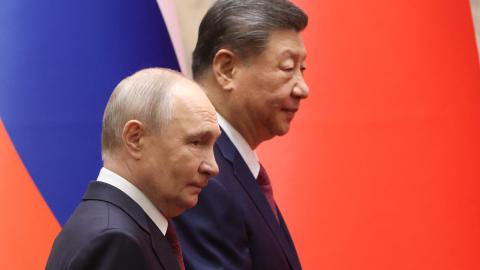
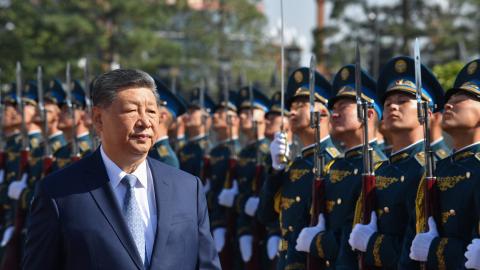
In September 2013, China’s top leader Xi Jinping launched his signature infrastructure project, the Belt and Road Initiative, in Astana, Kazakhstan. He declared that relations with Central Asia would become a priority of Chinese foreign policy. A month later, Xi convened a foreign policy work conference specifically on the theme of China’s “periphery diplomacy,” the first such themed forum since the establishment of the People’s Republic of China in 1949. “We need to help neighbors in times of crisis, treat them as equals, visit them frequently, and take actions that will win us support and friendship,” Xi said. A dozen years later, in April 2025, Xi convened the Central Conference on Work Related to Neighboring Countries, once again doubling down on neighborhood diplomacy as a guiding principle of foreign policy. The timing was symbolic, coming just days after U.S. President Donald Trump announced sweeping tariffs on his “Liberation Day.”
At the end of the road lies Xi’s ambition: the Chinese Dream of the “great rejuvenation of the Chinese nation.” It pledges that by 2049 China will be prosperous, strong, and globally leading — with “socialism with Chinese characteristics” vindicated as history’s winner. As U.K.-based China specialists Steve Tsang and Olivia Cheung argue, the crowning achievement of this rejuvenation would be the subjugation of Taiwan, a spectacular move meant to expose American strategic inability. It would be the end of Pax Americana and the beginning of a Sino-centric order, a Pax Sinica.
Malacca on Land
If we are right, the key to deterrence may be to complicate Beijing’s assumptions about the security and reliability of the continental corridors on which its long‑term strategy depends. Washington should deepen diplomatic engagement with the Eurasian countries that sit astride the energy and trade corridors Beijing is trying to establish across the continent.
Three are particularly important to China’s overland connectivity. Kazakhstan, with its long, flat terrain and extensive rail network, offers China a stable overland route to the Caspian region. Uzbekistan, true to its Silk Road heritage, is set to become a key transit hub when the China-Kyrgyzstan-Uzbekistan railway comes online. Once in Uzbekistan, the Chinese-built rail link will connect onward to Turkmenistan and Iran.
Azerbaijan, meanwhile, controls one of Eurasia’s most important trade choke points, known as the Ganja Gap. The Hudson Institute’s Luke Coffey notes that overland trade between Asia and Europe seeking to avoid Russia and Iran must pass through the narrow corridor connecting Azerbaijan with Georgia. Only about 60 kilometers wide at its narrowest point, the Ganja Gap carries an extraordinary concentration of strategic infrastructure. Oil and gas pipelines, the Baku-Tbilisi-Kars railway, and other critical infrastructure all pass through the corridor.
Its importance extends far beyond Azerbaijan. To the west, the corridor opens through Georgia and Turkey toward the Black Sea, the Mediterranean, and Europe. To the east, it reaches across the Caspian toward Kazakhstan and the rest of Central Asia — and ultimately China. The Ganja Gap is the narrow hinge connecting the trans-Caspian Middle Corridor on either side of the Caucasus. It is, in effect, Malacca on land. These corridor states are not Chinese satellites. Kazakhstan, Uzbekistan, and Azerbaijan are quintessential “swing states,” cultivating relations with competing powers rather than committing themselves exclusively to either side. Their willingness to work with both Washington and Beijing was apparent when their leaders attended China’s military parade in Beijing last September and the U.S.-led Board of Peace launch ceremony in Davos in January.
They are part of a broader belt of Eurasian swing states whose decisions on infrastructure, energy and diplomatic alignment will help determine whether China’s continental strategy unfolds in a permissive or contested environment.
Countering Belt and Road
In addition to diplomatic outreach, Washington must offer credible economic alternatives to Chinese financing. Previous efforts to compete with the Belt and Road Initiative — such as the Blue Dot Network — struggled to gain traction, mostly because the money involved paled beside China’s program.
An alternative may already be on the table. What if the investment commitments Trump secured in trade deals with the European Union, Japan, and South Korea to reduce tariffs — worth $600 billion, $550 billion, and $350 billion, respectively — could be mobilized? Those commitments are currently intended for investment in the United States. But the Trump administration should consider renegotiating the agreements to allow a portion of the commitments to finance strategic projects in third countries. Japan, whose $550 billion commitment is proving particularly difficult to deploy, offers the clearest test case. If successful, the model could eventually be extended to other trade-deal commitments.
The U.S.-Japanese arrangement emerged from an unusually informal and intensely personal negotiation between Commerce Secretary Howard Lutnick and Japanese trade envoy Ryosei Akazawa. Akazawa repeatedly flew to Washington — at times without a meeting firmly scheduled — and waited for opportunities to negotiate with Lutnick, later describing the talks as a fight to protect Japanese interests. The resulting framework was repeatedly adjusted as the two sides worked out its terms. It was a product of bargaining rather than an immutable legal architecture, and there is no reason why the bargaining could not continue.
For Japan, such a change could be a blessing in disguise. Under the current arrangement, Japan provides the financing, while project cash flows are divided equally between Japan and the United States until Tokyo recovers its allocation. That structure dramatically lengthens the time required for Japan to recoup its money. The Federal Reserve Bank of St. Louis calculates that, under a simplified scenario in which a project yields 10 percent annually, Japan would require 20 years to recover its initial investment. Without the 50-50 split, the same investment would take 10 years.
Unsurprisingly, projects that can plausibly remain profitable over 20 years are limited. Energy infrastructure has therefore figured prominently among the six projects, worth $109 billion, announced so far. But announcements have stalled, leaving Japan struggling to identify enough viable projects to fulfill its $550 billion commitment by the end of Trump’s term.
Washington, meanwhile, wants the full $550 billion deployed. The two governments could establish a limited third-country window for projects they jointly designate as advancing American and Japanese economic security. Japanese capital could finance critical mineral, energy, and transportation infrastructure in Central Asia and the Caucasus, where commercially viable projects could simultaneously reduce Chinese and Russian leverage.
Denying China the Interior
If Beijing becomes less confident about its continental periphery, it may become less willing to take military risks elsewhere. The point is not to turn Central Asia or the Caucasus into formal allies. It is to deny China confidence that the interior of Eurasia will function as a sanctuary.
This does not mean integrating Kazakhstan into NATO or rapidly expanding arms sales across the heart of Asia. It means making Beijing think twice. Injecting complicated, multi‑vector choices into Chinese decision‑making can help prevent the fait accompli seizure of Taiwan that American planners worry about — and do so far more cost‑effectively than pressuring allies to double and triple defense budgets.
China needs confidence that its continental trade and energy routes would remain reliable in a crisis. But Kazakhstan’s response to Russia’s invasion of Ukraine in February 2022 should give Beijing pause. Only a month earlier, Russian-led forces from the Collective Security Treaty Organization had deployed at President Kassym-Jomart Tokayev’s request during the worst domestic unrest since Kazakhstan’s independence. Yet this extraordinary security assistance from Russia did not translate into obedience once Russia went to war. Tokayev refused to recognize the Russian-backed entities in Donetsk and Luhansk and publicly pledged that Kazakhstan would not violate Western sanctions.
Kazakhstan did not sever its relationship with Russia. Instead, Tokayev sought to preserve the country’s multi-vector foreign policy and avoid excessive dependence on Moscow. Washington should not expect Kazakhstan or other Central Asian states to cut trade or energy ties with China over Taiwan. Yet Kazakhstan’s response to Russia demonstrates that dependence on a powerful neighbor does not necessarily mean acquiescence. The more alternatives these states have, the greater their ability to resist pressure from Beijing when their interests diverge.
Furthermore, recent U.S. diplomatic initiatives in Central Asia — new corridors, new formats, and new partnerships — have begun to insert American influence into the very interior on which China relies. Central Asian embassies are actively discussing with the administration an invitation for Trump to visit the region next year. He would be the first sitting American president to visit Central Asia. A photo of Trump standing in Registan Square in Samarkand alongside Central Asian leaders would send an unmistakable message to Beijing: The United States is on the Silk Road too.
If the Indo‑Pacific is where a Taiwan war would be fought, Eurasia is where Beijing is shaping the conditions under which it would choose to fight. Washington should adjust its strategy accordingly.