















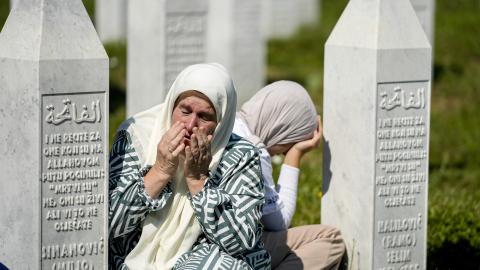
The anniversary of the Srebrenica genocide of July 1995 was marked last week. It is estimated that, in just 12 days, ethnically Serb forces murdered more than 8,000 Muslim Bosniak men and boys, while about 30,000 women and children were displaced and many women were subjected to sexual violence. This remains one of the darkest chapters in modern European history and new revelations about this period continue to emerge.
For example, late last year, prosecutors in Milan, Italy, opened an investigation into the so-called Sarajevo Safari, in which wealthy foreign businessmen allegedly paid large sums of money to Serb fighters for the opportunity to shoot civilians in Sarajevo from the hills overlooking the city.
In 2024, the UN General Assembly passed a resolution establishing July 11 as the International Day of Reflection and Commemoration of the 1995 Genocide in Srebrenica. This year, commemorations were held at the UN and in communities around the world. In Srebrenica, at the Srebrenica-Potocari Memorial Center, a collective funeral was held for 10 newly identified victims whose remains are now buried at the memorial cemetery. More than three decades later, thousands are still haunted by the horrors that took place.
The Balkans remains an area of concern for policymakers because the possibility of instability, and even renewed violence, never seems too far away. Perhaps the epicenter of the region’s geopolitical challenges is Bosnia and Herzegovina.
Bosnia and Herzegovina emerged from the breakup of Yugoslavia in the 1990s, which triggered a bloody interethnic and interreligious conflict. Bosnia suffered the brunt of the violence. In addition to the Srebrenica genocide, it is estimated that Bosniaks accounted for the vast majority of the approximately 100,000 people killed during the Bosnian War.
In November 1995, a peace agreement signed in Dayton, Ohio, reorganized Bosnia and Herzegovina as a single state composed of two entities: the Federation of Bosnia and Herzegovina, populated primarily by Bosniaks and Croats, and Republika Srpska, which is predominantly Serb.
Today, Bosnia and Herzegovina faces several serious internal challenges. Foremost among them are the continued secessionist ambitions of Republika Srpska’s leadership. Such efforts have often received political backing from neighboring Serbia and Russia, while much of the international community views them as deeply destabilizing. There is also concern that if Republika Srpska were to break away, it could open a Pandora’s box by encouraging other separatist movements across Europe and beyond to pursue independence outside established legal frameworks.
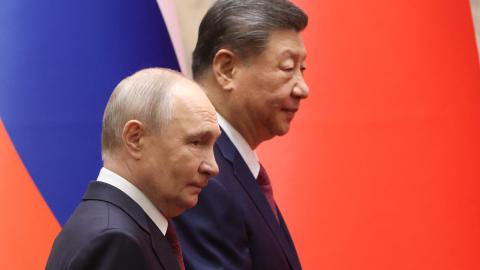
These concerns are compounded by Russia’s continued efforts to use the Western Balkans as a source of instability for the transatlantic community. Russian President Vladimir Putin regularly treats Republika Srpska’s leaders as though they are heads of state, inviting them to Moscow for bilateral meetings and high-profile ceremonies, including this year’s commemoration marking the end of the Second World War.
At the same time, another sectarian-based political debate has gained momentum among Bosnia’s Croat community. Ethnic Croats make up roughly 15 percent of the country’s population and some have renewed calls for the creation of a third entity alongside the Federation of Bosnia and Herzegovina and Republika Srpska. While Croats have legitimate concerns about political representation at the national level, creating a third entity would almost certainly prove destabilizing.
When the Dayton Agreement was negotiated, Bosnia’s Croat leadership did not seek a separate territorial entity. Moreover, Croats are not the only community that faces shortcomings in Bosnia and Herzegovina’s political system. Other minority groups, including Jews and Roma, are also excluded from full political representation under the country’s complicated ethnic power-sharing arrangements.
These legitimate concerns should not be addressed by redrawing the Dayton settlement. While electoral reform and improved political representation deserve serious attention, creating a third entity would almost certainly accelerate secessionist pressures in Republika Srpska, undermine the coherence of the Bosnian state and revive the dangerous political geography of the 1990s.
Instead of rewriting the Dayton Agreement, Bosnia and Herzegovina should focus on building institutions that function more effectively and better represent all its citizens. Rather than introducing even greater decentralization in one of the world’s most decentralized political systems, the priority should be meaningful political, constitutional and institutional reforms.
Has the Dayton Agreement been perfect? Of course not. But now is not the time to abandon it. There is little political consensus within Bosnia and Herzegovina, across the wider region or among the transatlantic community about what should replace it. Given today’s geopolitical environment, any attempt to reopen the 1995 settlement would be a major distraction at a time when Europe and North America must remain united in addressing other pressing challenges, particularly Russia’s war against Ukraine.
It should also be remembered that, despite its shortcomings, the Dayton Agreement has preserved peace in Bosnia and Herzegovina for more than three decades.
What should be welcomed are locally driven reforms that accommodate the reasonable concerns of all Bosnian citizens, regardless of ethnicity, while strengthening the country’s democratic institutions and advancing its aspirations for NATO and EU membership.
Throughout modern European history, the Balkans has repeatedly shaped wider geopolitical events. The Balkan Wars of 1912 and 1913 helped set the conditions for the assassination of Archduke Franz Ferdinand in Sarajevo in 1914, which sparked the First World War. During the Second World War, developments in the region influenced the creation of socialist Yugoslavia and the complex role it later played during the Cold War. Following the collapse of the Soviet Union, some of Europe’s bloodiest conflicts in nearly half a century erupted in the Balkans, requiring sustained American and European engagement to restore peace and stability.
While the region is far removed from the bloodshed of the 1990s, this month’s commemoration of the Srebrenica genocide should remind policymakers that the Balkans continues to matter. Maintaining peace there requires sustained attention, continued engagement and a commitment to preserving the stability that has been built, however imperfectly, over the past three decades.