













View Full Report PDF with Figures
Aerial refueling is an unmatched United States military advantage, but it currently depends on vulnerable forward bases and medium-range tankers that could be neutralized. Suppression of this critical capability could collapse US air operations and heavily contribute to US defeat in a war against the People’s Republic of China (PRC).
To generate a force ready for contested global operations, the US Air Force and Department of War (DoW) can transform its aerial refueling architecture within planned budget levels by:
- Boosting the resilience of its most important tanker airfields
- Incorporating adaptive mission systems on current tankers to increase their effectiveness and survivability and unlock options for future tankers
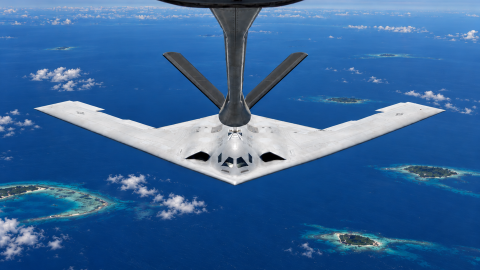
- Fielding a medium-sized, long-range, high-offload tanker capable of flying a modest distance into contested airspace, such as a Medium-sized Blended Wing Body (Medium BWB) tanker
Although the medium-range KC-46A has performed well in recent operations, our analysis finds that it lacks the range, offload, and survivability needed to sustain large-scale refueling across the vast Indo-Pacific in a conflict with the PRC—even when force extending. The slightly longer-range A330 MRTT+ faces similar constraints. Reduced signature shuttle tanking designs we modeled could provide a potent capability to refuel in contested airspace, thus improving the tactical performance and efficiency of a small number of supported force packages. However, they would face limitations operating at large scales, and their operations would depend on vulnerable parent tankers such as the KC-46A.
In contrast, aerodynamically efficient Medium BWB could carry large fuel loads over long distances and could be equipped with a robust self-defense suite to fly a modest distance into contested airspace. Moreover, given its medium size, lighter weight, and refueling-only design, a Medium BWB could cost less to procure and operate than larger, multi-role tankers such as the KC-46A.
Compared to 250 KC-46As, acquiring and operating 250 Medium BWB tankers could:
- Refuel more than twice as many force packages or refuel force packages more than twice as far
- Deploy forces across the Pacific more than twice as fast
- Sustain large-scale protracted operations under attack
- Cost $15.5 billion less over 30 years and could be fielded with either additional funding or within planned annual funding levels, including in a budget-neutral manner that reduces KC-46A Tanker Production Extension procurement to fund Medium BWB development.
The resulting architecture’s abundance of aerial refueling would unleash the full lethality and optionality of the joint force, enable new standoff and penetrating concepts of employment, and assure US global reach, regardless of enemy attack. The Air Force and DoW can achieve a redesigned aerial refueling architecture that deters and wins.
Analyzing Tanker Attributes
To interact with some of the models and budgetary plans used to analyze aircraft attributes in this project, please find them below.
Problems facing the aerial refueling force
The People’s Liberation Army (PLA) can deliver thousands of munitions per day near the PRC and can also strike increasingly distant targets.
By 2035 the PLA could potentially suppress large-scale, sustained tanker operations from forward airfields in the Western Pacific. In practice US and allied forces would likely adopt approaches that thin the level of threats and ensure continued tanker operations from some of these forward airfields. However, widespread suppression of the forward and many of the intermediate airfields that tankers normally rely on would hobble the US military’s ability to conduct a range of critical operations.
Long flight distances in the Indo-Pacific aggravate the threat that PLA strike capacity poses. Most US aerial refueling operations during major conflicts, including Operation Epic Fury, have originated from uncontested airfields relatively close to operating areas. In a conflict with the PRC, most aerial refueling might take place from far more distant airfields—especially if planners eschewed operating large numbers of tankers from close-in airfields that would be more vulnerable to attack.
Current tankers are also vulnerable in the air, which could force them to stand off so far from threats that their supported receiver aircraft must devote more of their fuel transiting to and from tankers and have little-to-no time on station to conduct operations. In turn, it requires far more receiver aircraft to conduct the same mission.
Assessing tanker options
To identify the necessary attributes for future tankers, we evaluated representative tanker types: the Boeing KC-46A, the Airbus A330 MRTT+, a Medium-sized Blended Wing Body (BWB), a Medium-sized Reduced Signature design, and a Collaborative Tanker Aircraft (CTA). Other designs not pictured were also examined.
The largest differentiators among the designs are the amount of fuel that they can offload at radius and whether they can transport cargo or personnel. The Medium-sized Reduced Signature (hereafter referred to as Medium Reduced Signature) and Collaborative Tanker Aircraft (CTA) concept designs are optimized to shuttle tank from parent tankers such as the KC-46A at short-to-moderate distances. The KC-46A and A330 MRTT+ are medium-range, multirole designs. And the Medium BWB is a long-range, high offload dedicated tanker.
The radius at which tankers could offload fuel to receiver aircraft greatly varies and impacts their ability to support operations in different theaters. With its aerodynamically efficient design and large fuel capacity, the Medium BWB can refuel more than twice as many force packages or refuel force packages more than twice as far as the KC-46A. At longer-ranges and higher offloads, the Medium BWB can deliver up to five times as many operationally relevant increments of fuel as the KC-46A. This enables it to effectively operate over broad areas, including from airfields less vulnerable to attack in the contiguous United States.
Most US and allied Indo-Pacific airfields suitable for sustained tanker operations are either close to the PRC or far from the PRC.
To maximize optionality and resilience, tankers require the ability to conduct refueling missions from many airfields. A medium-sized, long-range, high-offload tanker such as the Medium BWB could sustain orbits from more than twice as many airfields as alternatives.
We examined 32 short-, medium-, and long-range vignettes requiring different levels and frequency of fuel offloads set in the Pacific, North America, Europe, and the Middle East. In general, the Medium BWB provides the greatest performance and cost improvement relative to the KC-46A.
A subset of the mission vignettes can be watched below. To do so, please select a mission and select a tanker type.
The number of F-35As required airborne to support a single continuous four-fighter CAP grows from a modest 6 fighters to an astounding 58 fighters as the distance from the CAP to the ARCP increases. Conversely, tankers that can approach to 300 nmi from the CAP would require 14 fewer fighters airborne to support the four-ship CAP than those that stand 600 nmi off. In short, addressing this force package–tanker standoff problem is imperative because tankers’ inability to reach relevant operating areas could slash the effectiveness of Combat Air Forces aircraft in contested airspace.
Is shuttle tanking the answer?
Shuttle tanking could allow reduced-signature, risk-worthy, or attritable child tankers to work with parent KC-46As or KC-135s to penetrate and persist inside contested airspace and refuel receiver aircraft. This potent capability could increase the fuel state and improve the tactical performance of supported force packages, reduce the number of receiver aircraft required to accomplish missions, and keep parent tankers safe outside contested airspace.
Depending on the distance of a refueling point from receiver operating areas, and the location of parent tanker airfields, there are cases—especially over short-to-medium distances and at small scales—where this approach could generally be less expensive than alternatives. As seen below, though, provided a Medium BWB can leverage a robust self-defense suite to fly 100-200 nmi closer to threats than KC-46A, it is still equal to or less expensive to sustain a single orbit of F-35A using Medium BWB than reduced signature shuttle tanking designs.
Analyzing the operations of a wing of 72 fighters further illustrates the cost and operational impact differences among tanker options. Spent on tankers flying from Andersen AFB, $8 billion buys roughly twice as many F-35As on station over Taipei with a Medium BWB compared to KC-46As or A330 MRTT+s. Shuttle tanking Medium Reduced Signature or CTA designs could support even more fighters on station, but it would require an additional $4 billion in tankers to support five more F-35As with the CTA and an additional $12 billion to support 11 more F-35As with the Medium Reduced Signature design.
At the theater level, the greater scale and distances involved makes the differences in the cost to sustain operations with different tanker options widen further. To maintain five F-35A patrols along the First Island Chain at once, the Medium BWB at its closest refueling point costs less than any other tanker option, whether tankers fly from forward, intermediate, or distant airfields. Moreover, operations with Medium BWB are resilient to adversary threats to airfields. The lowest-cost shuttle tanking option rises from about $24 billion with forward basing to about $80 billion when only distant airfields are available, while the Medium BWB rises from about $21 billion to $34 billion, counting the cost of tankers and fighters each option requires.
There are short-range, small-scale cases in which the cost to generate effects with child shuttle tankers working with parent KC-46As is less expensive than Medium BWBs, and reduced signature designs would be more survivable than moderate- or high-signature tankers. In general, though, our analysis shows that at the mission and theater levels, shuttle tanking is considerably more expensive. The greatest gains in receivers on station, and in turn lethality, come from flying another 100-200 nmi closer to threats and efficiently delivering high offloads of fuel over long distances, such as provided by the Medium BWB.
Fielding the future tanker fleet
We generated five representative year-by-year plans to compare their costs and performance metrics. The exercise demonstrated that the Air Force has viable options to transform its aerial refueling fleet. For example, Plan 3 that introduced Medium BWB could cost $15.5 billion less over 30 years than Plan 1 that solely bought KC-46A and would result in a force with 58% more offload capacity.
Many variations of these plans could be generated, including budget neutral ones that slim the KC-46A Tanker Production Extension buy rate to fund new tanker RDTE and procurement. Create your own plan.
View Full Report PDF with Figures
Contact the authors:
twalton@hudson.org
sdennin@hudson.org
To learn more about options to change US Air Force force design, please see Flipping the Script: Redesigning the US Air Force for Decisive Advantage (Hudson Institute, 2026).
To learn more, please visit Hudson Institute’s Center for Defense Concepts and Technology.