














Record diesel prices did not begin with an American shortage. Rather, they stem from a system that kept betting on unstable regions and suppliers, and from governments here and abroad that let their margin for error wear thin. Washington can ease the pain this fall without resorting to banning diesel exports, and it can leave the country more energy secure in the process.
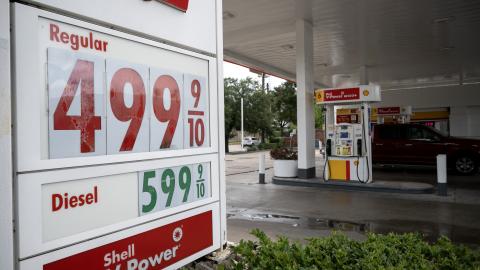
On September 15, the Energy Information Administration (EIA) reported that the average retail diesel price is up more than 77 percent from a year ago. Crude oil explains part, but not all, of the costs associated with diesel fuel. The EIA attributes much of the rest to unusually high refining margins, driven by tight global supplies of distillates like diesel and home heating oil.
In other words, the world is short of refined diesel, not oil in the ground. Yet that is little consolation for American consumers who depend on a transportation and supply network largely powered by it.
Several political and supply shocks hit the market at once. Oil exports from the Persian Gulf ran at about half their pre-war level in August, and diesel exports were roughly a quarter, or 390,000 barrels per day. Either would have moved prices on its own, but Ukrainian strikes have cut Russian refining, and China has curtailed its own fuel exports. Against this international backdrop, global refinery output in August was 4.2 million barrels per day below that of August 2025.
When demand outpaced supply, markets did what markets do and priced in shortage by selling to bidders willing to pay more. U.S. refineries ran at 97 percent of capacity in the week ending September 11, while distillate fuel inventories sat 13 percent below the five-year average. With refineries running flat out, domestic supply remains stressed. For example, weekly distillate exports reached 1.88 million barrels a day in late July, the highest in EIA’s weekly records. Refining margins in the Atlantic Basin hit records in August.
Rather than a conspiracy, this is a strong price signal to build additional refining capacity. Much of the world, and parts of the United States, spent the last decade doing the opposite, and so while the energy shock may have come from overseas, the missing supply cushion resulted from poor energy policies in Europe, Washington, DC, and Sacramento.
Starting with California, Phillips 66 stopped refining crude in Los Angeles in October 2025, and Valero has shut its Benicia refinery. Together they held nearly a fifth of the state's refining capacity. Berkeley economist Severin Borensteinhas noted that the closures cut in-state production faster than consumption can plausibly fall. California is an outlier for now, but the State’s drivers are paying dearly for it. Diesel there averaged $8.04 a gallon in the same week, about $1.75 above the national average.
Europe made a similar bet. It shut more than 400,000 barrels a day of refining capacity in 2025 alone, and roughly 30 refineries since 2009, while newer plants in the Middle East, India and Asia took over its business.
The point of a country’s strategic reserve is to carry it through a supply interruption, which is also why you fill it when oil is cheap. In this regard, Washington's own record is uniquely bipartisan. Beginning in 2015, Congresses and presidents of both parties ordered about 280 million barrels of Strategic Petroleum Reserve (SPR) sales, largely as budget offsets. In 2022, the Biden administration released 180 million barrels. Refilling was slow and small, even when oil was cheap in 2025.
Not to be outdone, the Trump administration has allowed emergency exchanges by US oil companies, which has drawn down the reserve by another 130 million barrels since March. To be fair, this year’s emergency exchanges do require companies to return the oil with premium barrels. While this may be the correct use of the reserve, the Strategic Petroleum Reserve now sits at about 285 million barrels, the lowest point since November 1982. The failure was not in using the reserve; it was entering a war with a depleted reserve in the first place.
The instinct to restrict diesel exports is understandable, and the policy has moved twice this week. The president called for a ban at the United Nations on September 22. A day later his energy secretary ruled one out and floated voluntary limits instead. Either version could lower Gulf Coast prices for a few weeks. Neither one solves the problem.
A mandatory ban runs into the law. Congress repealed the president's standing authority to restrict petroleum product exports in 2015, so any ban would rest on emergency powers. This president has never shied from using them, but even a temporary ban would face immediate legal challenge. It would also hit Mexico first, last year's largest buyer of U.S. diesel. Gulf Coast pipeline infrastructure is not configured to reach California or the Northeast, so the barrels held back would sit where they are least needed. A voluntary cap runs into a different wall. There is no clean way to convene competing refiners and settle on export volumes without either a formal order, which brings litigation back, or an informal understanding that no antitrust lawyer will let a client join. Either way, American supply would come with conditions just as we are asking allies to sign twenty-year contracts.
Policymakers could take four steps today to calm prices.
First, extend the Jones Act waiver beyond November 15. Since March, the U.S. has allowed foreign-flagged tankers to carry fuel, including diesel, between U.S. ports under a national-defense waiver. That waiver expires just as the heating season begins. Extend it now until next spring so tankers can load without delay.
Second, ask our allies to shoulder their fair share of the load. In March, IEA members agreed to a coordinated release of 400 million barrels of oil and refined products, with the U.S. responsible for 172 million barrels. A second round should lean on diesel, and Europe should lead it. European Union members previously agreed to hold a 90 day supply of net imports. As America continues to push fuel to Europe, its partners should draw on their own stocks and keep their own refineries running before calling on American barrels.
Third, the Department of Energy could match the crude grades it offers in its exchanges to refinery capabilities and current product needs. It should ask refiners to defer fall maintenance where that is safe, and it should prepare to release the Northeast Home Heating Oil Reserve as winter approaches.
A fourth step addresses the short-term pain. Congress should suspend the 24.4-cent federal diesel tax through December 31. While Washington cannot order refiners and marketers to pass the full savings on to consumers, publishing weekly rack and retail spreads would let buyers, shippers, politicians, and voters see who passed along the cut and who did not. The public pressure would be immense. Congress should then backfill the roughly $2.3 billion this approach will cost the Highway Trust Fund at a time when the country is still trying to catch up on infrastructure repairs and pass a new highway bill. The timing is poor, but the alternative is worse.
Finally, one of the biggest lessons learned is to stop treating the Strategic Petroleum Reserve like a political relief valve. Congress should cancel the roughly 100 million barrels of SPR sales still scheduled through 2031, and fully fund refills over a reasonable, but not indefinite, period of time. It should also set a firm deadline for court challenges to energy infrastructure permits, so that a permit means something. Capital markets deplore uncertainty. Canada, already tied to U.S. refiners by pipeline, is the best partner to strengthen North American supply. Venezuela could matter later, but only with capital, legal certainty, and a stable sanctions policy.
If history teaches us anything, regional conflicts and crises are the norm, not the exception. The United States cannot prevent every conflict. With innovative energy policies, it can better insulate the country from international instability.