


















Introduction
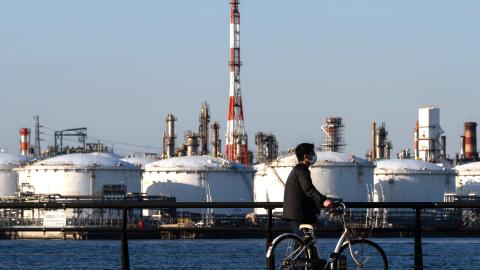
As an island nation with few natural resources, Japan has struggled for decades to find the right balance for its energy mix and still relies heavily on imports, especially from the Middle East. When oil stopped flowing freely through the Strait of Hormuz in March, Japanese industry met its immediate energy needs by tapping into the country’s deep strategic reserves. It also quickly found alternative sources of crude oil and natural gas and increased imports from the United States. Yet despite recent developments, the country likely cannot diversify substantially away from the Middle East.
The Japanese Government Response to the Hormuz Shock
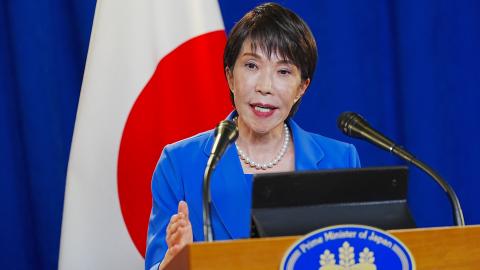
Among Group of Seven members, Japan is the least energy self-sufficient and relies heavily on oil imports.[1] The global shock to energy prices has been one of Prime Minister Sanae Takaichi’s greatest challenges since she took office in October 2025. In the immediate aftermath of Operation Epic Fury, Japanese gasoline prices increased by around 20 percent, from an average of ¥157 per liter to ¥190 ($0.98 per liter to $1.19, or $3.71 per gallon to $4.50).[2]
Since March of 2026, the government of Japan (GoJ) quickly introduced an emergency fuel-price mitigation program, paying refiners and fuel importers to keep the national average price of gasoline at approximately ¥170 per liter ($1.07, or $4.05 per gallon).[3] To this end, the Takaichi cabinet authorized emergency funding of ¥794.8 billion ($4.99 billion), with an additional reserve of ¥2.5 trillion ($15.7 billion) to be used as needed.[4] Additionally, the government opened access to the country’s strategic oil reserves, which hold 107 days’ worth of oil, and reduced the private sector’s required reserve amounts.
In the first round, the GoJ released about 8.5 million kiloliters from the national oil stockpile, which is about a month’s supply. In the second round, it released an additional amount equal to a 20-day supply.[5] The government also reduced the private sector’s mandatory stockpiling requirement from 70 days to 55.[6] Subsidies and changes to oil reserves have helped keep domestic prices from skyrocketing, but Japan must still import oil to minimize withdrawals from the reserves. However, oil imports in the second quarter of 2026 were 43 percent lower than the same period last year.
The GoJ is pushing importers to find alternative procurement options that do not involve the Strait of Hormuz. This includes crude from Saudi Arabia that transits the Red Sea, oil from the United Arab Emirates that is beyond the strait, and substantially larger imports from the United States, including Alaska.[7] However, many of these purchases have been made through emergency spot-market contracts rather than long-term commitments, keeping costs elevated. Finding a long-term solution will prove more difficult.
The Challenges of Oil Diversification
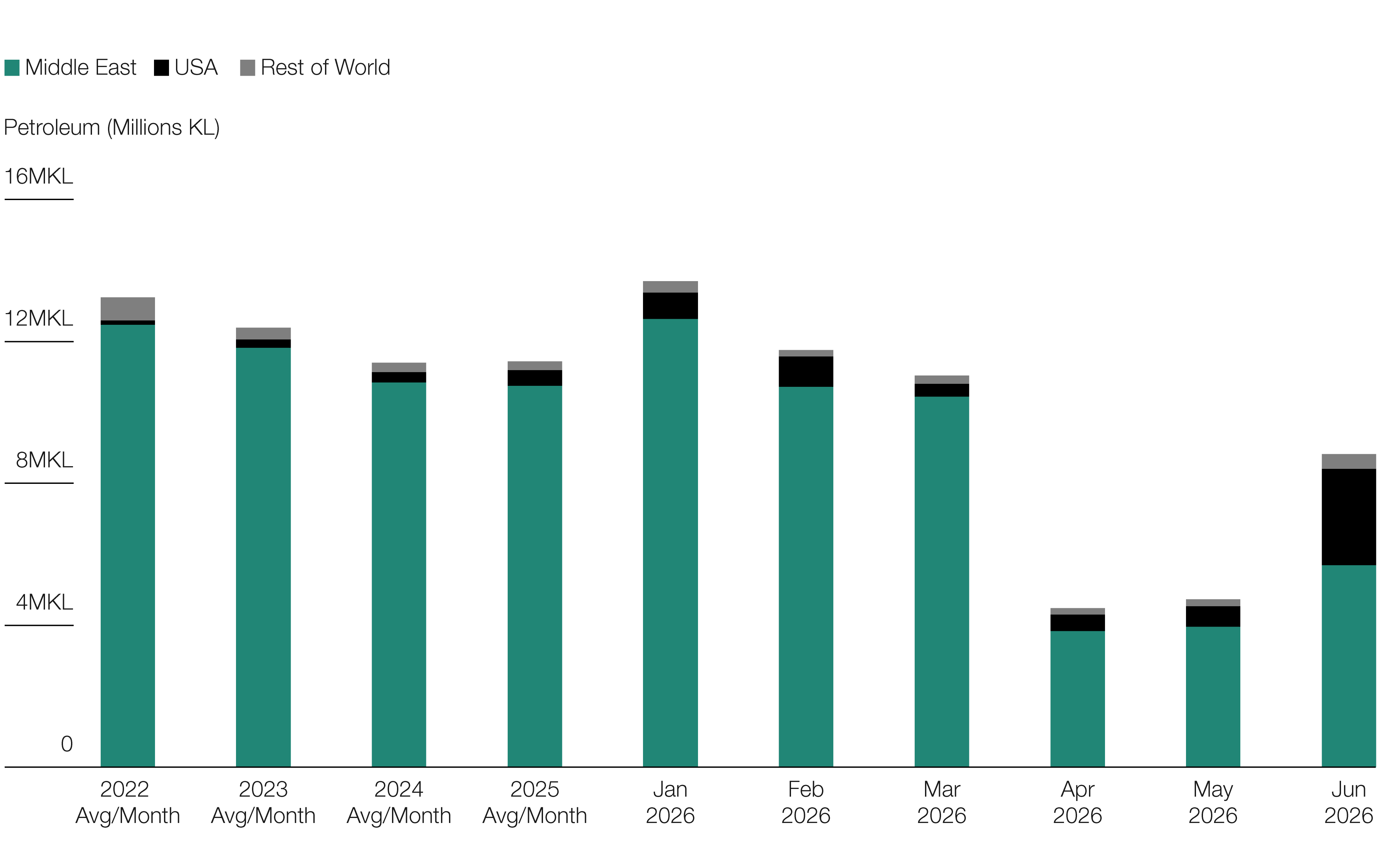
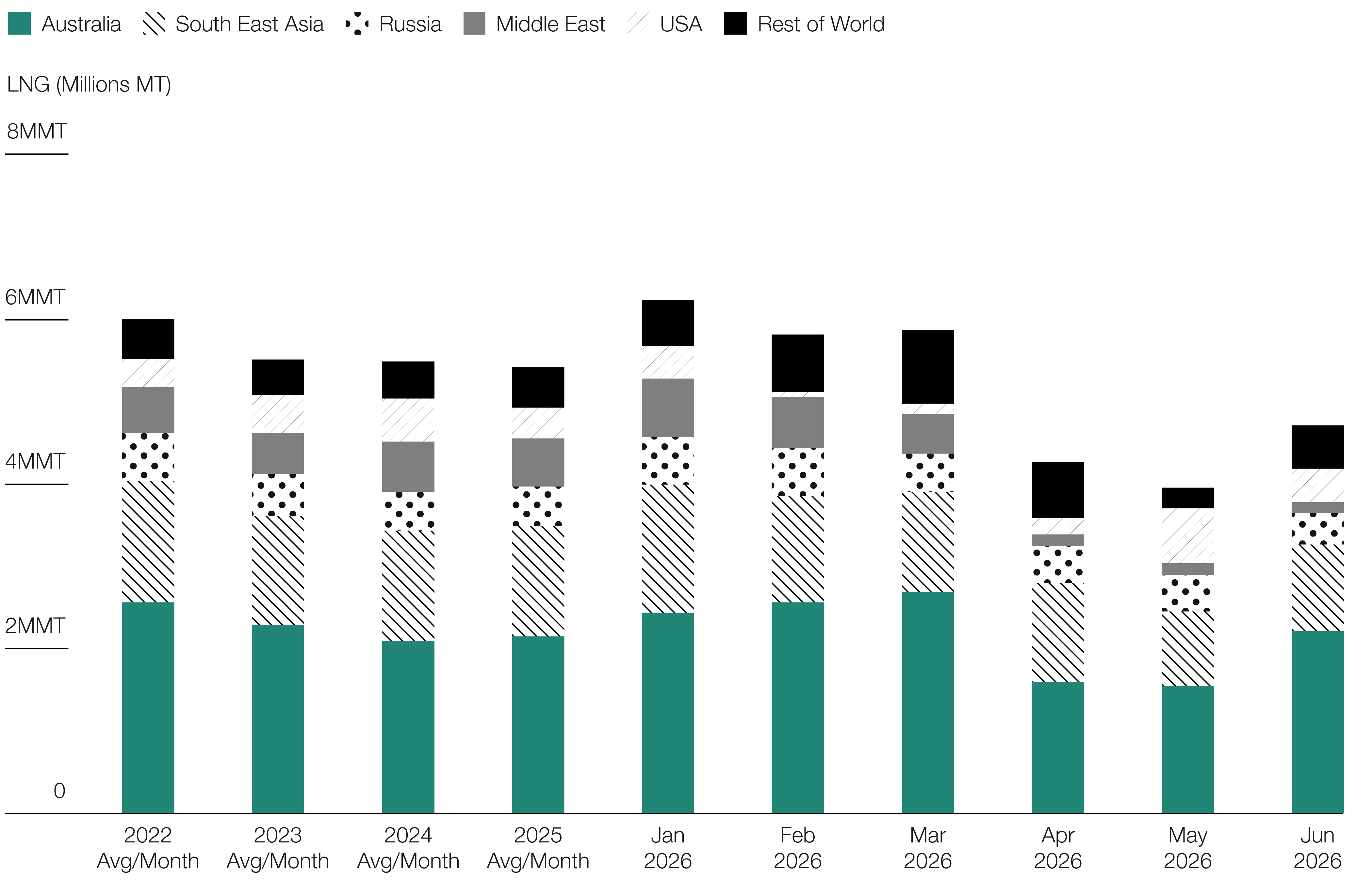
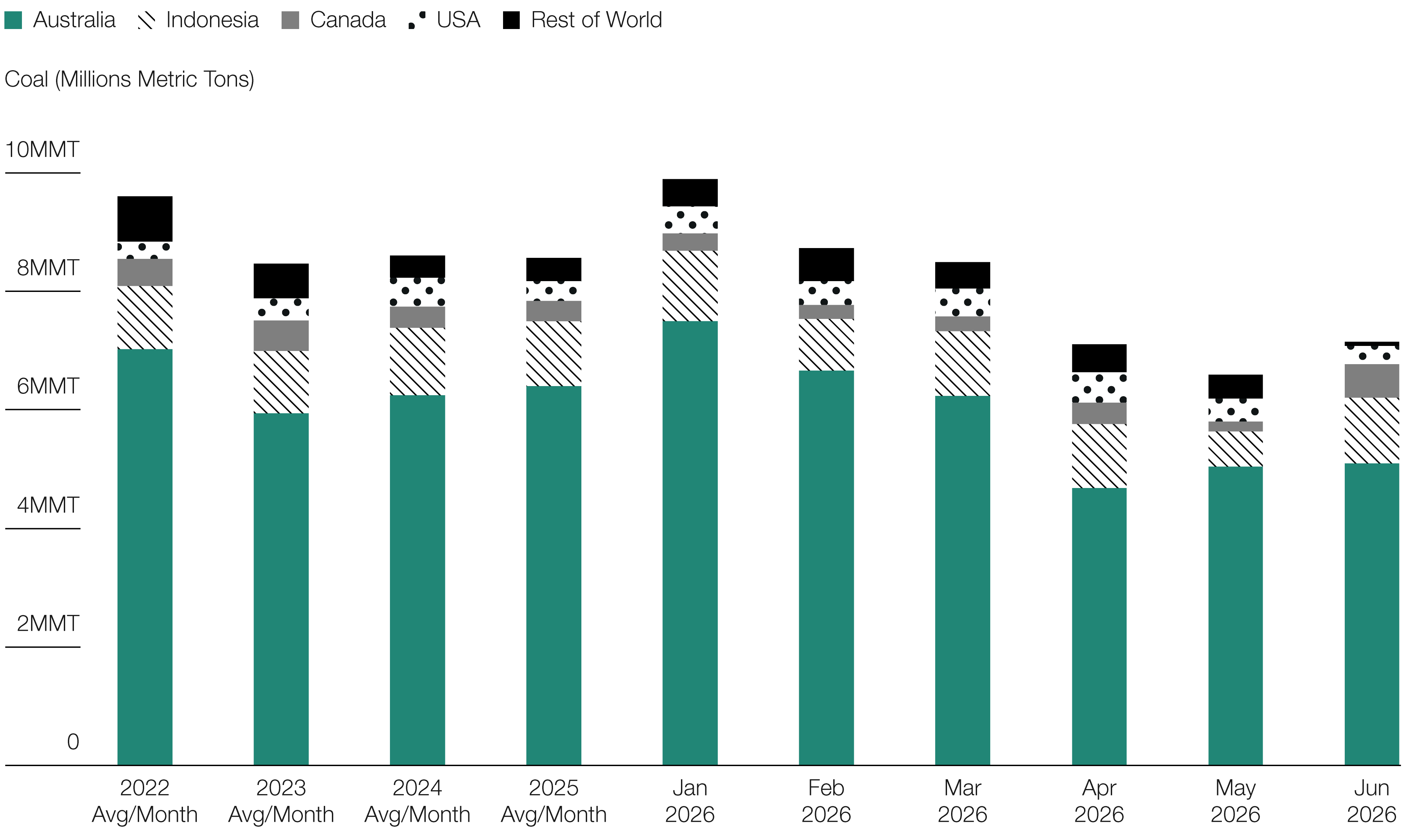
In 2025, Japan had the lowest level of energy self-sufficiency in the G7, relying on other countries for 85 percent of its energy. Moreover, it is most dependent on fossil fuels, which make up 80 percent of its energy supply.[8] Tokyo has tried for decades to diversify its energy mix to include oil, natural gas, nuclear power, and coal and to diversify the source countries (see figures 1–3). The oil shocks of 1973 and 1979 sent Japan scrambling for alternative sources, though the adjustments it made were short-lived: The country imported 76 percent of its oil from the Middle East in 1973 and reduced this to around 68 percent in the late 1980s,[9] but by the end of 2025, the figure was 94 percent.
Figure 1. Japanese Petroleum Imports
Source: Data compiled by authors from “Trade Statistics of Japan: Principal Commodity by Country,” Ministry of Finance, accessed August 10, 2026, https://www.customs.go.jp/toukei/srch/indexe.htm?M=13&P=0.
Figure 2. Japanese Liquefied Natural Gas Imports
Source: Data compiled by authors from “Trade Statistics of Japan.”
Figure 3. Japanese Coal Imports
Source: Data compiled by authors from “Trade Statistics of Japan.”
According to official trade statistics, in June, Japan was able to source 77 percent of its regular quantity of oil imports (as figure 1 shows), but at a much higher cost than usual. The Takaichi administration cannot continue to provide subsidies or draw down national oil stockpiles forever to cap gasoline prices—and no one knows when shipping will flow freely through the Strait of Hormuz again.
Japan needs a long-term vision to address its oil insecurity. Diversification can help, but the issue is complex due to shipping costs, refinery configurations, differences in the quality of oil from different regions, and possible differences between investors’ and the government’s priorities.
Any major changes could lead to higher oil costs. Shipping to Japan from the Gulf of America, from which most US crude exports depart, takes about two months, compared with just three weeks from the Middle East.[10] Japan built most of its refineries in the 1960s and 1970s to process Middle Eastern crude, especially medium-to-light sour grades, and many have not undergone the major reconfigurations needed to optimize them for different crude grades.[11] Reconfiguration would require a large upfront investment, which makes little sense given that Japan’s oil demand is projected to keep falling as its population declines and alternative energy sources grow.[12] Therefore, diversification is a structural problem, not a temporary one—the market will not reconfigure itself when there is no prospect of continued demand.
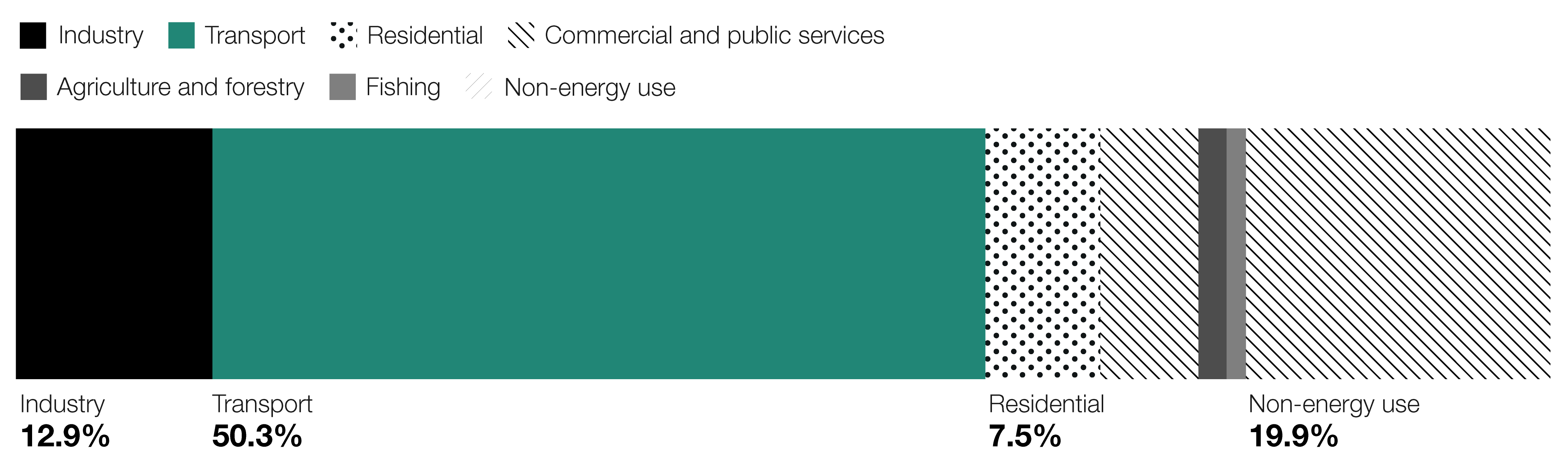
Japan needs oil for more than just transportation or energy; for example, downstream firms depend on refined products. Furthermore, even if all forms of transportation in Japan went electric, the country still uses roughly half of its current oil imports in agriculture, heating, and industry (see figure 4).[13] In addition, oil byproducts feed a massive petrochemical industry that supplies everything from medical equipment and construction materials to plastic packaging and ink.[14] There is foreign demand for these byproducts as well, and while exports of byproducts like petroleum spirits have decreased by 65 percent, the price per kiloliter has increased by nearly 50 percent. The price of other byproduct exports has increased by 16–80 percent.[15]
Stockpiling is a short-term fix. Crude oil from different regions requires different stockpiling methods, and stockpiled refined products degrade much faster than stockpiled crude oil.[16] Maintaining the quality of the refined products is also costly. Increasing stockpiles or extending mandatory stockpiling periods will not, by itself, solve Japan’s long-term oil-security problems.
Figure 4. Oil Products by Consumption, 2023
Source: “Japan,” International Energy Agency, accessed August 10, 2026, https://www.iea.org/countries/japan/oil.
Japan’s Energy Interests in the United States
Japan has been the number one foreign direct investor in the United States since 2019, with significant investments in the US energy sector.[17] Over the last two years, Japanese industry has become more interested in US energy, financing a greater number of projects in the sector and signing new purchase agreements. Washington and Tokyo also agreed that Japan will increase its investments in energy infrastructure in the US and purchase more commodities like oil and natural gas from America. In September 2025, the White House announced that Japan has committed to long-term purchases of US energy worth $7 billion per year.[18]
Japanese industry’s interest in US energy is holistic and not limited to oil. Companies like JERA (Japan’s Energy for New Era) and Mitsubishi have invested in multiple crude oil and liquefied natural gas (LNG) projects to expand their energy portfolios,[19] and JERA, Kyushu Electric Power, Mitsui, and Tokyo Gas have all signed long-term LNG purchase agreements as well. Table 1 shows just a small number of the major energy projects in which Japanese companies are investing.
Table 1. Japanese Energy Projects
|
Project or Location |
Details |
|
Tennessee and Alabama |
GE Vernova Hitachi will finance projects in Tennessee and Alabama with up to $40 billion worth of its BWRX-300s small modular nuclear reactors.[20] |
|
Portsmouth Powered Land Project |
SB Energy, a subsidiary of SoftBank, will operate a natural gas power facility near Portsmouth, Ohio, at a cost of $33 billion.[21] |
|
Project South Mon |
NextEra Energy Resources will invest $17 billion toward a natural gas–fired power-generation hub in southwest Pennsylvania.[22] |
|
Project Anderson |
NextEra Energy Resources will invest $16 billion toward a natural gas–fired power-generation hub in Anderson County, Texas.[23] |
|
Aethon |
Mitsubishi Corporation will acquire Aethon, its related entities, and shale gas assets in Texas and Louisiana for a total equity investment of approximately $5.2 billion.[24] |
|
Texas GulfLink |
Sentinel Midstream will invest $2.1 billion in a crude oil export terminal in Texas and the Gulf of America. The port is expected to generate $20–$30 billion in annual US crude exports.[25] |
|
Haynesville Acquisition |
JERA Co., Inc. will acquire Williams & GEP Haynesville II, LLC’s South Mansfield upstream assets, in the Haynesville Shale Basin in Louisiana, for an upfront investment of $1.5 billion.[26] |
|
VRIH Acquisition |
Japan Petroleum Exploration Co., Ltd. will acquire Verdad Resources Intermediate Holdings LLC (VRIH) and its oil and gas assets in Colorado and Wyoming for $1.3 billion.[27] |
|
Chevron USA Inc. |
TG Natural Resources LLC and Castleton Commodities International LLC will acquire a 70 percent interest in the East Texas gas assets of Chevron USA Inc. for $525 million.[28] |
|
NextDecade Corporation |
JERA Co., Inc. has signed a 20-year sale and purchase agreement with NextDecade Corporation for 2 million tons per annum of LNG from its Rio Grande LNG facility.[29] |
|
Sempra |
JERA Co., Inc. has signed a 20-year sale and purchase agreement with Sempra Infrastructure for 1.5 million tons per annum of LNG from its Port Arthur LNG phase 2 project in Jefferson County, Texas.[30] |
Source: Authors’ research.
Lastly, most of the projects in the $550 billion US-Japan investment agreement announced in July 2025 are energy projects.[31] The Japan Bank for International Cooperation (JBIC) financed two; for one it provided a $630 million loan for a natural gas–generation project,[32] and for the other it provided a $104 million loan for a crude oil transportation and export infrastructure project.[33] In addition, GE Vernova Hitachi will invest $40 billion in Tennessee and Alabama to build small modular reactor power plants.[34]
Challenges for the US-Japan Relationship
As mentioned earlier, the sudden closure of the Strait of Hormuz has caused difficulties for Japan. While Tokyo has increased imports of US crude oil, Japan is displeased with the suddenness of the conflict and is concerned about how long it will last. Energy investments and contracts are long-term in nature, given the need for affordable and reliable energy. But US politics threatens the predictability and reliability of the country’s energy market.
Japanese companies are worried about how US energy policy has changed from one administration to another. The Trump administration has been very supportive of the fossil fuel industry, which has helped Japan during the current conflict. Nevertheless, its predecessor moved aggressively away from the use of fossil fuels, and the next administration may change policies again.
Additionally, Congress is now taking a more aggressive approach to other countries importing Russian energy. A proposed bill could impose tariffs of up to 100 percent on all imported goods from countries that rank among the five largest importers of Russian crude oil or natural gas.[35] For years, American and European authorities have granted sanctions exemptions for countries importing Russian gas to avoid significant shocks to the energy market. Japan has been phasing out its import of Russian oil over the last several years but still imports roughly 9 percent of its LNG from Russia, including from its investments in the Sakhalin-2 project.[36] While it may qualify for an exception, it would have to show it has taken “significant steps” to reduce reliance on Russian imports, a phrase the bill does not define. This ambiguity leaves Japan in a difficult position as it attempts to align more closely with its US ally but is also scrambling to find alternative energy sources outside of the Middle East.
Recommendations
As a maritime state, Japan is constantly concerned about potential disruptions to important sea lanes, whether for energy imports transiting the Strait of Hormuz or other imports, most of which transit the Malacca Strait, South China Sea, or Taiwan Strait. If adversaries blockade or place quarantines on these chokepoints, Japan would face not only short-term price shocks affecting these goods, but also longer-term supply-chain disruptions. Investing more in the United States and the Western Hemisphere generally will help Japan’s diversification efforts. Tokyo should consider the following additional steps:
- Continue to diversify Japanese energy imports. Japan should continue its efforts to find and fund alternative sources of energy. Increasing imports, especially from the US Gulf Coast and Alaska, though availability is limited, would strengthen US-Japan energy security collaboration and contribute to the bilateral economic relationship. Sources in North and South America—for example, Canada and Brazil—can help supplement oil from the Middle East.
- Modify refineries. As Japan finds alternative sources of energy, its refineries will need to make modifications to process different grades of crude. Tokyo may find that it is more efficient to fund one-time refinery upgrades to process crude from geographically closer sources, such as Alaska, than from the US Gulf Coast.[37] Once the upfront costs are covered and the shipping penalty is reduced, refiners can process the new supply without perpetual government support.
- Increase US-Japan engagement on energy security. To reinforce the US-Japan alliance and encourage further collaboration on energy security, the United States and Japan should engage in a high-level dialogue on this issue.
Furthermore, Japan’s economic and energy interests are not limited to the United States, and the same is true for other Asian countries. Japan and its neighbors therefore have an opportunity to work together on projects such as the UAE’s West–East Pipeline. This project will connect Abu Dhabi to Fujairah on the Gulf of Oman and carry about 1.2–1.5 million barrels of crude oil per day while bypassing the Strait of Hormuz. Tankers will then take the crude oil to Japan or South Korea without crossing a dangerous waterway.[38] This is an essential project for Asia, and Japan, South Korea, the United States, and others can plan or finance such projects that avoid existing chokepoints.
Lastly, Japan, Taiwan, and other allies and partners have investment agreements with the United States. The Trump administration should consider how these separate investment agreements can work together by providing new equity or credit for energy projects that will expand opportunities for US energy.
Conclusion
The US conflict with Iran has once again exposed Japan’s weakness: a lack of domestic energy resources and concentrated dependence on crude oil. The Takaichi administration is under pressure to find a solution. The GoJ can alleviate supply shortages by increasing oil imports from the US Gulf Coast and Alaska, but finding a long-term replacement for Middle East oil will take time.
- Kato Manabu, “The ‘Energy Crisis’ Current Core of Geopolitical and Geoeconomic Risk,” Japan Bank for International Cooperation, February 2023, https://www.jbic.go.jp/en/information/today/today_202301/jtd_202301_sp3.html. ↑
- “Japan Gasoline Prices,” OpenGov, data for June 29, 2026, https://opengov.jp/en/prices/gasoline/. ↑
- “日本のガソリン価格は世界と比べて安い?高い?中東情勢を踏まえた燃料油の「緊急的激変緩和措置」” [Are Japan’s gasoline prices low or high compared with other countries? Emergency fuel-price mitigation measures amid the Middle East Situation], Ministry of Economy, Trade, and Industry, Agency for Natural Resources and Energy, May 15, 2026, https://www.enecho.meti.go.jp/about/special/johoteikyo/fuel_price_shien_2026.html. ↑
- 今夏の電気・ガス料金支援(2026年7月~9月) [Electricity and gas bill support this summer (July–September 2026)], Ministry of Economy, Trade, and Industry, Agency for Natural Resources and Energy, 2026, 2, https://www.enecho.meti.go.jp/category/gekihen_lp/gaiyo.pdf. ↑
- “日本のガソリン価格は世界と比べて安い?高い?.” ↑
- “日本のガソリン価格は世界と比べて安い?高い?.” ↑
- “赤澤経済産業大臣の閣議後記者会見の概要” [Summary of Economy, Trade, and Industry Minister Akazawa’s post-cabinet meeting press conference], Ministry of Economy, Trade, and Industry, March 24, 2026, https://www.meti.go.jp/speeches/kaiken/2025/20260324001.html. ↑
- “Energy White Paper 2025 (Summary): FY2024 Annual Report on Energy,” Ministry of Economy, Trade, and Industry, Agency for Natural Resources and Energy, June 2025, 4, https://www.enecho.meti.go.jp/en/category/whitepaper/pdf/2025_outline.pdf.pdf. ↑
- Matt Mushalik, “Japan Oil Imports: Update with Data to July 2020,” Crude Oil Peak (blog), accessed August 10, 2026, https://crudeoilpeak.info/japan. ↑
- Masaomi Shimosato and Miho Naganuma, “政府や石油業界、原油調達先の多角化急ぐ…輸送ルート・精製コスト増がハードルに” [Government and oil industry rush to diversify crude oil sources, but transportation and refining costs pose obstacles], Yomiuri Shimbun Online, March 24, 2026, https://www.yomiuri.co.jp/economy/20260324-GYT1T00003/#google_vignette. ↑
- Katya Golubkova and Yuka Obayashi, “Japan Refiners Run at Two-Thirds Capacity, Awaiting Crude from Outside the Gulf,” Reuters, April 15, 2026, https://www.reuters.com/business/energy/japan-refiners-run-two-thirds-capacity-awaiting-crude-outside-gulf-2026-04-15/. ↑
- “Japan: Oil,” International Energy Agency, accessed July 31, 2026, https://www.iea.org/countries/japan/oil#how-is-oil-used-in-japan. ↑
- “Japan: Oil.” ↑
- Osmond Chia, “Snack Giant Calbee Switches to Black and White Packaging as Iran War Hits Ink Supplies,” BBC News, May 12, 2026, https://www.bbc.com/news/articles/c78k405j8pdo. ↑
- “Trade Statistics: Value of Exports and Imports, 2022 (Fiscal Year) (April–March) (Fixed Annual),” Ministry of Finance, Customs and Tariff Bureau, November 13, 2024, https://www.customs.go.jp/toukei/shinbun/trade-st_e/2022/2022_217e.pd. ↑
- “SPR FAQs,” US Department of Energy, accessed July 31, 2026, https://www.energy.gov/hgeo/opr/spr-faqs. ↑
- Japan’s US Investment Dynamic 2026: Reflecting on the Economic Contributions Made by Japanese Companies (Japan External Trade Organization, 2026), https://www.jetro.go.jp/usa/japan-us-investment-report/. ↑
- “Fact Sheet: President Donald J. Trump Implements a Historic US-Japan Framework Agreement,” White House, September 5, 2025, https://www.whitehouse.gov/fact-sheets/2025/09/fact-sheet-president-donald-j-trump-implements-a-historic-u-s-japan-framework-agreement/. ↑
- JERA Co., Inc., “Close of Haynesville Shale Gas Asset in Louisiana,” news release, February 13, 2026, https://www.jera.co.jp/en/news/notice/20260213_2360. ↑
- “Fact Sheet: New Energy Projects from US-Japan Trade Deal,” US Department of Commerce, March 20, 2026, https://www.commerce.gov/news/fact-sheets/2026/03/fact-sheet-new-energy-projects-us-japan-trade-deal. ↑
- “Fact Sheet: US-Japan Trade Deal,” US Department of Commerce, February 17, 2026, https://www.commerce.gov/news/fact-sheets/2026/02/fact-sheet-us-japan-trade-deal. ↑
- “New Energy Projects from US-Japan Trade Deal.” ↑
- “New Energy Projects from US-Japan Trade Deal.” ↑
- Mitsubishi Corporation, “Mitsubishi Corporation Announces Acquisition of Haynesville Shale Gas Business in Louisiana and Texas,” news release, January 16, 2026, https://www.mitsubishicorp.com/jp/en/news/release/2026/20260116002.html. ↑
- “US-Japan Trade Deal.” ↑
- JERA, “Close of Haynesville Shale Gas Asset.” ↑
- Japan Petroleum Exploration Co., Ltd., “(Progress of Disclosed Matters) Completion of Acquisition of Tight Oil and Gas Assets Through Acquisition of the Entire Interest in Verdad Resources Intermediate Holdings LLC,” news release, February 27, 2026, https://www.japex.co.jp/en/news/detail/20260227_01/. ↑
- TG Natural Resources, “TG Natural Resources Acquires Majority Stake in Chevron’s East Texas Gas Assets, Strengthening Leadership in the Haynesville Play,” news release, March 31, 2025, https://tgnr.com/tg-natural-resources-acquires-majority-stake-in-chevrons-east-texas-gas-assets-strengthening-leadership-in-the-haynesville-play/. ↑
- NextDecade Corporation, “NextDecade Announces 2.0 MTPA LNG Sale and Purchase Agreement with JERA from Rio Grande LNG Train 5,” news release, May 29, 2025, https://investors.next-decade.com/news-releases/news-release-details/nextdecade-announces-20-mtpa-lng-sale-and-purchase-agreement. ↑
- JERA Co., Inc., “Sempra Infrastructure and JERA Announce Sale and Purchase Agreement for U.S. LNG from Port Arthur LNG Phase 2,” news release, August 1, 2025, https://www.jera.co.jp/en/news/information/20250801_2226. ↑
- “Fact Sheet: President Donald J. Trump Secures Unprecedented US-Japan Strategic Trade and Investment Agreement,” White House, July 23, 2025, https://www.whitehouse.gov/fact-sheets/2025/07/fact-sheet-president-donald-j-trump-secures-unprecedented-u-s-japan-strategic-trade-and-investment-agreement/. ↑
- Japan Bank for International Cooperation, “Financing for Natural Gas Generation Project in United States: Strengthening Supply Chain Resilience by Supporting Projects under Japan-US Strategic Investment Initiative,” news release, May 1, 2026, https://www.jbic.go.jp/en/information/press/press-2026/press_00014.html. ↑
- Japan Bank for International Cooperation, “Financing for Crude Oil Transportation and Export Infrastructure Project in United States: Strengthening Economic Security by Supporting Projects under Japan-US Strategic Investment Initiative,” news release, May 1, 2026, https://www.jbic.go.jp/en/information/press/press-2026/press_00016.html. ↑
- “Fact Sheet: President Donald J. Trump Strengthens US-Japan Alliance for the Benefit of All Americans,” White House, March 19, 2026, https://www.whitehouse.gov/fact-sheets/2026/03/fact-sheet-president-donald-j-trump-strengthens-u-s-japan-alliance-for-the-benefit-of-all-americans/. ↑
- Sanctioning Russia Act of 2026, discussion draft, 119th Cong., 2d sess., §113 (July 16, 2026), https://www.blumenthal.senate.gov/imo/media/doc/sanctioning_russia_act_bill_text.pdf. ↑
- “Japan’s Energy: 10 Questions for Understanding the Current Energy Situation,” Ministry of Economy, Trade, and Industry, Agency for Natural Resources and Energy, February 2022, https://outlook.stpi.niar.org.tw/pdfview/tdop/4b11410082b117250182d7e3a36b7b6a. ↑
- “Japan, US to Pursue Joint Crude Reserves in Energy Shift,” United Press International, March 18, 2026, https://www.upi.com/Top_News/World-News/2026/03/18/japan-increase-investment-us-crude-oil-production/7871773886349/. ↑
-
Country Analysis Brief: United Arab Emirates (UAE) (US Energy Information Administration, updated July 2026), https://www.eia.gov/international/content/analysis/countries_long/United_Arab_Emirates/UAE.pdf.