Caption
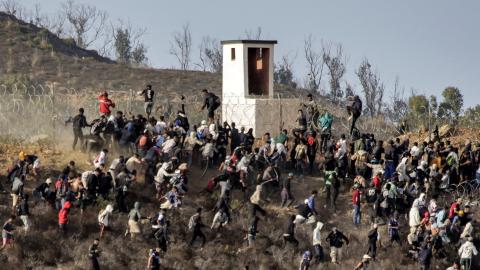
Migrants storm a barbed-wire fence as they attempt to cross the land border with Spain's African enclave of Ceuta near Fnideq in northern Morocco on September 15, 2024. (Getty Images)



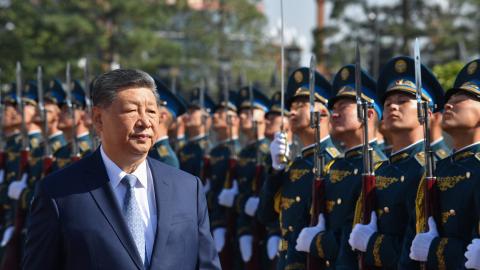

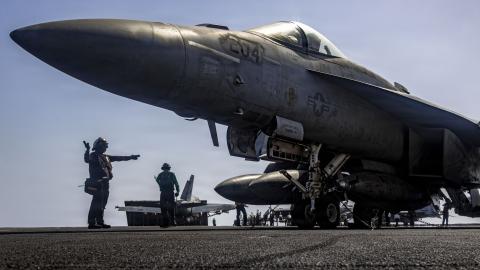
For years, the Middle East has been one of the most volatile regions in the world. And United States foreign policy toward the region often changes drastically with each administration.
Today, a fundamentally new regional order is emerging. A weakened Iran has attempted to exercise strategic leverage over one of the world’s most critical waterways. Russian influence continues to recede, underscored by Bashar al-Assad’s fall in Syria, and Beijing seeks to project its influence wherever it can. Meanwhile, the US government continues to prioritize the deepening of security and economic partnerships across the Middle East, and with partners once thought to be adversaries.
America’s role during this transformational period is more crucial than ever, but the US faces heightened scrutiny at home and abroad. Policymakers need to assess the current strategic environment to chart a path forward for US foreign policy in the Middle East under dramatically altered political, economic, and security dynamics.
Join Representative Mike Lawler (NY-17), chairman of the House Foreign Affairs Subcommittee on the Middle East and North Africa, for a conversation with Senior Fellow Joel Rayburn on the emerging Middle East security order and the future of American strategy in the region.
Listen on Spotify and Apple Podcasts.
Transcript
This transcription is automatically generated and edited lightly for accuracy. Please excuse any errors.
Joel Frushone:
Well, good morning everyone and welcome to Hudson Institute. I’m Joel Frushone, Director of External Affairs. Thank you for joining us in person and online today. The Middle East is undergoing one of its most significant geopolitical realignments in decades. America’s adversaries continue to compete for influence across the region.
Our partners face new security challenges and policymakers in Washington are grappling with how best to protect US interests and sustain American leadership in a rapidly changing strategic landscape. At the same time, the United States is strengthening relationships with key regional partners while reassessing its role in an increasing complex security environment.
Few members of Congress have been more engaged in these issues than Congressman Mike Lawler, who serves on the House Foreign Affairs Committee and chairs its subcommittee on the Middle East and North Africa.
Congressman Lawler represents New York 17th District in the Hudson Valley. As an institute named for the river that runs through it, we’re especially pleased to welcome him today. He’s been deeply involved in shaping discussions about American alliances, regional security, and the future of US engagement in the Middle East.
Joining him is my colleague, Joel Rayburn, a senior fellow at Hudson and one of the nation’s foremost experts on Middle East Affairs. Before coming to Hudson, Joel served as US Special Envoy for Syria and Deputy Assistant Secretary of State for Lebanon Affairs, where he helped shaped American policy towards Syria, Iraq, Lebanon, Jordan, and the broader region.
Together they’ll discuss the emerging Middle East security order, America’s security or strategic interests in the region and what the future of US policy may look like in the years ahead. Please join me in welcoming Congressman Lawler and Joel Rayburn.
Joel Rayburn:
Congressman, great to have you here.
Congressman Mike Lawler:
Thanks for having me.
Joel Rayburn:
Yeah. Can I start out also by extending Joel Frushone’s Hudson points So for seven years of my life, I lived across the river from your district at the US Military Academy at West Point, four years as a cadet, three on the faculty, and I just have to say you have a great district.
Mike Lawler:
Oh, no question.
Joel Rayburn:
It’s a beautiful district. There’s a lot to do there. That’s the place; poor West Pointers had to go across the river to shop in your district because the shopping is so much better—
Mike Lawler:
So, I’m on both sides of the river, I have all of Rockland County. So Bear Mountain, just south of West Point, but it really is a spectacular district. And actually my favorite painting in the Capitol is the painting of Henry Hudson discovering the Hudson and going up the river right around West Point. And it used to hang in the House chamber until the early 1900s and now it’s off the rotunda in a stairwell, but it’s a beautiful painting and really speaks to the history of the region and going back certainly during the Revolutionary War to today, so it really is a special place.
Joel Rayburn:
I think also the Hudson River Valley, there’s something about it. And New York City and the counties surrounding it, they’ve always had such . . . They’ve always had a global view, if you will, and global involvement that going right back to the founding as a Dutch colony, global commerce. So people from New York have always had, I think, a very broad view on international affairs. I think you fall into that tradition.
Mike Lawler:
And two of my more immediate predecessors, Benjamin Gilman and Eliot Engel, both served as chair of the committee and represented different portions of the district over the last few decades. And look, 75 percent of adults in my district have a college degree or higher. It’s a very affluent area, educated.
The Clintons live there in my district. So people have always been engaged on foreign policy. I have one of the largest Jewish populations in the country. I have the second-largest Haitian diaspora. People are aware of what is going on internationally and off our shores. And I think serving on both financial services and foreign affairs really gives me a front-row seat to what is happening and what many people in my district do care about.
Joel Rayburn:
Yeah. I think also, your tenure in Congress is not terribly long, but you made a really quick impact, I think, on the Foreign Affairs Committee. And now you’re the chairman of the Middle East and North Africa Subcommittee. You’ve been a thought leader and issue leader on Middle East-related issues.
You’ve proposed some very cogent legislation on some of the key national security issues for the United States in the region. And so obviously even before now, I think people woke up with the current confrontation, military confrontation with the Iranian regime, and maybe hadn’t understood the importance of it. And suddenly there it was in the summer of 2025, but you’d been engaged on it before then, even on specific legislation as I mentioned. So when you talk to people in your district, how do you explain to them the relevance of the Iranian regime problem, the axis of regime problem for them and for United States vital interests?
Mike Lawler:
Look, I think as you look at foreign policy, it’s not conducted in a vacuum or in silos. Almost all of it is interconnected. And so you look at Iran, and the unholy alliance they have with China, with Russia, with Venezuela, with Cuba, with North Korea, and you look at what has happened around the globe over the last five plus years, and you see the consequences of inaction and failure.
And obviously what happened on October 7 set off a chain of events in the Middle East. And in many respects, the world is in a much better place today than it was prior to October 7. And you see what President Trump has been focused on: not just striking Iran’s nuclear facilities last summer, not just removing Maduro, not just isolating China from other parts of the world and this alliance, you see what has happened with respect to their illicit oil trade.
Having Venezuela completely cut off from them is positive. Having the situation in the Strait of Hormuz while impacting obviously global oil markets, it has a profound impact on China. China’s the biggest purchaser of Iranian petroleum. And during my time, I’ve focused heavily on combating that illicit oil trade.
I’ve passed the SHIP Act, the Iran-China Energy Sanctions Act, this Congress I passed through the House, the Enhanced Iran Sanctions Act. And frankly, I hope the Senate will take it up because the more pressure we can put on them economically, the less financing they have available to fund their terror proxies, to fund their ballistic missiles program, to fund their drone capacity, to fund their nuclear ambitions. If you look at what happened during the Biden administration, they allowed it to fester. They allowed the illicit oil trade to explode to the tune of hundreds of billions of dollars financing all of this illicit activity.
And so from my vantage point, the way I talk to my constituents about this, this is the first time in 47 years a president has actually been willing to take action. It’s not enough to just say Iran cannot have a nuclear weapon. Everybody has said that. But the reality is very few have actually taken action towards preventing that.
I think when you look at the situation post October 7, where Hamas and Hezbollah have been largely decimated, where there has been significant change in Syria with the fall of Assad’s regime, where now the Ayatollah, the clerics, the leadership of the IRGC have been eliminated and military action has been taken to weaken Iran’s defense capabilities, their air defenses, their naval fleet, their ballistic missiles capabilities, these decisions matter and they have real consequence.
And I can tell you in dealing with all of the Gulf states and all of the ambassadors, they are on our side on this. They agree with us. Are they concerned about obviously attacks on their homeland and being targeted? Yes, but they want the threat eliminated. And so the president has made a difficult but necessary decision, in my opinion, to finally deal with the threat in a serious and meaningful way, especially when you have a regime that showed it was willing to use ballistic missiles in the thousands to attack civilian populations and to finance a terrorist attack against our greatest ally, inclusive of Americans being killed on October 7.
When I listened to some of the dribble coming out of my colleagues in Congress and people like Ro Khanna and others who have just completely jumped the shark because they’re more concerned about their base politics than they are actual policy, I’m not going to waver on this. And I think regardless of the political consequence, the president made the right decision.
Joel Rayburn:
I think also people, and I know you see it because you’re on the Foreign Affairs Committee. You’re very engaged in sort of the day-to-day developments coming out of these various regions. But I think otherwise Americans have lost track a little bit under the Biden administration about the way in which the rest of the world also changed its attitude toward the Iranian regime, really to align with what President Trump’s warnings were about the Iranian regime during his first term.
If you look at the way the Iranian regime essentially intervened in a European war by supplying the drones and missiles that Russia was using against Ukrainian population centers by sending essentially IRGC advisors to Ukraine to help the Russians conduct the war. And then the way in which the Iranian regime, through Hezbollah, but also directly, was using Venezuela as a platform to try to destabilize our allies and threaten our border in the Western hemisphere. And just the way the Iranian regime sort of projects power, destabilizing terrorist power and other destabilizing power around the world.
And as you pointed out, the Gulf states I think have come to the realization they can’t really reliably coexist side by side with that regime. I think people here in the United States sort of lost track of that.
Mike Lawler:
Couldn’t agree more. And I think a lot of this is driven by politics. Many of my colleagues on the other side of the aisle have completely changed their positions. Their positions are also inconsistent. If you support Ukraine, which I do, and you want to push back against Russia, why would you not want to eliminate the threat posed by a nuclear Iran or an Iranian regime that exports terrorism, whether through its proxies or by its relationship with Russia and what it has done in the war in Ukraine, or North Korea sending troops to just die on the battlefield? And there you have China, in large measure, involved in and behind much of it.
And I just fundamentally believe many folks in this city have lost track of what Congress’s responsibility is, what Congress’s role is. Yes, domestic politics matters. Yes, domestic policy matters. But it is the federal government that is responsible for foreign policy, not the states and not state government, but the federal government.
So we play a critical role in this. And you have to be able to walk and chew gum at the same time and be able to do both domestic policy and foreign policy and national security and obviously our military capacity. And so when you look at some of the challenges that we are dealing with, I don’t think there’s any question. Many folks have lost complete sight of what has happened in the world over the last five years and failed to truly recognize the coordinated and systemic attacks financially and militarily. From a national security standpoint, you look at things that China is doing, what they’ve done with intellectual property theft, what they’ve done with trying to seize control of ports and waterways.
When the president talked about, for instance, the Panama Canal, how many people snickered and laughed? "Oh, what is he talking about? He’s crazy." No, he was 1,000 percent correct that we allowed the Panama Canal to fall under the control of the Chinese Communist Party and he took action. Greenland to me is not an unimportant issue.
I’ve said from the very beginning, we’re not seizing Greenland. We shouldn’t be sending troops to Greenland for the purpose of taking Greenland. We shouldn’t even be threatening that. But the point of having stronger military capabilities on Greenland in partnership with our allies, he’s 1,000 percent correct on that.
And when you look at what we have invested to protect Europe, what we have invested to support our allies, he’s right to be annoyed about their response to the situation in the Middle East. Because the fact is all of this is interconnected, and they are right to push back against Putin.
They are right to defend Ukraine, but they should recognize the connectivity between that situation and what’s going on in the Middle East. And the failure of France and Germany and the UK in particular to respond in a coherent way to this situation I think speaks volumes to the disconnect in the West with what is actually happening around the globe.
Joel Rayburn:
Yeah. You raised an important point, which is I think there’s a handful of key strategic choke point waterways that the global economy, global trade, American prosperity is dependent on for the free flow of commerce. I mean, the United States, we are a global commercial empire. We rely on-
Mike Lawler:
And by the way, our naval fleet is critical to ensuring that.
Joel Rayburn:
Yeah, exactly. And I have to think that Xi Jinping must be watching very closely to see if a revanchist power, i.e., the Iranian regime, can get away with asserting control over an international waterway that a lot of the world depends on. And—
Mike Lawler:
The Taiwan Strait: 60 percent of international trade flows through the Taiwan Strait. So, if Iran is permitted to act with impunity here and our allies do nothing to support our effort on this, they’re going to regret that down the road. And China, to your point, is watching. They see how people respond. And ultimately the United States is not in a position where we can just go it alone. Our allies need to play a role.
They don’t have to be the lead, but they certainly have to play a role. And I think that’s the point the president has made time and again, especially with our NATO allies who too often want, want, want and take, take, take, but don’t understand the importance of participating when asked.
Joel Rayburn:
So, I mean, you’ve laid out very well, I think, what the global strategic significance of this confrontation with Iran is, what it means for China and other of our global competitors.
There is a strain of argument that’s coming from, I’d say, sort of people who are sympathetic to the Iranian regime or even some who maybe have different reasons for saying so, saying actually the United States has sort of been lured into this conflict in a way that’s against its interests, especially dragged in by Prime Minister Netanyahu and Israel. How do you reply to that line of argument?
Mike Lawler:
Look, it’s so easy for some seemingly to just blame the Jews for everything. But the fact of the matter is if you look at President Trump’s first term and you look at his second term, he has been clear and consistent on his views with respect to Iran and with respect to how to contain them, whether it was Soleimani or enacting the sanctions or ripping up the JCPOA.
He has been unequivocal in his position that Iran cannot possess a nuclear weapon, that the illicit oil trade that funds their activities must cease. And his maximum pressure campaign has been one of the most important strategies in dealing with Iran. It’s the only thing they actually understand. They don’t understand begging. They don’t understand sending pallets of cash. And ultimately the Obama approach and the Biden approach, in my opinion, created this mess.
And you have to be willing to take action. To just say as Republicans and Democrats have forever, that Iran cannot possess a nuclear weapon, but not be willing to actually take action to stop that means what? What does it actually mean? And so many of my colleagues, frankly, have undermined this effort over these past few months pushing for war powers votes and totally inconsistent with their previous positions when Barack Obama was president.
A seven-month campaign in Libya. Nancy Pelosi and Chuck Schumer both arguing repeatedly that he did not need approval by Congress, that he was well within his Article 2 powers and that a war powers resolution was not warranted.
So what changed? The only thing that changed is that they absolutely hate Donald Trump and so whatever he does is problematic from their worldview. But ultimately in this situation, the idea that we were forced into this by Bibi is both ignorant and just rooted in Jew hatred. I mean, it is just one more example of where the Democrats are today within their party if that’s their line of attack.
Joel Rayburn:
Plus it’s not like President Trump woke up in late February and suddenly discovered because of input from Prime Minister Netanyahu that the Iranian regime was a problem for US national security. He’s been engaged on Iran as a problem for the United States going back to the early mid ‘80s and he’s on record as far back . . . Have you seen those videos going back as far as I think 1988 or so talking about Kharg Island and the problem with the Strait of Hormuz?
Mike Lawler:
And let’s remember, had October 7 not happened, had Iran not financed its terror proxies to conduct that terrorist attack we’d be in a different situation today. Now I look at where we are and see real opportunity.
I think Prime Minister Netanyahu and President Trump have created a dynamic in which normalization between Arab states and Israel is a greater possibility today than it was prior to October 7. And I think the Abraham Accords, which were one of President Trump’s most consequential foreign policy initiatives in his first term has a chance of expanding and thriving long term. And I think that is important to recognize.
The other thing I’d say, President Trump, as he did last summer with respect to their nuclear facilities, as he did in advance of these attacks in March, as he did with respect to Maduro, he gave the opportunity for a negotiated peace. He gave the opportunity for a legitimate diplomatic effort, but he also put a timetable on it.
And unlike Barack Obama who said he had a red line in Syria and then chose to do nothing, Donald Trump followed through on his red line. He followed through on the 60-day notice. And from that vantage point, it sends a very clear message to not just Iran or Venezuela, but to China that we are not screwing around. And I think one of the things that has been fascinating to watch in all of this is that Iran’s allies effectively have not gotten engaged.
Russia has stayed out by and large. China is sitting on the sidelines. Venezuela obviously has been completely cut off. That matters. And I don’t think that would be the case if Kamala Harris were president today or certainly Joe Biden. And so people can criticize, but I think fundamentally there’s a much bigger play happening here that I think is lost on a lot of people.
Joel Rayburn:
Also, diplomacy, having been a diplomat myself, I can attest that diplomacy doesn’t work if it’s just words, not backed up with anything. If you’re a diplomat, you’ve got to have the credible threat of the use of force at your back or you have to have the credible threat of economic pressure at your back, not just carrots, not just intoxicates.
Mike Lawler:
And look, Iran responded in the way that many thought they would, which was to try and control the Strait of Hormuz, and what the president did by putting a blockade on their blockade was cripple their economy. They’re losing $500 million a week, and their inflation is through the roof. And remember, we don’t rely on Iranian oil. We don’t purchase Iranian oil. Yes, it impacts the global supply, but it speaks to a much larger issue, which is that domestic energy policy is national security, which is part of the reason why I have been advocating vociferously to rebuild and reopen nuclear power plants across the country, increase domestic production of oil and gas.
Yes, renewables. I support solar and wind and hydro among others. But we need to be a net exporter of energy. We need the world purchasing US oil and gas. And we want to cripple the Iranian regime until such time as they wake up and choose to conduct themselves differently.
Is that going to happen today or this year or within the next 10 years? Probably not. But the path they were on where they’re mass-producing ballistic missiles, where they’ve shown a clear willingness to use them, where they have enough enriched uranium to produce 11 bombs, what exactly were we waiting for and when did people want to act, once they used the nuclear bomb, once they struck our military bases in the region? What did people want us to wait for? And nobody can actually answer that because they don’t actually have a plan to deal with the threat from Iran. They just want to attack and criticize because they don’t like the president.
Joel Rayburn:
Well, I mean, you raise a very interesting point because the point that the Iranian regime lacked a real Air Force, Navy, Army, they had air defense. It wasn’t very good, and it was taken out. They were relying almost entirely on what we would in the past have called asymmetric means: ballistic missiles, drones. And then they were trying to, I’m convinced, trying to acquire a nuclear deterrent.
And that matches a lot with the character of the war in Ukraine where Russia is using ballistic missiles and drones against population centers in order to exert existential blackmail against not just Ukraine, but by example against some of the rest of Europe. That I think is what the Iranians were trying to replicate.
Mike Lawler:
They were learning from the Russians.
Joel Rayburn:
They were learning. Yeah, exactly.
Mike Lawler:
And this is-
Joel Rayburn:
They were learning from each other.
Mike Lawler:
This is fundamentally where, if you look at what is happening. The idea that we just do nothing is crazy. When you look at what happened on October 7, when you look at what the Iranian regime was doing, when you look at the connection with Russia, when you look at what China is doing, these are real threats posed by this alliance.
And what the president has been doing is pulling at the threads of that alliance and isolating Venezuela, reclaiming control of our own hemisphere, and pushing back on the malign influence of China and Russia and Iran in our own hemisphere is critical.
What’s happening off the coast of Africa is critically important for us to exert ourselves, especially in the Mediterranean off the Northern coast. But also when you look off the Eastern coast of Africa, and you see the growth in terrorism in Northern Africa, that is vital that we tackle that. And so there’s a lot happening, and I just fundamentally believe if we did not deal with this now, the consequence of it would be far worse. And I think that’s the president’s perspective on this. Yes, there is some short-term volatility.
Yes, there are some short-term economic challenges as a result of this, and obviously we want to bring gas prices down as quickly as possible. But again, that also points to actually having a coherent energy policy. It’s why Congress should be moving to pass permitting reform through this Congress so that we can build large-scale energy.
And it ties into a bigger issue, which is where we’re headed. AI, digital assets, quantum computing. China is aggressively pursuing all of this. They’re aggressively ramping up their military capabilities.
These are real challenges, and we have to be focused on this next battle and how we counteract that. It’s why we need to get the CLARITY Act done, for instance, and why the Senate needs to move on that. You want market structure done so that digital assets are operating out of the United States and not off our shores. You don’t want China to have a stranglehold on digital assets.
AI obviously is going to be important. How we deal with that issue, how we deal with data centers. These are real debates and discussions that have to happen, and it’s not just a domestic economic issue. It’s a national security issue.
Joel Rayburn:
Because of the wars that we’ve seen—Ukraine, Iran, the Houthis—I think people have woken up to the problem of the weapons that they’re using and the need to really ramp up our capabilities to defend ourselves and work with our allies so they can defend themselves against that threat.
But with your other committee hat on for a second, the Financial Services Act, what are the weapons that people need to be aware of that could be used to attack our financial systems that we need to do more, Congress needs to do more to defend ourselves?
Mike Lawler:
This is one of my biggest concerns sitting on both of these committees is foreign bad actors, specifically China, but Iran, Russia, using AI, using digital assets, using quantum computing as that comes online commercially, using this to undermine our financial institutions and our capital markets. The reason the United States is the global behemoth that it is in addition to our military is because of our capital markets. And China will do everything it can to undermine that. Everything.
That is their game plan. It’s why they engage in intellectual property theft. It’s why they use the cloud to hack and steal. I have a bill that passed the House, the Remote Access Security Act. The Senate is sitting on it. Move it. We have real issues that have to be addressed to combat this economic warfare that China is engaged in.
So from the standpoint . . . Their military buildup is not so much about let’s go head to head to war, their military buildup is how they can use that as a hammer economically and how they can coerce other countries into seizing control of their ports, their waterways. That’s why they’re so aggressively building up their naval fleets.
So these are real issues that we have to contend with. And I think from the standpoint of both financial services and foreign affairs, I am very concerned over the next decade in this race for AI and the race for quantum computing. China is not beholden to regulations. She doesn’t worry about what the law says. We sit and fight, not even realizing what’s happening around the globe. And how we tackle these issues matters and how we talk about it with the American people so that they actually understand it’s a much bigger issue at play than just a domestic policy dispute.
Or you look at AI and the use of data centers and there’s real policy arguments to be made and there’s a responsibility of these companies to pay for. And obviously energy plays into all this. But if you look at how China operates and the fact that they’re not worried about environmental concerns, they’re not worried about water consumption, they’re not worried about regulations, they just build. They’re not worried about what source of energy they use. They don’t care if they use coal. And so they are going leaps and strides ahead of us on some of these things. And there are real consequences to that from a national security standpoint.
And we’re not making the connection for people. We’re not talking to them honestly about these issues in a way that I think the American people have to understand what is actually happening around the globe and the direct impact on us economically and from a national security standpoint.
Joel Rayburn:
Couldn’t agree with you more. We have a few more minutes. I’d like to give the audience a chance to ask some questions. We can start here. Wait for the microphone. If you could tell us your name and your affiliation.
Audience Member Robert Guest:
Sure. Robert Guest from The Economist Magazine. Thank you very much for that, Congressman. I was wondering, there was a poll released yesterday from YouGov saying that nearly half of Americans think that the war in Iran might last for a year or longer. And I’m wondering, given what you said about the importance of the objectives, what do you think the administration should be doing to prepare Americans for the possibility of a long war if you think that’s what it’s going to take?
Mike Lawler:
Well, look, I don’t know how long it’s going to take. I don’t think anybody has a clear answer on that. I think what the objectives were very clearly at the onset was to degrade Iran’s military capabilities, its ballistic missiles capabilities, its drone capacity, and eliminate the leadership of the IRGC. And obviously its air defenses over the last several years have been severely degraded and effectively wiped out. Their naval fleet is sitting at the bottom of the sea, but they obviously are still hellbent on holding on to power.
More than anything, that’s what the Iranian regime, the remnants of this regime, care about. And the question is, can you get to a place where you have someone in the leadership there that you can actually negotiate diplomatically with or not?
From my vantage point, the most outstanding issue is two things. One, the highly enriched uranium and destroying it. Or removing it. The removal barring some negotiation would require troops on the ground and I’m not certainly inclined to do that and don’t think that is what we should do.
But secondarily obviously is the Strait of Hormuz. And I think the president rightly tried to engage in a good faith negotiation with them on these outstanding issues. But as we’ve seen for 47 years, then they’re not trustworthy. And so the only thing they will understand is military action. And I think what you’re seeing now is after a little bit of a reset, action being taken to achieve the goals and further degrade their military capabilities, ensure safe passage in the strait. And ultimately we will see what happens with respect to the highly enriched uranium.
Obviously nobody wants war. Nobody wants this to last in perpetuity. The president has made very clear he doesn’t support forever wars. I think people misunderstand something though, forever wars does not mean you don’t take military action.
Being against being in these wars that last years does not mean you don’t use military force. And the president has shown both in his first term and his second term, he is willing to take action when it comes to protecting our interests abroad and at home, whether it is striking at the cartels, removing dictators or striking against terrorist regimes.
Fundamentally, obviously we want to see the war come to an end, but I think it is imperative that the goals be met. And so I think it’s important for the administration, the president and Secretary Rubio and Hegseth to do a level check with the American people and to explain where we are, what has been accomplished to date and what the remaining objectives are so that the American people fully understand where we are in this moment.
I also think it is imperative for our allies, especially our European allies to recognize where we are in this moment. And as we talked about earlier, the importance of looking at this holistically and not in a silo and ensuring safe passage in the strait is to their long-term benefit, and they should recognize that.
Joel Rayburn:
Okay. We’ve got three minutes to go. I want to take two last questions. And I want to bundle them. So if we could go back here and please identify yourself and make your questions very short.
Audience Member Brian Katulis:
Yeah, Brian Katulis, Middle East Institute. Thanks for your leadership and your voice on all of this. And thanks also for co-sponsoring legislation with Democrats like Josh Gottheimer. Assuming you get reelected, do you see any possibility there for rebuilding the vital center on national security? Or do you think it’s just a hopeless case where we just beat each other up on a partisan basis on national security?
Joel Rayburn:
Okay. And last question from here.
Audience Member William Lawrence:
William Lawrence, The National Council on US-Arab Relations. Other than the nuclear piece and the Hormuz piece, what would an ideal eventual negotiated deal with Iran look like? The second topic, I understand your criticism of the other side, but what on war powers and congressional oversight and military actions, what is the optimal formula?
Mike Lawler:
Got it. So Josh Gottheimer’s my best friend in Congress. I say it often. And we talk almost every day and work together on a myriad of issues. Obviously the base politics have driven the two parties further and further apart, unfortunately. And gerrymandering certainly has made it very difficult because there’s very few seats that are competitive, which means there’s less reward structure, if you will, for working across the aisle because people are more focused on their primaries. They’re more focused on appealing to the base than they are appealing to the middle.
I’m in a seat that has 80,000 more Democrats than Republicans. Now, obviously from the standpoint of trying to win an election, you have to be able to build a coalition. But it’s in my nature and it’s who I am to want to find compromise and to want to actually work with people on all sides. t’s why I worked with Joe Biden and why I worked with Donald Trump.
I mean, the idea that you can just say, "I’m not going to work with that person," and assume that you’re going to be able to get anything done is idiotic. And yet this town is filled with people saying, I won’t work with them because I don’t like them. Fuck you. It’s so stupid, but this is where we are in this moment.
So from that standpoint, I think we are at a really sad point in that foreign policy was kind of one of those areas where people kind of checked their party politics to a larger degree and found ways to really work together. The Foreign Affairs Committee, broadly speaking, has always been pretty bipartisan. I think today’s vote on support for Israel is going to be very telling. I mean, you’re looking at upwards of 150 Democrats maybe voting to cut off funding to Israel, which is insane. I don’t think they actually understand what the funding is.
I don’t think they actually understand the consequence on our own military. But putting that aside, we’ve allowed party-based politics to trump, pun intended, everything else. And that’s a real shame. So do I think we can get back to a better place? Yes. But it requires people to actually grow a spine and start pushing back against the Looney Tunes.
As far as war powers and what should be done, look, Congress hasn’t declared war since World War II. I think this entire debate that has gone on has been inconsistent and hypocritical at best. I do think the War Powers Act should be reformed. I don’t think as it’s currently written and structured, it actually really makes sense. I think Congress absolutely has a role.
I think Congress, certainly from an oversight capability and from a constitutional responsibility of declaring war, yes, Congress absolutely has a role. But the president is the commander in chief and the president has the authorities to act. And presidents of both parties have done so.
And so my point to all of my colleagues is be consistent in your position. I believe Joe Biden had the authorities to act and take numerous strikes against Syria and Iraq and other areas in the Middle East in which he took action. And I also believe Barack Obama did.
People have to be consistent on that. Do I think the War Powers Act should be reformed and that there should be a little more teeth in terms of how it is structured? Yeah, I do. I think as it’s written, it really does not work. And I think obviously you’ve seen presidents of both parties push back against it for obvious reasons.
And your first . . .
William Lawrence:
The rest of the Iran deal—
Mike Lawler:
Oh, what would it look . . . Look, I think fundamentally the terror proxy issue and financing of terror proxies has to be addressed. No sanctions relief should come unless the enriched uranium, the Strait of Hormuz and the financing of terror proxies is addressed. And certainly unfreezing of assets. I wouldn’t ever send them cash, not one cent. So there’s a lot of challenges ahead. I did not like much of the language in the MOU, but I understood the objective was to get to a final agreement if you could. It’s clear with these folks that is almost an impossibility. So the question really becomes what actions must be taken militarily to force the end result that you want?
Joel Rayburn:
All right. And we will leave it there. I know you have to get to your day job.
Mike Lawler:
Thank you. I do. Thank you.
Joel Rayburn:
Thank you, Congressman Lawler.
Mike Lawler:
Thank you, everybody.
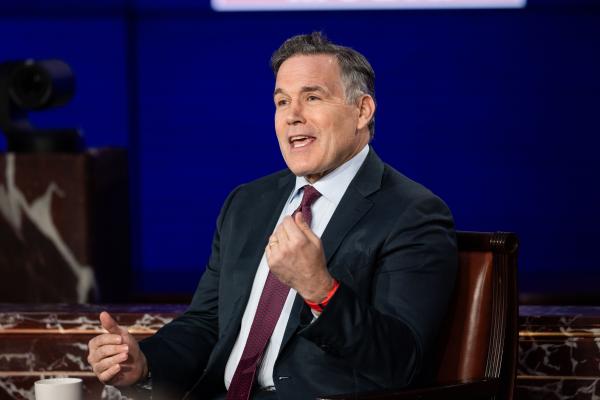
Join Senator Dave McCormick (R-PA), who recently visited Japan and Korea, and Distinguished Fellow Mike Gallagher for a fireside discussion on United States–China relations, the role of allies and partners in America’s Indo-Pacific strategy, and how the US can harness technology, industrial capacity, and allied strength to prevail in the defining strategic competition of our time.
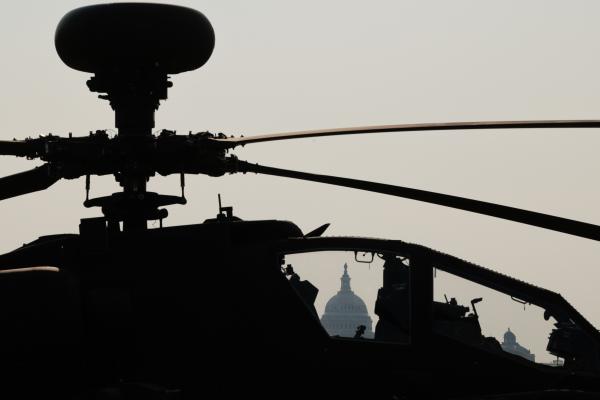
The United States Congress will have a full defense agenda in the months ahead, with the National Defense Authorization Act, the reconciliation package, and a supplemental funding request on the docket. Join Hudson Institute for a conversation with Fellow Jeremy Hunt and James Byrn, the US Army’s chief legislative liaison and the service’s lead on Capitol Hill, on what this legislation could mean for the Army and how his office maintains its relationship with Congress.

Join Hudson Institute for a conversation with US Ambassador to the EU Andrew Puzder and Senior Fellow Harold Furchtgott-Roth on America’s interests in reducing the harmful effects of CS3D and CSRD.

Join Hudson Institute for a conversation with Lazarus, founder of Lazarus Consulting and former speechwriter to the Commander of the US Southern Command.