







Over 30 days in May and June 2026, India hosted meetings of the foreign ministers of BRICS+ nations and then the United States-led Quad. Prime Minister Narendra Modi also attended the G7 leaders’ summit in Evian, France. Given U.S. President Donald Trump’s description of BRICS as an anti-American grouping, India’s simultaneous participation in BRICS+ and in groups where the U.S. occupies a central position could appear contradictory. But it reflects India’s longstanding aversion to bloc alignment in international relations and its willingness to join any combination of countries that advances its national interests.
Mr. Trump’s rhetoric against BRICS+ has not deterred India from using it as a convenient, if imperfect, platform for advancing its strategic interests outside the Western-led international order. For Indian policymakers, multilateralism reinforces national pride and enhances the country’s global status and influence. BRICS+ helps India bolster its claim to leadership of the Global Majority.
A platform for a multipolar order
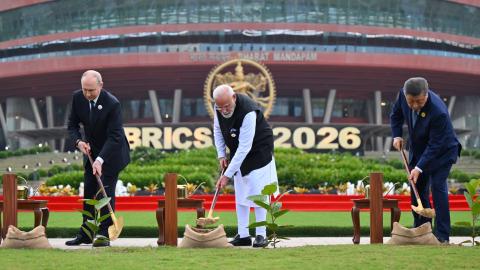
In September 2026, India hosted the BRICS+ summit in New Delhi. BRICS+ comprises 11 countries: the five original members – Brazil, Russia, India, China and South Africa – as well as Egypt, Ethiopia, Indonesia, Iran, Saudi Arabia and the United Arab Emirates.
For New Delhi, the forum’s key value lies in its contribution to a genuinely multipolar order. During the Cold War, India led the Non-Aligned Movement (NAM), opposing the domination of international affairs by one or two competing powers. Like NAM, BRICS+ faces both internal and external difficulties. Its members come from different continents, have divergent national interests and are at different stages of economic development.
These differences are reflected in the bloc’s lack of consensus on issues such as reform of the United Nations Security Council and joint statements on the wars in Ukraine and Iran.
India’s hopes of leveraging its geopolitical and geoeconomic heft through the grouping face significant limitations. Although India is the world’s most populous country, it accounts for 17.7 percent of the global population but only 3.3 percent of global gross domestic product (GDP) and 2.5 percent of global exports. By comparison, its principal Asian rival, China, accounts for 16.8 percent of global GDP and 11.3 percent of global exports. This disparity helps explain why India needs to reconcile its BRICS+ membership with its ties to the U.S.
Bilateral gains within BRICS+
Multilateral action within BRICS+ has often been slow, but membership facilitates bilateral relations among its members. The threat of U.S. tariffs on BRICS+ countries, along with the unpredictability of the second Trump administration, has pushed India closer to other members of the grouping.
India has maintained close ties with Iran while preserving its partnerships with Israel and the Gulf Arab states. Despite economic pressure from Washington, India continues to purchase Russian oil and military hardware. Its ties with other BRICS+ countries are also generally warm and strategically important.
South African exports to India totaled $4.7 billion in 2025. Brazil and India have deepened economic cooperation through BRICS+, with bilateral trade reaching $15 billion in 2025. India’s long-standing ties with the UAE have expanded to include closer energy cooperation and a defense partnership. In July 2026, India and Indonesia signed several agreements covering critical minerals, missiles, agriculture and critical infrastructure.
Sino-Indian rivalry in South Asia and the Indian Ocean region, differing views on the Dalai Lama and Tibet’s future, and the unresolved border dispute complicate India’s bilateral and multilateral relations with China. Yet the two countries maintain robust economic ties, with bilateral trade totaling $155 billion in 2025. India’s ambition to become the voice of the Global Majority remains constrained by the economic dependence of BRICS+ members on China.
The limits of de-dollarization
President Trump’s threats to impose tariffs on BRICS+ countries in 2025 centered on de-dollarization concerns. These concerns have grown with China’s economic rise and the deepening Sino-Russian relationship. India, however, continues to view the dollar as a “source of international economic stability,” while the prospect of a China-led BRICS+ currency system is anathema to New Delhi.
Instead of a common currency, India’s central bank has proposed linking the official digital currencies of BRICS+ members to streamline trade and tourism payments while reducing dependence on the dollar. The proposal emphasizes using local currencies in trade. It is likely to draw criticism from the U.S. but would fit India’s multi-alignment strategy.
The main obstacle to full implementation is the limited demand within BRICS+ for most member currencies compared with the dollar. This is a particular concern for India, as the 2026 Iran conflict and rising capital outflows have pushed the Indian rupee to a record low.
India is a founding member of the UN and the Bretton Woods financial institutions. Yet it is also a prominent member of non-Western institutions such as the New Development Bank (NDB), which, together with the Contingent Reserve Arrangement, represents an attempt by BRICS+ to provide alternatives to the World Bank and the International Monetary Fund.
Control of the NDB is divided equally among the five founding BRICS members. Its ambition to rival the World Bank has so far been constrained by undercapitalization. Since beginning operations in 2015, the NDB has approved $42.9 billion to finance 139 projects. This places it far behind institutions such as the Asian Development Bank (ADB), which committed about $50 billion to development projects in 2024 and 2025 combined, and the World Bank, which committed over $100 billion in fiscal 2025 alone.
At a time when the U.S. is adopting mercantilist and unpredictable economic policies and strategic relations remain strained, India sees closer commercial cooperation with BRICS+ as beneficial. However, slow manufacturing growth, a historically weak currency, reluctance to become overly dependent on China and difficulties coordinating with other BRICS+ members remain concerns.
As with its other multilateral engagements, New Delhi has often found that bilateral economic relations with individual BRICS+ countries give it more leverage than working through the grouping, where China carries greater weight.
Since independence in 1947, India’s foreign policy has been shaped by its commitment to multi-alignment and multilateralism, as well as its desire for a multipolar world order. Membership of groupings such as BRICS+ and the Shanghai Cooperation Organization also has a realpolitik dimension. India participates partly to prevent these organizations from becoming Chinese-led, even if they remain Chinese-dominated.
For India, BRICS+ is a non-Western rather than an anti-Western institution. It enables the country to engage with developing and post-colonial countries that often feel excluded from Western-led international institutions and want the international order to become more receptive to their interests.
Scenarios
The most likely path for BRICS+ is one of selective convergence: The grouping will become more visible and useful without becoming more strategically coherent. For India, its value lies in its versatility. It is broad enough to amplify its voice, flexible enough to preserve strategic autonomy and divided enough to prevent any one member, including China, from easily dominating it.
More likely: India preserves BRICS+ as a flexible platform
The most likely scenario is that India will continue to treat BRICS+ as a flexible platform for influence rather than a fixed alliance. Its value lies in widening New Delhi’s diplomatic space, strengthening its claim to Global Majority leadership and ensuring an Indian presence in institutions where China and Russia already exercise influence.
India will seek to prevent BRICS+ from becoming an anti-Western bloc. It will instead try to preserve it as a pragmatic, non-Western forum that supports its commitment to multi-alignment and strategic autonomy. India’s 2026 chairmanship reinforces this practical orientation.
The expansion of BRICS+ gives India a larger platform but also makes the grouping harder to manage. It gives the bloc greater diplomatic reach and makes it more representative of the developing world, but competing geopolitical and economic interests make consensus harder.
India will likely manage this tension through agenda-setting and a focus on issues relatively insulated from existing geopolitical friction. The wide range of sectors covered by BRICS+ will provide opportunities to shape discussions in areas where consensus is easier to reach, even when members disagree on broader security questions.
The NDB will be a central pillar of this effort, although it needs greater financial backing to rival the ADB or World Bank. Its initial successes give BRICS+ some institutional substance to advance common goals in infrastructure and development. Facilitating the use of local currencies in BRICS+ trade will also support the grouping’s goal of reducing reliance on the U.S. dollar during an unpredictable American administration.
Less likely: Divisions undermine India’s BRICS+ strategy
The less likely scenario would arise if the grouping’s internal divisions became impossible to manage. India’s ability to shape BRICS+ is already limited by the geopolitical and geoeconomic upheaval affecting the world order. If President Trump imposes tariffs on BRICS+ countries, the U.S. Congress adopts additional sanctions on Russia and sanctions on Iran remain in place, India will find it increasingly difficult to maintain its position. Renewed tensions along the India-China border would also affect its participation in and support for BRICS+.
As chair, India has already encountered the limits of geopolitical cooperation. At the BRICS+ foreign ministers’ meeting in May 2026, Iran pushed the group to condemn the war. Other members, including India and the UAE, sought to avoid a strong public statement.
India responded by issuing a chair’s statement acknowledging differing views on the Middle East conflict. The failure to issue a joint statement was nevertheless widely seen as evidence of the grouping’s internal divisions.