



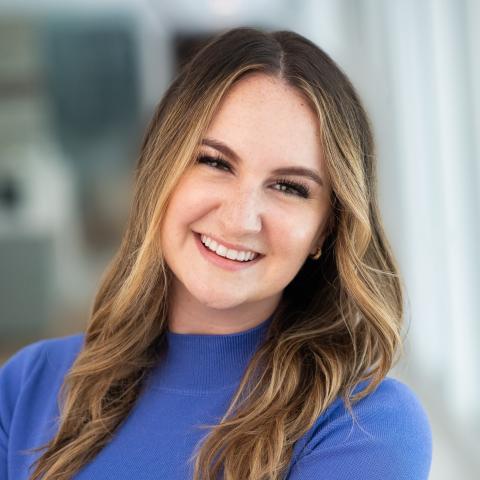
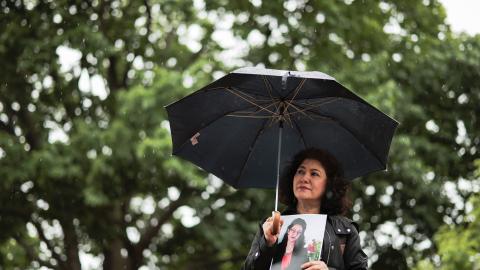
In September 2018, Dr. Gulshan Abbas, a 64-year-old doctor with no history of political activism, was disappeared from her hometown of Urumqi, the capital of the Uyghur Autonomous Region, during a state-sponsored mass arrest.[1]
Her disappearance came mere days after her sister, Rushan Abbas, spoke at a Hudson Institute event on the Chinese government’s ongoing atrocities against Uyghurs.[2] Within six months of her disappearance, the Chinese Communist Party (CCP) sentenced Dr. Abbas to 20 years in prison on fabricated charges of “participating in a terrorist organization” as well as “aiding terrorist activities” and “gathering a crowd to disrupt social order.”[3] She remains behind bars.
The case of Dr. Abbas has long been a priority for the United States, partly because she has more than 24 family members who are American citizens. The government recognizes that her case is unique in that she was detained because her American relative exercised her right to free speech.
On July 4 of this year, Chinese pastor Ezra Jin Mingri, who was detained with other pastors and associates of Zion Church, arrived in the United States after the Trump administration secured his release.[4] His safe arrival on the 250th anniversary of US independence was an unmitigated victory for freedom and indicated that the CCP may be willing to release political prisoners before President Donald Trump’s meeting with Chinese leader Xi Jinping at the White House in September.[5]
The United States should insist on the release of political prisoners across China before rolling out the red carpet for Xi.[6] Washington should also consider Pastor Jin’s release to be just the beginning of its efforts to secure political prisoners’ freedom, especially as his release happened shortly after Chinese authorities detained Burmese-American academic Min Zin in June of this year.[7] The administration should focus on the release of Dr. Abbas and other high-priority political prisoners before the September meeting. By obtaining the release of Abbas, the eight remaining Zion Church associates, and Hong Kong pro-democracy advocate Jimmy Lai, the US would not merely demonstrate its benevolence but would also signal its strength.
America has the upper hand in negotiations. Economically, China needs the US more than the US needs China.[8] In addition, visiting the US would be a privilege for Xi. Washington should condition the visit on the release of several priority political prisoners, including Dr. Abbas.
Why Abbas’s Release Matters for US Interests
While every political prisoner has inherent value as an individual, Dr. Abbas’s case is unique because it overlaps with several issues of concern to the United States:
Her detention has direct implications for her American relatives. Not only is she a peaceful, 64-year-old doctor with no history of political activism, but Dr. Abbas also has 24 American citizen family members, including her two brothers and a sister, as well as her two daughters and a number of grandchildren. Many of them have directly advocated at the highest levels of the US government to secure the release of their mother, sister, and grandmother. What started as an act of transnational repression against adult American citizens is now impacting innocent American children, including Dr. Abbas’s grandchildren who have never been able to hug their grandmother. The US has a history of prioritizing American citizens in its advocacy, and in this case, she has dozens of American citizen family members who are demonstrably harmed by her ongoing detention.
Her detention has implications for free speech in the United States. The timing of Dr. Abbas’s arrest and initial detention clearly demonstrates that the Chinese government was retaliating against her sister’s outspokenness on the plight of the Uyghur people. This is one of the clearest-cut cases of transnational repression—where the CCP commits crimes against individuals who speak out against the party beyond the country’s borders. Rushan Abbas, like any American, has the right to freedom of speech; her remarks should never have led to her sister’s detention and sentencing. A strong US stance in support of Dr. Abbas would signal American commitment to defending free speech.
Her detention has implications for US efforts to counter forced labor across China. Abbas has been detained since 2018, first in a political “reeducation” camp and later in a prison adjacent to a factory where, given the CCP’s long history of “reeducation” through forced labor, she likely was subjected to this practice. Marco Rubio, while serving in the Senate, was the lead sponsor of the Uyghur Forced Labor Prevention Act. The administration continues to view forced labor as an issue of concern, as demonstrated by its recent imposition of Section 301 tariffs, which it implemented, in part, on forced labor grounds.[9]
Her detention has implications for US efforts to advance religious freedom. Dr. Abbas is a Uyghur Muslim. The CCP has wrongfully labeled Uyghurs a threat on the basis of their faith and used that as justification for its ongoing genocide and crimes against humanity. Dr. Abbas is one of the 1.8 million Uyghurs who have been detained inside China’s vast system of political reeducation camps, a clear example of the price Uyghurs pay for the ongoing atrocity crimes the CCP continues to carry out.[10] During the previous Trump administration, the US became the first country to formally issue a determination that Uyghurs face genocide and crimes against humanity, and now the president has the opportunity to act on that determination by securing Dr. Abbas’s freedom.[11]
Failing to prioritize her release would have implications for issues of increasing importance to the US government and signal weakness to Xi.
Dr. Abbas has been detained for nearly eight years and has served nearly half of her 20-year sentence.[12] She suffers from serious health conditions, including high blood pressure, severe osteoporosis that often leads to immobilization, and an eye condition that requires annual monitoring to prevent permanent blindness.[13] Given her age, her health, and the amount of time she has served, the CCP could easily release her.
The Way Forward
Ongoing negotiations between Trump and Xi have created an opportunity to win the release of Gulshan Abbas and other political prisoners.
It is past time for the US government to make good on promises to prioritize Dr. Abbas’s case and secure her release. Her case is well-known: a bipartisan, bicameral congressional resolution passed in May 2026 that called for the release of high-priority political prisoners included her and several others, including Pastor Jin.[14] (Pastor Jin’s case set a precedent for prioritizing the release of political prisoners who are not US citizens but have family members who are.) Speaker of the House Mike Johnson invited Dr. Abbas’s daughter, Ziba Murat, to the State of the Union address earlier this year as a special guest.[15] Heads of state and secretaries of state have met with Dr. Abbas’s family and expressed a commitment to securing her release, and her daughter and sister have spoken at the United Nations on her behalf. Yet despite her fame, diplomats have made little progress in securing her release. President Trump could change this if he raised her case by name in negotiations with Xi.
The US government should do the following:
Press for Dr. Abbas’s release. Before Xi’s White House visit, President Trump should demand that China release Dr. Abbas and ensure she is reunited with her American family members. Because of her myriad health problems, the Chinese government could easily release her on humanitarian grounds, and the fact that she has already served nearly half her sentence should also work in her favor.
Condition future diplomatic engagement with China on the release of political prisoners. Visiting the White House is a privilege for foreign leaders, and such an honor should come with a high price. Xi’s visit to Washington could always be called off. The return of Pastor Jin was a step in the right direction, and the CCP has the opportunity to continue that trajectory by releasing other high-priority political prisoners like Dr. Abbas.
Establish an Office of Political Prisoner Advocacy (OPPA) and appoint a special envoy. The office should coordinate and manage US efforts to secure the release of political prisoners around the world, with a focus on prisoners relevant to US national security. Congress should require the OPPA to release an annual report that identifies key political prisoners and states what the office, civil society, and Congress have done, or can do, to secure their release. A special envoy of ambassadorial rank, confirmed by the Senate, would lead the OPPA and serve as a liaison between the executive branch, Congress, and civil society.[16] This would centralize processes for securing the release of political prisoners, updating families on what the government has done to advocate on their family member’s behalf, and coordinating government and civil society responses to extrajudicial imprisonment. To streamline the process, the envoy should coordinate with other key parts of the State Department tasked with advocacy for political prisoners. The special envoy should also work with the Treasury Department and entities like the National Security Council to identify individuals who could be sanctioned for facilitating arbitrary detentions.
Create a designation of arbitrarily detained for political prisoners. The United States has a robust apparatus for obtaining the release of hostages, especially when the State Department officially labels them as wrongfully detained. This term usually only applies to hostages and not political prisoners. For political prisoners, the department generally uses the informal term arbitrarily detained. The special envoy and the OPPA should have the power to officially label political prisoners “arbitrarily detained,” publish a list of such prisoners in the OPPA’s annual report, and exercise authorities similar to those of the hostage release apparatus to obtain the freedom of these prisoners.
Advocate for the release of all political prisoners in China, particularly those with US citizen family members and those relevant to US national security. In every meeting with Chinese officials, US diplomats should demand the immediate release of political prisoners,[17] including Uyghurs Ilham Tohti, Rahile Dawut, and Ekpar Asat; Tibetans like the eleventh Panchen Lama, Go Sherab Gyatso, and Konchok Nyima; Hong Kong residents like Jimmy Lai, Gwyneth Ho, and Joshua Wong; persecuted Christians like the eight pastors and associates of Zion Church who remain behind bars, Pastor Gao Quanfu and his wife Pang Yu from Light of Zion Church, as well as Pastor Wang Yi of Early Rain Covenant Church; and human rights defenders like Gao Zhisheng, Yu Wenshang, and Ding Jiaxi.
Sanction individuals and entities involved in violating religious freedom and taking political prisoners unless progress is made in securing the prisoners’ release. The Treasury Department should issue specific tranches of sanctions at key diplomatic moments to promote the release of political prisoners across China. It should make full use of Global Magnitsky authorities and other mechanisms, on both human rights and national security grounds. The State Department should also make full use of its new authorities under Section 212(a)(3)(C) to restrict the visas of individuals responsible for wrongful and abusive or unjust detentions of American citizens and foreign nationals.
Endnotes
- “Gulshan Abbas,” United States Commission on International Religious Freedom, accessed July 31, 2026, https://www.uscirf.gov/religious-prisoners-conscience/forb-victims-database/gulshan-abbas. ↑
- “China’s ‘War on Terrorism’ and the Xinjiang Emergency” (event), Hudson Institute, September 5, 2018, https://www.hudson.org/events/1591-china-s-war-on-terrorism-and-the-xinjiang-emergency92018. ↑
- “Gulshan Abbas,” Congressional-Executive Commission on China, accessed July 31, 2026, https://www.ppdcecc.gov/ppd?id=result&number=2021-00002. ↑
- Ezra Jin, “Pastor Ezra Jin: I’m Free. Now Pray for China,” Wall Street Journal, July 8, 2026, https://www.wsj.com/opinion/pastor-ezra-jin-im-free-now-pray-for-china-b5c6ca86. ↑
- Jin, “I’m Free. Now Pray for China.” ↑
- Olivia Enos and Michael Sobolik, “Trump Should Demand Release of Chinese Political Prisoners as Precondition to Xi’s US Visit,” Washington Examiner, June 11, 2026, https://www.washingtonexaminer.com/op-eds/4602500/trump-release-chinese-political-prisoners-xi-jinping-us-visit/. ↑
- “Letter to President Trump on Min Zin,” Vandenberg Coalition, July 15, 2026, https://vandenbergcoalition.org/wp-content/uploads/2026/07/1.-The-Vandenberg-Coalition-Letter-on-Min-Zin-final.pdf. ↑
- Olivia Enos, “Why Trump Should Call for the Release of Political Prisoners in Negotiations with China,” Hudson Institute, April 23, 2026, https://www.hudson.org/why-trump-should-call-release-political-prisoners-negotiations-china-olivia-enos. ↑
- Office of the US Trade Representative, “USTR Takes Action in Forced Labor Section 301 Investigations,” press release, July 23, 2026, https://ustr.gov/about/policy-offices/press-office/press-releases/2026/july/ustr-takes-action-forced-labor-section-301-investigations. ↑
- Joshua Lipes, “Expert Says 1.8 Million Uyghurs, Muslim Minorities Held in Xinjiang’s Internment Camps,” Radio Free Asia, November 24, 2019, https://www.rfa.org/english/news/uyghur/detainees-11232019223242.html. ↑
- US Department of State, “Determination of the Secretary of State on Atrocities in Xinjiang,” Secretary of State Michael R. Pompeo, press statement, January 19, 2021, https://2017-2021.state.gov/determination-of-the-secretary-of-state-on-atrocities-in-xinjiang/. ↑
- “Campaign for Uyghurs Marks Dr. Gulshan Abbas’s 64th Birthday,” Campaign for Uyghurs, June 12, 2026, https://campaignforuyghurs.org/campaign-for-uyghurs-marks-dr-gulshan-abbass-64th-birthday/. ↑
- Enos, “Why Trump Should Call for the Release of Political Prisoners.” ↑
- “Expressing the Sense of the House of Representatives that the President Should Prioritize Securing the Release of Pastor Jin Mingri, Pastor Gao Quanfu and His Wife Pang Yu, Dr. Gulshan Abbas, and Jimmy Lai Detained by the People’s Republic of China During Future Engagements with Chinese President Xi Jinping,” H.R. 1259, 119th Cong., introduced May 7, 2026, https://www.congress.gov/bill/119th-congress/house-resolution/1259/text; “Expressing the Sense of the Senate that the President Should Prioritize Securing the Release of Pastor Jin Mingri, Pastor Gao Quanfu and His wife Pang Yu, Jimmy Lai, Dr. Gulshan Abbas, and Ekpar Asat Detained by the People’s Republic of China During Future Engagements with Chinese President Xi Jinping,” S.R. 677, 119th Cong., introduced April 16, 2026, https://www.durbin.senate.gov/imo/media/doc/ma13passeddurbincruzchinares.pdf. ↑
- Emily Brooks, “Speaker Johnson to Bring Daughter of Detained Uyghur Doctor as SOTU Guest,” The Hill, February 23, 2026, https://thehill.com/homenews/house/5750654-mike-johnson-daughter-uyghur-doctor-state-of-the-union-guest/. ↑
- Olivia Enos, “A Strategy to Free Political Prisoners in China,” Hudson Institute, December 17, 2024, https://www.hudson.org/human-rights/strategy-free-political-prisoners-china-olivia-enos. ↑
- Olivia Enos et al., “Prioritizing Human Rights in United States Policy toward China: A Guide for the Trump Administration,” Hudson Institute, January 28, 2025, https://www.hudson.org/human-rights/prioritizing-human-rights-us-policy-toward-china-guide-trump-administration-olivia-enos. ↑