
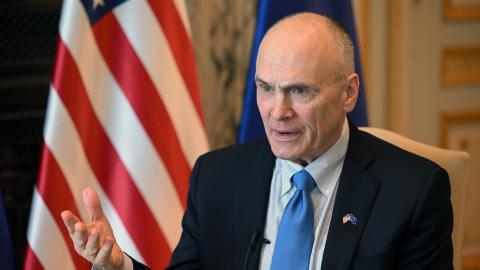







NATO, but not necessarily strategic autonomy understood as emancipation from the United States. That is how the director of the Hudson Institute reads the international moment, explaining his analysis clearly from an American perspective. In his view, Europe has spent decades accumulating "more talk and more white papers than actual action", and the challenge is no longer just to spend more, but to turn that spending into effective military capabilities.
In this conversation in Lisbon, during the latest Foro La Toja gathering, Rough walks through the main axes of U.S. foreign policy: China, Ukraine, Iran, the Mediterranean, Spain and Europe’s difficulty in acting as a unified actor. Rough argues that "Strategic autonomy is still greeted with a fair amount of scepticism", defends a more pragmatic reading of the international order and warns that, in Ukraine, "the most likely outcome is simply more war".
Do you see a serious appetite in the U.S. policy community for a stronger European pillar within NATO, or is there still underlying scepticism about European strategic autonomy?
I think it matters how we define our terms. Strategic autonomy is still greeted with a fair amount of scepticism, but a European pillar within NATO is broadly seen as a positive development and would be welcomed.
We have been talking about strategic autonomy for decades. From initiatives like PESCO, which had very little funding attached to it, to more recent efforts to pursue greater autonomy, there has been more talk and more white papers than actual action. In some areas, capabilities are still so incipient that it probably makes sense for Europe to proceed gradually, relying on American support while building up its own defence industrial base.
There is a lot of debate right now about instruments such as the SAFE mechanism — whether EU defence spending should be transatlantic or more protectionist. But with so much funding coming online, the real debate in the next few years will be less about where the money is spent and more about how we ensure that these investments translate into real capabilities. A significant amount of money is being committed, and it often takes a long time for capabilities to materialise.
That is where I think the real tension in defence lies, more than in the debate about strategic autonomy.
Would you say that we are moving towards a more interest-based and less value-driven transatlantic partnership?
I think the transatlantic partnership still has a values component, but it also has an economic argument and a geopolitical rationale.
I do not believe that we should frame the world as democracies versus autocracies. If we are going to succeed in this competition against what I see as a real threat to the international system — the Leninists in Beijing — we need to win over non-democracies such as Saudi Arabia, Azerbaijan and Vietnam. These are key swing states in the competition with China.
If we impose on them the same human rights standards we apply to ourselves, we at minimum limit their cooperative potential and at maximum risk pushing them into the Chinese camp. And if we lose that competition because we alienate these swing states, we could be entering a new dark age that will make those critiques of individual nations seem foolish and quaint in retrospect.
To me, the relevant category is whether countries are willing to operate within the international order that the United States has built since the end of the Second World War or not. Saudi Arabia broadly says yes, Iran says no, Vietnam essentially says yes, China and Russia clearly say no, and our European allies say yes. I think that is the threshold we should set.
Looking beyond the Trump presidency, do you expect the current trajectory in U.S. defence and partnership policy to persist, regardless of who is in power?
If the Democrats take power, they will be less inclined to support the kind of large defence budgets that President Trump has proposed. They are generally less focused on hard power capabilities than Republicans. That said, they do not ignore defence altogether — it would be unfair to suggest that — but it is clearly less central to their approach.
To give a simple example, in U.S. budget debates, whenever Republicans call for an additional dollar in defence spending, Democrats tend to argue that an equivalent amount should be spent on domestic priorities. That captures the underlying tension: Republicans prioritise defence, Democrats prioritise domestic spending.
Where Democrats differ more clearly is in the tone of the relationship. They will focus on the language and the overall atmosphere of transatlantic relations. They will try to repair ties with Europe, adopting a more reassuring and conciliatory approach. Republicans tend to worry that, while this may appear effective on the surface, it could ultimately backfire by encouraging complacency in Europe.
In other words, it may lead European countries to conclude that increasing defence spending is not necessary — that maintaining current levels is sufficient, especially when there are competing domestic pressures, such as pensions. That was one of my main criticisms of President Biden: he gave the impression that the problems in the transatlantic relationship were solely a product of Donald Trump, and I do not think that is an accurate assessment.
To what extent has Trumpism structurally changed U.S. foreign policy thinking?
President Trump should be credited for the enduring shift in China policy that began in 2017. We will see how competitive he intends to be with China, starting with his planned trip to Xi Jinping’s Beijing in May, if it goes ahead. But more broadly, the idea that integrating China into the World Trade Organization and other Western institutions would shape its behaviour has ultimately strengthened what is now our principal adversary.
That approach is generally seen as having failed. The expectation was that greater prosperity would lead to political liberalisation — that China would become wealthier, more democratic and more aligned with the West. That has simply not been the outcome. So I think that shift in thinking is here to stay.
Secondly, it is not that Democrats will conduct trade policy in exactly the same way as President Trump, but they are already more inclined towards economic intervention. They are closer to social democrats than to free-market conservatives. As a result, Trump’s willingness to use tariffs and to manage trade, rather than promote free trade, is something Democrats may also adopt and develop further.
Part of this is driven by domestic politics. Trump has made significant gains among working-class and blue-collar voters, and Democrats are responding to that. So these two trends — a tougher stance on China and a more interventionist approach to international political economy — are likely to endure. And alongside that, there will continue to be talk with Europe to assume a greater share of the burden.
How do you see internal polarisation in the U.S. affecting its external commitments, particularly towards Europe?
We are sitting here in Lisbon just above ruins from the Roman Empire, which hopefully isn’t a metaphor for America’s fate! That said, I am not sure that internal polarisation — and at times dysfunction — is as relevant for foreign policy as one might think.
Americans tend to vote on domestic issues unless there is a major international crisis. On foreign affairs, they do have instincts, and polling reflects that. In general, they view Europe positively and recognise Vladimir Putin as an aggressive and problematic actor.
However, under the U.S. Constitution — particularly Article II — a great deal of authority in foreign policy rests with the president. Combined with the fact that the rest of the world is geographically distant, it really falls to the president to lead, define and shape public thinking on foreign policy. The political science literature is quite clear on this: leadership matters more in foreign affairs than in areas such as tax policy, where public opinion is more firmly established.
The American public has a broadly positive and healthy disposition towards Europe. At the same time, some of the criticisms voiced by President Trump have gained traction, largely because they come from the Oval Office.
There is increasing discussion about a possible U.S.-Morocco-Israel alignment in the Western Mediterranean. How might this affect Spain’s strategic position?
I do not know this issue in detail. That said, as a general observation, the administration’s relations with Israel and Morocco are extremely strong, while its relations with Madrid are relatively weak. To the extent that this triangular dynamic exists — which I cannot fully assess — it would place Spain at a disadvantage.
I do not think Portugal, or the current government there, factors significantly into this equation.
Southern Europe does not seem to be a primary focus for U.S. policy at the moment. Could that change?
The issue that most animates President Trump in relation to the Mediterranean and southern Europe is migration. That is a constant point of focus for him and remains closely tied to his understanding of national security, as well as to the concerns of Mediterranean countries.
However, when it comes to hard security issues, the primary concern for the Pentagon is Russia — particularly the threat it poses to Europe’s eastern and northern flanks, as well as the southeastern flank. That weighs more heavily than migration from Africa.
There may be one partial exception, which is the recent increase in activity around Libya over the past six months or so. But beyond that, there is limited additional focus.
In your view, when it comes to Iran, and considering recent developments, is U.S. policy primarily driven from Washington, or is it significantly influenced by regional allies such as Israel?
It is true that Gulf Arab countries and Israel — especially Israel — have access to the President and have made their case, and he has listened to them.
But ultimately, this has been a U.S.-driven strategy on Iran, led by Donald Trump. At the point when the President decides — depending on the phase of the conflict — that operations should be halted or adjusted or increased, and communicates that to Prime Minister Netanyahu, the response from Jerusalem will be to agree, even if privately they may have reservations. Israel is operating within the framework of an American-led campaign and will not openly diverge from U.S. direction.
So while it may have been an Israeli preference or objective for the United States to take this course of action, President Trump was persuaded rather than simply pulled along. He is now taking decisions based on input from a range of actors, both domestically and internationally. The Israelis will continue to present their arguments, but in the end they will have to work within a framework developed in Washington.
How will the upcoming midterm elections affect U.S. foreign policy?
I do not think the midterms will matter that much because foreign policy and national security are ultimately the domain of the President.
If Democrats take the House of Representatives — which most analysts expect, given how narrow the current Republican majority is — that could actually lead President Trump to become more active on the world stage. We have seen similar patterns elsewhere. Emmanuel Macron, for example, lacks a parliamentary majority and has leaned more heavily into foreign policy. One could even argue that Pedro Sánchez’s positioning internationally is partly shaped by domestic political pressures.
In that scenario, Trump might conclude that major domestic reforms are no longer feasible and instead focus more on external affairs. That is entirely plausible.
You mentioned Pedro Sánchez, who has been quite vocal against the 5% benchmark. Do you think this has a real impact on President Trump’s policy?
I am sometimes struck by the regular questions about American interference in European politics, when, for example, Pedro Sánchez has just hosted the Socialist International — a coalition of international left-wing actors. These critiques cannot just cut one direction.
That comparison comes to mind because some of the criticisms Sánchez directs at Trump could arguably be applied in reverse. There is, to some extent, a degree of projection there.
In terms of impact, I do think Spain’s active and public opposition to Operation Epic Fury will have consequences. There could be a review of the U.S. force posture, and installations such as Naval Station Rota could be part of that discussion. But beyond that, there are also more subtle measures that could affect Spain and its diplomats.
For instance, within NATO, the United States could push for changes to Spain’s role in certain formats — potentially limiting its influence, even informally. There are also softer instruments: speaking order in key meetings, access, levels of engagement. These are the kinds of signals that matter within bodies like the North Atlantic Council or the Military Committee.
In other words, there are multiple ways in which the United States could signal its displeasure, including simply reducing the level of day-to-day cooperation.
That said, I should point out that there are legitimate and constructive ways to criticise the war. Governments can raise concerns privately with the U.S. administration and publicly with their own citizens, as long as this is done in a serious, measured and credible way.
The difficulty is that Iran’s strategy is, in part, to drive a wedge between Washington and its allies — particularly in Europe and the Gulf — in order to force an outcome on its own terms. In that context, rhetoric from Madrid that appears aligned with that dynamic risks reinforcing Iranian perceptions and could therefore have tangible consequences.
Is Europe perceived as a unified actor in the United States?
In my view, to project power globally you need three things: military power, economic power and a cohesive decision-making structure — in other words, an executive authority.
Europe has some military power, but not enough to act as an independent pole in global affairs. It certainly has economic power, so it meets that criterion. But when it comes to executive decision-making, it falls short.
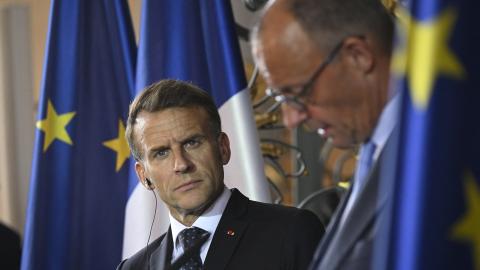
Ursula von der Leyen has authority as President of the Commission, but she is not really the political leader of Europe. If someone like Friedrich Merz were to assume that role, it would likely create tensions with figures such as Emmanuel Macron. And if Macron were to claim that position himself, others — particularly in Germany — would push back. Meanwhile, the United Kingdom still asserts its role as a nuclear power. And I haven’t even mentioned the states of eastern or southern Europe. So there is no clear leadership centre.
As a result, Europe can sometimes reach common positions, but only through complex and bureaucratic consensus-building processes. The outcome is frequently the lowest common denominator, and the pace can be a serious limitation.
That is why I am sceptical of the idea, discussed today, of middle powers forming a coherent bloc. Even Europe — which is geographically connected, historically intertwined and broadly aligned in political values — struggles to act in a unified way. It is hard to see how countries like Indonesia, South Africa, Brazil or Turkey, each with very different strategic interests, histories and geopolitical positions, could form a cohesive group.
Washington engages Europe on a case-by-case basis depending on where competencies lie. Where the European Union has clear authority, it is treated as a meaningful interlocutor. For example, the Trade Commissioner — Maroš Šefčovič — has real influence because that power has been delegated to him, and U.S. counterparts engage accordingly.
By contrast, in areas such as foreign and defence policy, where authority is more diffuse, European representatives are often seen as less relevant. Access and engagement depend heavily on whether a given actor is perceived to have real decision-making power. It’s actually a rather pragmatic American approach.
We have seen this in practice. President Trump concluded a trade and investment agreement with Ursula von der Leyen because she was seen as the appropriate counterpart. It is similar to what happened during the eurozone crisis, when attention focused on Angela Merkel and Wolfgang Schäuble. But in a different context — for instance, when it came to military action in Syria against Assad — the U.S. looked to the United Kingdom and France.
Do you see any credible pathway towards a negotiated settlement in Ukraine? Or are we more inclined or locked into a frozen conflict? Is there a risk that this war fatigue in Europe and in other Western countries could reshape the strategic calculus?
We are unlikely to see an agreement in the short term because both Russia and Ukraine believe they have a viable path forward. As long as that is the case, neither side is inclined to make meaningful concessions.
The Russians believe they can grind down the Ukrainian armed forces. They see divisions, or at least strains, between Washington and European capitals, and they also note that U.S. resources — such as Patriot interceptors — are being drawn down in other theatres, which could limit support to Ukraine. From their perspective, this creates an opportunity to make gains on the battlefield, potentially isolate Ukraine and ultimately win the war. That is their theory of victory.
The Ukrainians, however, have their own path forward. They are in a very different position from a year ago, let alone two years ago, in their defence industrial capacity. The European defence industrial base is also improving slowly but steadily. Meanwhile, the U.S. continues to provide essential intelligence support.
As a result, Ukrainian forces have been able to inflict significant losses on Russia — tens of thousands of casualties per month — while also targeting key economic infrastructure, such as refineries and export terminals. This puts pressure on the Russian economy and forces the Kremlin into difficult choices, including rising costs to sustain recruitment and the risk of broader economic strain.
From the Ukrainian perspective, this creates a pathway to weaken Russia over time and get to a resolution. These duelling theories of victory manifest themselves in a negotiating stalemate: Ukraine is not going to voluntarily concede Donetsk or Luhansk, while Russia continues to see control of the Donbas as a minimum objective.
Rather than a frozen conflict, we are likely to see continued active combat operations, possibly including a new Russian offensive in the coming months.
Only if, over the next six to twelve months, one side concludes that it cannot achieve its strategic objectives are the conditions likely to emerge for a negotiated settlement.
President Trump has also mentioned the 4th of July — the 250th anniversary celebrations in the United States — as a potential deadline by which he would like to see the war brought to an end. One possibility is that he could attempt to increase pressure on President Zelensky in pursuit of that objective.
However, Ukraine continues to receive substantial European financing and retains significant capabilities of its own. For that reason, I think the most likely outcome is simply more war.
Thank you very much.