






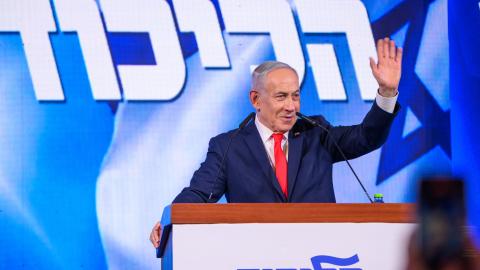
Benjamin Netanyahu towers over Israeli politics like a colossus. Two factors, more than any others, determine how Israelis vote: their attitude toward religion and their attitude toward the prime minister. At the polls, Israelis choose among a bewildering array of parties, but nearly every one of them falls clearly into one of two blocs: pro-Netanyahu or anti-Netanyahu.
The Hamas attacks on October 7, 2023, gave the anti-Netanyahu bloc its best chance yet to topple the king, because they exposed grave flaws in Israeli security and defense policy—long considered Netanyahu’s strongest suit. Last week’s election was the first since that fateful day, and therefore the first real opportunity for voters to hold the leadership accountable. The anti-Netanyahu forces took their best shot—and missed, with Netanyahu’s coalition winning a plurality of seats in Israel’s 120-seat parliament, the Knesset.
They failed for two reasons. First, the leader of the anti-Netanyahu bloc is lackluster. To call Gadi Eisenkot a creation of consultants and public-relations gurus would be an exaggeration, but his very real accomplishments mattered less than the ways they could be weaponized against Netanyahu. Eisenkot spent 41 years in the Israel Defense Forces, rising to chief of staff before retiring in 2019. He also has a wrenching personal story: He lost a son and two nephews in the war in Gaza. He presented himself to the electorate as a security professional untainted by October 7 who had nonetheless paid an unbearable personal price for the leadership’s failures. Even the name of his new party, Yashar—“straight” or “upright”—drew a pointed contrast with a prime minister he and his supporters portray as crooked.
Eisenkot’s biography checked the boxes the moment seemed to require, but it never answered the more important question: Why this particular security professional, and why now? Eisenkot entered politics in 2022, after the mandatory cooling-off period for retired generals, and has left almost no mark since. In his first election, he ran third on the list in Benny Gantz’s National Unity Party, which won 12 seats in the Knesset. It sat in the opposition coalition, then joined the emergency government formed after October 7, only to walk out a few months later.
Thus, Eisenkot’s only stint in civilian office lasted about eight months. He has never run a ministry, never led a party into government, and never shown he can assemble a coalition and hold it together. His record as a soldier is solid. The political case the consultants built on it is mushy.
If Eisenkot’s political career gave him proximity to power without authority, the same pattern defines nearly the entire elite of the opposition bloc. A striking number of its leaders were once Netanyahu’s allies or protégés—Avigdor Liberman, Naftali Bennett, and others who gravitated into Netanyahu’s orbit only to break with him. Netanyahu has long shown a genius for drawing ambitious figures close while denying them independent power or a clear path to succession. The result is a large cohort of party leaders who feel that Netanyahu squeezed them like lemons and tossed them aside. They burn with the special resentment of those kept forever at the threshold.
Their desire to topple Netanyahu is real and personal. What voters struggle to discern is the affirmative case for why they, rather than he, should hold the authority they have so long been denied.
This brings us to the second reason the opposition failed: Its case that Netanyahu bore unique responsibility for October 7 was weak. The anti-Netanyahu parties and press mounted a sustained campaign to pin that day squarely on the prime minister. Its centerpiece was a Haaretz investigation, immediately amplified by The New York Times, The New Yorker, and other prestige outlets, claiming that United Arab Emirates president Mohamed bin Zayed al-Nahyan had personally warned Netanyahu roughly 10 days beforehand that Yahya Sinwar was planning a Hamas “earthquake”—and that Netanyahu neither shared the warning with his security chiefs nor acted on it.
The account relied on a Palestinian source, whom Netanyahu publicly identified as Mohammed Dahlan, the former Fatah security chief in Gaza, whose close ties to the Emiratis are well known. Netanyahu denied the story outright, said no such conversation ever occurred, and announced a libel suit. So, while the story gave the opposition the attack line it needed, it rested on unreliable sourcing, not on a documented intelligence failure that voters had real reason to pin on the prime minister alone. It was the campaign’s best shot, and it missed. No one who didn’t already hate Netanyahu took it seriously.
Israelis did not need Haaretz to tell them who failed on October 7. They already know the answer: everyone. The failure was systemic. It implicated the IDF high command, which misread Hamas’s intentions and left the Gaza border thinly manned on a holiday weekend. It implicated the heads of military intelligence and Shin Bet, who dismissed the warning signs in the hours before the attack. And it implicated the government that presided over them all.
Netanyahu, the dominant figure in Israeli politics for two decades, certainly bears his share of the blame. But the failure runs far deeper than any one man, and it reaches Eisenkot himself. As IDF chief of staff from 2015 to 2019, he was a leading champion of the “small, smart army”: a force that traded mass for technology, cut ground units and reserves, and counted on intelligence, precision firepower, and a high-tech border barrier to hold threats at bay. October 7 exposed the flaw in that design. When Hamas breached the fence, there were too few soldiers on the ground to stop the slaughter. The candidate sold as untainted by October 7 helped build the army that failed that day.
Netanyahu benefited in the election not only because the October 7 failure was overseen by senior officers Eisenkot personally advanced during his tenure as chief of staff but because he is the key figure who then changed the approach. After the attack, he abandoned the reliance on technological barriers and thin ground forces and adopted a new doctrine of forward defense: establishing security zones on the enemy’s side of the border so that Israel no longer tries to hold the line from its own territory alone. While implicated in the systemic failure of October 7 along with everyone else, Netanyahu receives some credit for the reversal—not to mention for conducting the war that took the fight from Gaza to its source in Iran.
On October 27, Israeli voters handed down a Solomonic verdict: Neither camp gets the whole baby. The result is a deadlock in which no one can form a stable government. Netanyahu’s bloc holds 53 seats. Eisenkot’s opposition bloc holds 48. Arab parties hold a record 19. Neither side reaches the 61 needed for a governing majority in the Knesset. Under Israeli law, the process of trying—and failing—to form a government can drag into early 2027. If every deadline is exhausted, new elections will fall around late May.
President Trump has but two years to finish the jobs he started in the Middle East. How much of that time will be devoured due to Israeli domestic political gridlock? Trump has already endorsed Netanyahu and said he would “take a look” at helping form a unity government—meaning a 61-seat majority composed of Netanyahu’s bloc and some of his political opponents, with Netanyahu at the helm. But he must do more than look. The United States has a direct stake in a stable Israeli partner that can act on the issues that matter to America.
Primary among these is the war with Iran, which is just one front in America’s larger contest with a China-led axis that includes Russia and North Korea. The central American interest is to prevent these powers from dominating Eurasia. Iran’s missiles and proxies threaten the energy supplies and shipping lanes on which America’s Asian allies depend. Israel brings intelligence, technology, and sustained offensive power to the fight against this common enemy, and its willingness to bear the costs of combat reduces the demands on American forces. The more Washington concentrates its strength against China, the more it needs capable allies elsewhere. Israel plays an outsize role in that strategy.
America therefore needs an Israeli government capable of sustaining pressure on Iran, making durable security commitments, and helping bind other regional states into an order anchored in American power. Months of political paralysis give adversaries time to recover and regional partners reason to hedge. They leave Washington carrying more of the burden with less ability to shape the outcome. Israel’s capacity to govern is an American strategic imperative.
Consider, then, Eisenkot’s current plan to take power. His Yashar Party finished second, and his bloc trails Netanyahu’s by five seats. But under Israeli rules, a new government does not actually need 61 votes; it needs only more votes in favor of it than against. Which brings us to the coalition negotiation process.
After the official election results are published on Wednesday, President Isaac Herzog will begin consulting with party leaders. He will then decide which one gets the first chance to form a governing coalition. The Arab parties are expected to recommend Eisenkot. That could give him the first attempt, even though Eisenkot’s bloc commands fewer seats than Netanyahu’s.
Eisenkot campaigned on three commitments: He would not form a government dependent on Arab parties; he would not cut deals with the ultra-Orthodox (Haredi) parties to preserve their sweeping exemptions from mandatory military service; and he would not cooperate with Netanyahu. The plans his team are now examining require him to abandon the first two to keep the third. In other words, they may sacrifice everything to remove Netanyahu.
The most concrete path is a minority government. According to Israeli media reports, figures in United Torah Judaism (UTJ), a Haredi party currently allied with Netanyahu, are considering allowing Eisenkot to take office by abstaining from the parliamentary vote, signaling its frustration with Netanyahu’s failure to secure blanket military draft exemptions for Haredi men. If all seven UTJ lawmakers abstained and the Arab parties also abstained, Eisenkot’s 48 seats would outnumber Netanyahu’s remaining 46. He could therefore become prime minister without commanding a majority of the Knesset. But taking office would be easier than governing: His government would depend on the continued acquiescence of UTJ and the Arab parties to pass legislation and a budget. Failure to pass a budget by the legal deadline would dissolve the Knesset automatically and send Israel back to the polls.
This arrangement is deeply controversial inside Eisenkot’s own bloc. Avigdor Liberman, whose Yisrael Beiteinu Party won seven seats, is reportedly throwing up a roadblock. He has repeatedly ruled out relying on either Arab or ultra-Orthodox parties. Even if he changes course and goes along with the minority government plan, he will continue to chafe at the arrangement, as will some members of Eisenkot’s own party.
Getting the government sworn in would be the easy part. UTJ’s principal concern is preserving draft exemptions for men studying in religious seminaries, yet Eisenkot has promised to force conscription on the ultra-Orthodox; buying UTJ’s ongoing cooperation would therefore require continuous concessions on the draft that could split his own camp. Relying on Arab abstentions for crucial votes would likewise create exactly the dependence he and his allies promised voters they would avoid. To honor his vow never to serve with Netanyahu, he would place much of his program at the mercy of parties that oppose it.
All of Eisenkot’s conceivable paths to the premiership lead him into unmanageable contradictions that will bedevil him while in office. Outside supporters could withhold their votes on any bill or budget to extract further concessions. Even if Eisenkot kept the title of prime minister, he might lose the power to carry out his program. His personal weakness and the inherent instability of such a government would endanger national security. The next Israeli government will face hard decisions on what to do in Iran, Gaza, and Syria—the most controversial choices in Israeli politics. A prime minister dependent on parties outside his cabinet that oppose hard-line approaches to those regions would be incapable of taking them. Every major decision would hand his outside supporters the leverage to demand changes or threaten his survival.
Israeli politics has long held that decisions of war and peace must rest on a Zionist majority—the support of parties committed to Israel as a Jewish state. In 1995, Yitzhak Rabin won approval for the second agreement in the Oslo Accords—which would expand Palestinian self-rule—by 61 to 59, with the decisive margin supplied by Arab lawmakers. The right challenged the agreement’s legitimacy for lacking a “Jewish majority,” and the charge shadowed it from then on. A government making consequential decisions on war or territory while dependent on Arab abstentions and ultra-Orthodox support would face the same charge, and much of the country would regard those decisions as illegitimate. Adversaries would work to widen the fissures. Regional partners would question whether any commitment this government made would survive its next coalition crisis.
The voters left their leaders with three options. The first is prolonged paralysis: months of failed negotiations under a caretaker government, followed by another election whose outcome is just as uncertain. The second is a ridiculously narrow minority government, led by a politician who has never held senior office and dependent for its survival on parties that oppose core parts of his program.
The third, of course, is a national unity government. Together, the two major blocs command a majority with room to spare. Making that majority governable would require an agreed program on security and the budget, and possibly a temporary compromise on Haredi conscription. Eisenkot and his allies would have to drop their veto on serving with Netanyahu, whose survival at the polls gives him the strongest claim to lead.
Only the third option provides the foundation America needs. Trump, the dealmaker, should broker the bargain. He should bring the leaders together, make plain America’s interest in a unity government, and put a common security and diplomatic agenda before them. His sponsorship would give each side a defensible reason to retreat from its campaign promises: Israel’s indispensable ally has asked them to share responsibility in a time of war. The leaders would negotiate the division of offices and authority. Trump would press for a government able to deliver what the alliance requires.
Israeli voters denied both camps the majority they sought. Trump should side with the voters and demand that Israel’s leaders put the country’s security first and find a way to govern together. Eisenkot must accept that removing Netanyahu cannot be the precondition for every other national objective. Netanyahu must accept that keeping his office requires sharing power. Solomon never meant to cut the baby in half. His threat was a test, and the true mother revealed herself by refusing to let the child be destroyed. Israel’s voters have set the same test. Whoever would rather see the country paralyzed than share it fails. The king has survived. He now has a country to govern, and his rivals have a duty to help him govern it.