





















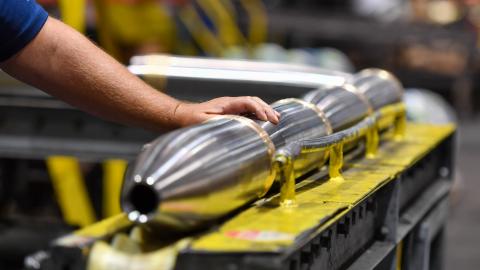
First Breakfast asked several experts, “If you had free reign to fix America’s munitions bottleneck, what would you propose?” Below are responses from Mike Gallagher and Nadia Schadlow.
Mike Gallagher: Stop Lighting Money on Fire
The Pentagon is rightly rushing to spend every single one of its Congressionally appropriated dollars before the end of the fiscal year. If it succeeds, it will avoid a self-inflicted problem that has had a disastrous impact on our deterrent posture.
In the last decade, the Pentagon has lost more than $125 billion because of an outdated budgeting process that requires any unspent, Congressionally appropriated dollars to be returned to the Treasury. In other words, billions of budgeted dollars have been allowed to simply vanish instead of being used to replenish munitions stockpiles, procure new technology, or invest into our defense industrial base.
The FIRES Act I introduced as a member of Congress fixes that.
Rather than let this appropriated but unspent money disappear, the FIRES Act puts these dollars into a special fund that the Secretary of War could use to fund Congressionally mandated priorities. This could go a long way toward supporting priorities that may prove decisive in a Pacific conflict. The first of these: Deputy Secretary Feinberg’s efforts to ramp munitions production via multi-year purchases. The second: scaling the manufacturing and deployment of autonomous capabilities that can turn China’s coastal waters into a hellscape. The third: funding advanced energetics such as CL-20 in existing systems to extend both their range and destructive power.
The Pentagon has rightly identified munitions production and autonomy as key to preventing or winning war in the Pacific. But funding it sufficiently and in time remains a challenge. The FIRES Act gives the Secretary of War the flexibility and authority needed to fund enduring priorities at the speed of relevance, making us safer without budgeting another dime of taxpayer dollars.
Nadia Schadlow: It’s Not Easy, But It’s Not Rocket Science
In the category of “kind of simple” (recognizing that simple and the Pentagon are something of an oxymoron), there are some basic steps that could help avoid repeating past mistakes. Start by taking stock of recent efforts to support new entrants and expand capacity in the energetics space: What was funded? What actually got built? What new capacity came online? What worked, what didn’t, and why? This is not a “gotcha” exercise. It is a way to learn from recent investments and inform the next round.
For example, in 2024 the Department of Defense awarded $192.5 million to seven companies under the Defense Production Act to expand domestic production of 22 chemicals used in defense systems, including critical energetic precursors and other materials such as oxidizers and magnesium. What resulted? Which projects delivered the capacity they promised? Which did not? And why?