














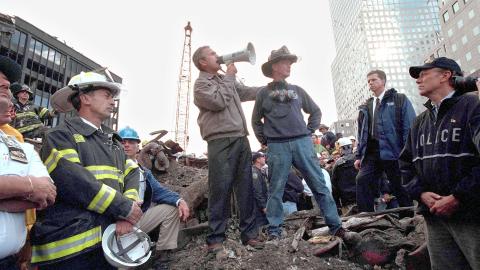
On September 20, 2001, President George W. Bush gave a major speech to Congress and the country in which he outlined the coming U.S. response to al-Qaeda’s 9/11 attack. He said, “Our war on terror begins with al-Qaeda, but it does not end there. It will not end until every terrorist group of global reach has been found, stopped, and defeated.” Thus began what would soon be known as the “Global War on Terror,” or GWOT, in its unlovely acronym.
Over the quarter century since, a parade of commentators, scholars, and politicians has marched through the media to offer overwhelmingly negative judgments on the GWOT. Here is former national security adviser Zbigniew Brzezinski in 2007: “The damage these three words [“war on terror”] have done—a classic self-inflicted wound—is infinitely greater than any wild dreams entertained by the fanatical perpetrators of the 9/11 attacks.” CNN’s Fareed Zakaria in 2008: “Bush’s basic conception of a ‘global War on Terror’… has been poorly thought-through, badly implemented, and has produced many unintended costs that will linger for years if not decades.” In the journal International Security in 2012, John Mueller and Mark G. Stewart pronounced the GWOT “an ill-conceived and remarkably unreflective effort.” Boston University’s hawk-turned-isolationist Andrew Bacevich, who lost a son in Iraq, in 2021 repeated his long-standing conclusion: “The Global War on Terrorism was a needless and costly distraction.” From the anti-interventionist left, here was journalist Spencer Ackerman in 2021: “We’ve learned from the war on terror, that security solutions to political problems are doomed to failure, they’re doomed to making those political problems worse.” In his recent book The Return of the Great Powers, Cambridge University’s Brendan Simms decries “the huge cost and abysmal failure of the ‘War on Terror.’”
These blanket judgments are wrong.
They are heavily colored by the American experience in Iraq and Afghanistan, almost as if “GWOT” was just another name for those wars. In fact, the record of the failures in Iraq and Afghanistan is, in its own right, far more complicated. But more to the point, the “war on terror” was indeed “global,” not just focused on these two countries. And it was a war not only in the kinetic sense but also insofar as it marshaled a full spectrum of resources of the United States and allied governments in identifying and targeting malevolent organizations and their support structures abroad before they could effectively target American and allied interests. And this war, the real Global War on Terror in its totality, has been a remarkable success, notwithstanding Iraq and Afghanistan.
What Didn’t Happen
Let’s begin with the obvious. In the fall of 2001—that is, in real time after the 9/11 attacks but before the opportunity for retrospective judgment arrived—the question of what horror might be coming next for the United States took on an urgency unseen since the aftermath of the Japanese attack on Pearl Harbor 60 years before. Osama bin Laden’s spectacular plot succeeded not only in destroying the twin towers of the World Trade Center and gashing the Pentagon but also in its more general and visceral objective: It terrorized.
What would its perpetrators do next? This was a question whose answer was unknown to government officials and individual Americans alike. One could and did speculate. Would bombs be going off downtown in New York, Washington, and other big cities? What about a dirty bomb producing a cloud of radioactive debris? What about an actual “loose nuke”? Would platoons of would-be martyrs undertake massive urban assaults? Would chemical weapons be unleashed on the subway, like in the 1995 sarin attack in Tokyo? Powdered anthrax of unknown origin was already taking lives through the mails; was a massive aerosolized attack next? Were water reservoirs and the food supply about to be poisoned? Would more airplanes be turned into fuel-air bombs?
The answer to all these worries turned out to be no—but that was not for want of terrorist ambition or effort. Following 9/11, foreign-trained or inspired jihadist terrorists attempted numerous suicide or sabotage attacks. Individuals included would-be “shoe bomber” Richard Reid, dirty-bomb plotter José Padilla (who trained with al-Qaeda), and would-be “underwear bomber” Umar Farouk Abdulmutallab. A number of plots targeted infrastructure, including the Brooklyn Bridge, fuel tanks at JFK airport, and a rush-hour backpack-bomb attack on the New York City subway. Financial buildings were another target. A group was planning an attack on Fort Dix, New Jersey.
In some cases, the attacks came close to deadly success but were undone by the incompetence of the perpetrators—a bomb that did not detonate properly in Times Square, as well as the shoe- and underwear-bomb failures. Some did come off to lethal effect, such as the bombing of the Boston Marathon in 2013, which killed three and injured hundreds; an attack at a government building in San Bernardino in 2015, in which two shooters killed 14; and the Pulse nightclub attack in Florida in 2016, in which a gunman killed 49. Yet none of these successful attacks was remotely close in scale to 9/11, and the perpetrators came not from abroad but were self-radicalized jihadists on American soil of Chechen, Pakistani, and Afghan origin.
According to a regularly updated New America Foundation database, only one lethal attack in the United States took place under the direction of a foreign jihadist organization: the 2019 shooting at Pensacola Naval Air Station, which killed three. In New America’s tally, the total number of American lives lost to jihadist terror attacks in the United States since 9/11 stands just over 120—barely 4 percent of the direct 9/11 death toll (excluding the 19 hijackers) of 2,977.
By the broadest and most important indicator, then, one must ask: If this is failure, what would success have looked like?
Meanwhile, numerous other jihadist terrorist attacks were foiled by American authorities, often in collaboration with allied governments. Hundreds of individuals are serving prison terms in relation to these plots. A 2015 RAND working paper analyzed 150 successful and foiled terrorist plots from 1995 through 2012. It found that plots were more likely to be thwarted in the years after 9/11 than in the six years before.
Why? Many of the details we will never know. These operations were and are the work of counterterrorism and counterintelligence efforts undertaken internationally, domestically, and locally (the NYPD Intelligence Bureau is the most notable example of the latter). The FBI’s Joint Terrorism Task Forces date back to the establishment of the first such regional office, in New York in 1980. After 9/11, the FBI substantially expanded the program, which does its own work but also liaises with other federal, state, and local law enforcement. There are now about 200 JTTFs, including at least one in each of the bureau’s 56 field offices. Protecting the United States from terrorist attack is the bureau’s stated “number one priority.”
Hardening the Targets
Substantial resources have also gone into “hardening” potential terrorist targets. The most conspicuous is the airport screening of the Transportation Security Administration, created in legislation Congress enacted in November 2001. The Aviation and Transportation Security Act federalized airport screening and began the process of requiring airlines to report all passenger and crew manifests, including biographical data such as sex and date of birth, to the government.
As the shock of 9/11 wore off over the years, the TSA came in for criticism for its randomized practice of selecting the occasional grandmother for additional screening procedures. Nevertheless, the “security theater” so roundly mocked seems to have been an effective deterrent to attempts to smuggle weapons onto planes. Well before 9/11, Americans had largely forgotten how easy that used to be during the hundreds of hijackings worldwide from the late 1960s through the 1970s.
Consider the case of the Federal Air Marshals program. The number of armed agents flying incognito increased from about 30 before 9/11 to an estimated 3,000 in the years since. There are hundreds of inbound international flights on American carriers daily, so the program places one to four marshals on routes (including domestic routes) that officials deem high-risk—or in response to specific intelligence on a threat.
There’s no public record of marshals foiling a plot in the air, though there have been reports of marshals intervening with unruly passengers, presumably including circumstances in which the reason underlying the unruliness was initially unknown. But does the program deter, as is its major purpose? Hard to say, but would Americans feel safer, and actually be safer, if the Department of Homeland Security announced it was halting the program to divert the resources elsewhere? Should we no longer require that cockpit doors be hardened against easy entry on grounds that only intoxicated or crazy passengers, not terrorists, have tried to bust through them since 9/11?
These questions are especially relevant because all initiatives intended to prevent or deter represent an opportunity cost—if you do one thing, you won’t have money left to do another. The resource allocation has been neither random nor frivolous but has rather been the product of risk analysis and deliberation by officials who take their responsibilities seriously. That they may err and that their errors may become clear only after a failure is hardly a warrant for the dismissal of the seriousness of their efforts.
The 9/11 attack also brought forth legislation intended to enhance federal authority to detect and disrupt terrorist plots. The first to be signed into law, within weeks of 9/11, was the Patriot Act, which (among other provisions) broadened wiretap rules to encompass multiple devices, thus making it easier to track plotters rather than specific phones. Government officials have credited the new rules as instrumental in foiling the New York subway attack. The Patriot Act also enabled domestic law enforcement and U.S. foreign intelligence agencies to share information; government officials early on identified the firewall separating foreign and domestic counterterrorism agency missions as a leading cause of the failure to detect the 9/11 plot.
Next was the Homeland Security Act of 2002, which created the new Cabinet department and revamped or consolidated numerous protective agencies there. The department would also become a clearinghouse for collecting relevant information from the FBI and intelligence agencies. Meanwhile, the “what went wrong” investigation of the estimable 9/11 Commission produced a slew of recommendations enacted in subsequent legislation. In 2004 came a major intelligence overhaul, which created the coordinating position of director of national intelligence as well as the National Counterterrorism Center. State drivers’ licenses had to meet new federal standards set forth in the REAL ID Act of 2005. Those IDs, which provide confident correspondence between the ticketed passenger and the person boarding a plane, were the last link in the government’s comprehensive knowledge of who is flying where (and it took two decades for states to implement the program fully). The process now has integrated facial-recognition systems, which have the added benefit of speeding up the security checks at airports. Welcome to what U.S. spy agencies refer to as “ubiquitous technical surveillance.” This is worrisome to many civil libertarians. But taken simply as a security measure, the ubiquity provides a new level of deterrence.
As Abe Greenwald noted, writing in these pages 15 years ago on the 10th anniversary of 9/11, a decade without a comparable attack on the homeland should have been thought a considerable achievement. At this writing, the record stands at a quarter century. There is no predicting what will come in the years or even days ahead, and if a failure on the scale of 9/11 is in our future, that will be very bad indeed—but it will not negate the 25 years of prevention Americans experienced through 2026.
Taking the Fight to the Terrorists
Beyond the homeland defensive measures of the kind discussed above, a key premise of the GWOT was that taking the fight to terrorist organizations where they were quartered would reduce their ability to target Americans at home and U.S. interests abroad. Again, let’s start with the basics: Even before 9/11, the United States had the ability to identify and strike its enemies, from genocidaires in former Yugoslavia to jihadists. But doing so wasn’t necessarily easy, and the willingness to do so was often lacking.
Following the World Trade Center bombing in 1993 and the revelation of its direct tie to a new type of Islamic radicalism, the FBI led an investigation that produced criminal charges against the conspirators and lengthy prison sentences, then an international manhunt for the ringleader of the attack, Ramzi Yousef. A policy debate erupted in Washington and elsewhere over whether the “law enforcement” model of response was adequate for terrorist attacks or whether the new danger required a new approach. In 1995, Pakistani authorities working with the FBI and CIA nabbed Yousef and transferred him to the United States, where he was tried and convicted—a temporary victory for the complacent “law enforcement” model.
The United States made no attempts to target jihadists abroad until the deadly al-Qaeda attacks on U.S. Embassies in Kenya and Tanzania in August 1998. Later that month, U.S. officials tried to target and kill the head of the organization, Osama bin Laden. A Tomahawk attack on al-Qaeda training camps in Afghanistan reportedly missed him by hours. The Clinton administration, the 9/11 Commission found, had had numerous other opportunities to attempt to kill bin Laden—all, however, “uncertain” and carrying “high risks.” The commission found “no credible evidence that the U.S. government had actionable intelligence that could have prevented the 9/11 attack.”
This politick but contentious bipartisan conclusion took President Bush off the hook for his first nine months in office—and President Clinton off the hook for seven years of muted response following the World Trade Center bombing. His refusal to focus on the threat lasted the entirety of his second term—at the start of which, and well ahead of the embassy bombings, the CIA was already well aware of the danger bin Laden posed. The story of Clinton 2 was one of multiple declined opportunities to take out bin Laden and one unsuccessful attempt. Of course, it is impossible to assert that capturing or killing bin Laden would have prevented 9/11, but the commission’s bland assertion that no “actionable intelligence” the U.S. government had “could have prevented” it is hypothetical hindsight speculation that minimizes the undeniable ambivalence of the Clinton administration about how far to go to do it.
Here’s another hypothetical: If we had had the drone-strike technology of today at the time of bin Laden’s emergence, especially after the embassy attacks, but before 9/11, would Clinton have tried harder? I think the answer is no, because seriously going after jihadist terrorists abroad required the paradigm shift that 9/11 produced.
That shift produced the Global War on Terror as offense. Its charter was the Authorization to Use Military Force, which Congress passed three days after 9/11 and Bush signed into law four days later. It gave the president authority “to use all necessary and appropriate force against those nations, organizations, or persons he determines planned, authorized, committed, or aided” the 9/11 attack “or harbored such organizations or persons.” The law included no expiration for this authority, and every president since has relied on it. The executive branch has invoked it for air strikes and military operations against jihadists in Afghanistan, Djibouti, Iraq, Libya, Pakistan, Somalia, Syria, and Yemen, as well as in “support” of counterterrorism efforts in partner countries from the Middle East to Africa and the Philippines.
Its first major use was in the U.S. military and CIA paramilitary operation toppling the Taliban government in Afghanistan. In his September 20, 2001, speech to Congress, Bush delivered an ultimatum to the radical Islamist Afghanistan rulers: Shut down and deliver al-Qaeda or “share their fate.” When the Taliban refused, they were effectively acknowledging their role in the attacks by having harbored and continuing to harbor the 9/11 plotters. The U.S. campaign swiftly toppled the government, dispersing the Taliban and al-Qaeda to remote regions of the country and over the border into largely lawless northwest Pakistan.
Our military’s ability to carry out such a mission was little known. The supremacy of U.S. military power was well understood, especially after we demonstrated in 1999 that we could halt a genocide in Kosovo by the judicious application of air power. Nevertheless, the speedy collapse of the Taliban came as a revelation to many.
The skill set already available in time for Afghanistan in 2001 would continue to develop over the succeeding years of the War on Terror. The visible culminating points to date—and there is no indication they represent peak achievable U.S. capability—were the destruction of the Fordow nuclear site in Iran in 2025, the raid on Venezuela nabbing its ruler, Nicolás Maduro, and the utter military dominance over Iran in the 2026 war (an intervention whose geopolitical consequences have still to be reckoned, of course). The U.S. military is very good at what it does, and a significant reason is the experience gained fighting the Global War on Terror.
What We’re Good At
The two central means of striking jihadists abroad were (and remain) drone or air strikes and raids by Special Operations forces. Like the FBI’s terrorism task forces, the military’s Joint Special Operations Command (JSOC) predated 9/11 but got a tremendous boost in its aftermath. The Iraq War was its crucible. During the war’s worst phase, 2004–2006, JSOC was under the command of General Stanley McChrystal. He realized that its highly capable operators nevertheless lacked the skills they needed to defeat the gathering insurgency of al-Qaeda in Iraq (AQI). He embarked JSOC on a crash program of changing its ways to meet the challenge. It successfully did so alongside President Bush’s “surge” of troops to Iraq in 2007–2008 and the “Anbar awakening,” in which Sunni sheikhs switched their sympathies from the fanatical AQI insurrectionists to the United States. The Iraq experience—the turnaround that actually won the war for the United States but has never been acknowledged as such—produced sufficient stability by 2009 to allow President Barack Obama to make good on his opposition to the war from the outset by ending the U.S. military presence there in 2011.
Unfortunately, Obama proved wildly off when it came to the emerging successor to AQI, the Islamic State. A civil war that blew up in Syria in 2011 proved a magnet for jihadist foreign fighters against the Assad regime, and many consolidated their loyalties under the Islamic State’s founder, Abu Bakr al-Baghdadi. As late as January 2014, Obama pooh-poohed the Islamic State as a “JV” squad compared with bin Laden’s al-Qaeda—even as its all-black flags were rising over considerable swaths of territory in Syria and Iraq, including the strategic city of Mosul, which fell less than six months after Obama’s glib comment. The atrocities of the newly proclaimed caliphate were boundless, from beheadings and sex slavery to genocide against the Yazidi people of Iraq.
The necessity of destroying the Islamic State was obvious. But the challenge was greater due to Obama’s unnecessary withdrawal from Iraq and then his reluctance to provide adequate resources to make good on his new pledge to “degrade and destroy” the caliphate.
Painfully slowly, U.S. Special Operations deployments increased, this time to lead allied Iraqi Army and Kurdish forces in pushing the Islamic State back. This culminated in urban combat to retake Mosul house by house in 2017. This was the U.S. military’s “by, with, and through” model, first advanced in the 1990s, in action. We fought an enemy in partnership with local forces, with U.S. Special Operations fighters on the ground effectively running the show and directing air power in support. The approach became paradigmatic for ground operations in the Global War on Terror. The idea was that American boots on the ground in large numbers would be unnecessary with properly trained and led local forces. The eventual victory over the Islamic State was the product primarily of the ingenuity and efficacy of U.S. Special Operations forces implementing the model.
Afghanistan was likewise a proving ground. The role of JSOC and CIA paramilitary operators evolved over two decades from initial successes on horseback directing precision air strikes in October 2001 to a key role assisting the Afghan army in keeping the regrouped Taliban at bay. JSOC developed a specialty of finding and killing or capturing “high-value targets”—al-Qaeda and Taliban leaders. Special Operations raids in 2008, for example, hit 550 targets, killing about 1,000. To his credit, Obama saw great value in JSOC capabilities and leaned on them even more heavily than Bush had. Al-Baghdadi met his end in a Trump-era raid in Syria in 2019. He detonated a suicide bomb vest, taking out as well two children who were with him.
President Trump, in his first term, wanted out of Afghanistan but got talked out of it. Unfortunately, President Biden could not be. His rigid timeline produced the appalling, unnecessary, and lethal spectacle of the chaotic withdrawal of U.S. forces in August 2021. Note that in both Afghanistan and Iraq, the failures to stem the revival of terrorist satrapies were the product not of military inefficacy but of political decisions made by the commander in chief, the U.S. president. And the military and political successes the United States achieved in the past quarter century required brave U.S. leadership under extreme pressure, which the United States got from Bush during the Iraq surge and from Obama after his belated recognition of the Islamic State threat.
The Philippines, by contrast with Afghanistan, provides an example of efficacious military operations that ended well. Starting in the 1990s, several Islamist separatist groups conducted a bubbling insurgency in the south Philippines, replete with kidnappings, bombings, and beheadings. The Joint Special Operations Task Force-
Philippines deployed 500–600 personnel from 2002 to 2017. CIA paramilitary officers joined as well. The counterinsurgency efforts of Filipino forces aided by Americans—“by, with, and through”—culminated in 2017 with a five-month battle in Marawi, which wiped out the jihadists but for local remnants.
One must not omit mention of the greatest Special Operations raid of all time, orchestrated in close collaboration with the CIA. In May 2011, Navy SEAL Team Six entered a walled compound in Abbottabad, Pakistan and killed Osama bin Laden. This raid, like many others, also yielded a substantial cache of intelligence, including letters lamenting the decline of al-Qaeda in recent years—as well as bin Laden’s personal collection of porn videos, which in turn prompted the greatest New York Post front-page headline of all time: OSAMA BIN WANKIN’.
In some cases, the potential for collecting intelligence stemming from elimination of a high-value target through a raid justifies the greater risk of a JSOC operation. In others, taking an enemy off the board is sufficient reward in itself to allow for a drone or air strike. A 2006 air strike called for by Special Operations forces took out Abu Musab al-Zarqawi, the head of al-Qaeda in Iraq. Qasem Soleimani, the head of Quds Force, the branch of Iran’s Islamic Revolutionary Guards Corps working outside the country, met his end in a 2020 drone strike in Iraq.
Targeted drone and air strikes numbered in the multiple thousands in Afghanistan and in the hundreds in Pakistan, Yemen, and Somalia. Although he would claim credit for reducing U.S. reliance on targeted killings by drone in 2013, Obama in his first term took the number of strikes to its peak, in 2010. During his time in office, the United States killed or captured 45 jihadist leaders from al-Qaeda, the Islamic State, and Al Shabab in East Africa. This seems to be an indication of the indispensability of drones and targeted killings to presidents in the overall scheme of protecting the country.
The United States has lost about 660 Special Operations personnel fighting the Global War on Terror. More than half died in Afghanistan, with Iraq accounting for about 1 in 5. Other theaters of the GWOT claimed a total of about 90. The figure is just under 10 percent of the total U.S. service members killed over the past quarter century, including in Iraq and Afghanistan. Add another 140 or so CIA paramilitary fatalities, about whom the public record is understandably much thinner.
Was this success? In Afghanistan, it was—until Biden’s catastrophic bugout, which threw success away. Afghanistan was hardly easy duty, but the total number of American combat deaths there from 2020 until the chaotic withdrawal itself, during which 13 service members lost their lives in a suicide bomb attack, was four. The number was fewer than 20 in each of 2017, 2018, and 2019. If this were truly a “forever war,” as critics took to calling it contemptuously, by 2021 it was “war” only in the sense of a support operation that gave Afghan forces the spine they needed to keep the Taliban at bay.
In Iraq, the rise of the Islamic State after we had quelled the post-Saddam chaos counted as a failure of vigilance, its destruction as a success. Notably, Iraq is no longer a source of security concerns outside its borders. And recall that Iraq was very possibly the single most destabilizing country in the world from 1969 onward, after Saddam Hussein took power.
If Saddam Hussein had been left unmolested, would Iraq be as placid as it is today? Would Saddam have kept a lid locally on the global rise of Islamic State–style radicalism, or would he have humored it and helped it along? Most observers note that the gravitational power of terrorist organizations rises with success (for example, 9/11 and the declaration of the Islamic State caliphate) and declines over time with setbacks, such as the defeat of the Islamic State. As a 2022 study by George Washington University researchers observes, “Both IS and al-Qaeda—the two brand names of global jihadism—are severely weakened. Both have suffered crippling blows to their leadership, and neither appears to have the stature, manpower, territorial control, and ability to operate on a global scale they had in their heyday.” Far-reaching international plots—the 2015 attacks in Paris, for example—seem to have receded in favor of retail jihadist efforts to recruit local “lone wolf” actors. Bigger attempted plots tend to be thwarted. That’s an improvement.
The Tools of the GWOT
From its inception, the Global War on Terror has been subject to criticisms large and small, ranging from tactics to overall conception. From their first use in the War on Terror, drone strikes have come under sharp attack. Some expressed concern about civilian casualties, and that’s a legitimate issue insofar as it is morally wrong and illegal to target civilians. But no U.S. drone strike goes forward without an assessment of risks to civilians. Numerous anecdotes describe strikes called off due to civilians being too close to the target. Unfortunately, civilian death as “collateral damage” has always been an element of warfare, and it will stop only when the use of force is no longer necessary as an instrument of national policy.
Drones are also remarkably precise, far more so than the cruise missiles lobbed toward bin Laden. True, drone strikes anger those in proximity to them. Some claimed that drone attacks would call forth a flood of new recruits committed to jihadist terror. There has been no such flood. Jihadist movements in Africa have been growing in recent years, but their ambitions lie only distantly in attacking Americans and U.S. interests. Their agendas are primarily locally focused.
Some have also questioned the overall efficacy of drones and targeted killing. Critics acknowledge that such operations hit their targets efficiently and, in the case of drones, at effectively no risk to U.S. military personnel. But won’t junior members of terrorist organizations simply step up to fill the shoes of their eliminated superiors, whether they died by drone or raid? Certainly, but as captured documents have revealed, the disruptions have created difficulty and friction in jihadist organizations in the descriptions of their leaders themselves.
We should also keep in mind the moral dimension of targeted killing in wartime. Let us not mince words. In the characterization of future CENTCOM commander and Defense Secretary James Mattis, speaking to his Marines early in the Iraq War, “There are some a******s in the world that just need to be shot.” This is true, and the reason in the case of jihadists is that they are evil and intend to do evil.
At a broader level, some, like Brzezinski, took early issue with the very idea of a “war on terror” or with “global war on terror” as a descriptor of what lay ahead for the United States after 9/11. Time proved them wrong. Of course, a nation shouldn’t go to war against a tactic in the expectation of crushing it as the favored means of policy of your enemies’ organizations, especially when terrorism is all they’ve got. But you can go to war against those who plot and practice terrorism and those who house and fund them. You can take the armed conflict to them, where they are. Waging war on terrorists is what the United States has done for 25 years with more success than failure, Biden’s Afghanistan tragedy excepted.
Stopping the Money Flow
The Global War on Terror has had two other main components, one on the economic side, one diplomatic. The U.S.-led clampdown on terrorist financing has been one of the singular achievements since 9/11. If money is the mother’s milk of politics, that’s no less true for the means to pursue jihadist politics through terror.
The basic principle has been to interrupt the flow of funds before the money can get where the jihadist paymasters want it. Various points in the flow offer different opportunities for disruption. One almost amusing example from 2016, as the war against the Islamic State was picking up steam: U.S. air strikes blew up more than $500 million in physical cash in Islamic State distribution centers, where the paper dollars were awaiting payout for various expenses, including the salaries of fighters.
The process of disruption is generally less kinetic, however, with the U.S. Treasury Department in the lead role. A 1990s law gave the secretary of state the authority to brand malign entities with the designation of Foreign Terrorist Organization, subjecting them to sanction. A quick post-9/11 executive order from President Bush granted the Treasury Department the authority to name Specially Designated Global Terrorists and substantially increased the scope of available sanctions. Following designation, Treasury’s Office of Foreign Asset Control can move in to freeze assets, deprive designees of access to the international banking system, and prohibit transactions with U.S. citizens and entities, from businesses to NGOs. Whereas pre-9/11, money used to flow alarmingly freely, now jihadists and their supporters have to work much harder to finance their activities. Designated entities have increased from several hundred a few years after 9/11 to more than 900 by the mid-2010s to more than 3,000 today.
In 2004, Treasury announced the establishment of its Office of Terrorism and Financial Intelligence as a consolidated clearinghouse for its activities and its liaison with other government agencies, including the Justice Department, the FBI, the IRS, and the intelligence agencies.
The United States has also pressed banks and other private-sector financial institutions into service in combating terrorism and other crimes. One such requirement is called “Know Your Customer,” an anti–money laundering program that predated 9/11 but was enhanced after. Banks must demonstrate that they have done what is necessary to have a “reasonable belief” that their customers are who they say they are. They also have to engage in assessing the potential risk a customer poses and monitor for suspicious transactions. They and other institutions have a strong incentive—a “safe harbor” protection from civil action against themselves—to file Suspicious Activity Reports about whatever they encounter with the Financial Crimes Enforcement Network, or FinCEN, another part of Treasury’s Office of Terrorism and Financial Intelligence. The key point is that each bank has a compliance officer overseeing the green-eyeshade version of “If you see something, say something.” Numerous individuals convicted of abetting terrorist plots have faced charges of bank or wire fraud as well.
The United States has not merely focused within its own borders but also worked internationally to establish a global system for bank-customer identification and monitoring and reporting on suspicious activity. Global sanctions also contributed to putting the squeeze on Islamic State finances.
As in the case of the international crackdown on terrorist financing, so too did the kinetic element of the War on Terror involve international partners and diplomacy, as did counterterrorism intelligence gathering. The U.S. leadership role in international politics has long required the support of allies and other partners. Unsurprisingly, the 9/11 attack was a turning point.
Pre-9/11, Saudi Arabia, though itself conventionally Sunni in religious outlook and a kingdom as authoritarian and repressive as they come, was also a significant funder of radical Islamist ideology—Salafism or its Wahhabi variant. No doubt some members of the House of Saud were true believers in terrorist jihad. Others probably concluded pre-9/11 that providing a payoff to the radicals would result in less domestic pressure for a revolution to install a caliphate at home. In any case, the Saudi government spent billions on madrasas teaching radical Islam around the world. Fifteen of the 19 9/11 hijackers were Saudi nationals, as was bin Laden prior to being stripped of his citizenship for denouncing Saudi Arabia’s hosting of U.S. forces during and after the 1991 Gulf War to eject Saddam Hussein from Kuwait. Saudi ambivalence continued after 9/11, even as the United States turned up the diplomatic pressure on Riyadh to crack down on financial flows from the Kingdom to al-Qaeda. Then a series of al-Qaeda suicide bombings inside Saudi Arabia from 2003 to 2006 produced a greater sense of urgency. Major cuts in funding for madrasas abroad ensued.
Well aware of the threat it faced from the radicalism it had helped promote, Saudi Arabia was also keenly aware of a potentially greater danger that entered the scene in 1979: Iran. Iran’s Twelver Shiism regards Sunni Islam as erroneous and the Gulf states that embrace it as rivals seeking to thwart Iran. For different but no less heartfelt reasons, revolutionary Iran has long sworn to wipe Israel off the map. Israel, for its part, was never a proponent of the United States going to war to topple Saddam Hussein; it saw Iran as the bigger problem. This view converged with the Saudi view and, by various accounts, led to the development of a security and intelligence dialogue between Israel and Saudi Arabia.
That exchange increased after the 2006 Lebanon war and intensified further around 2009–2010. The head of Israel’s Mossad met repeatedly with Saudi counterparts. The Iranians, for their part, were aware of this budding relationship, and they hated it. In 2011, the Justice Department announced it had unraveled an Iranian plot to assassinate the Saudi ambassador to the United States, Adel al-Jubeir, by detonating a bomb at the Georgetown restaurant he frequented. But—why him? It seems plausible that he was playing an outsize role in developing stronger covert ties between Saudi Arabia and Israel, which were little reported on at the time.
In any event, the perception of where the biggest terrorist threat comes from was evolving, with events from al-Qaeda and the Islamic State to Iran. U.S. diplomacy to develop the subtle Sunni–Israeli dialogue into something bigger eventually yielded the Abraham Accords—still a work in progress, especially with regard to Saudi Arabia itself, but a great diplomatic breakthrough nevertheless.
The 25-Year Odyessey
The 25-year Global War on Terror has had many successes—and where it has failed, especially in Afghanistan, the reason was not that the United States was in the fight, but that we precipitously left for gratuitous reasons. The same had been true with the rise of the Islamic State, thankfully corrected by its eradication.
Look again at that quotation from George W. Bush’s speech of September 20, 2001. Of the War on Terror, he said: “It will not end until every terrorist group of global reach has been found, stopped, and defeated.”
There aren’t many terrorist groups of global reach left in business. That’s impressive in its own right, but put it aside. Bush’s rhetoric seemed to imply an achievable end point—but only superficially. Terrorism of some sort will always be a threat, and so the Global War on Terror will continue. The terrorists themselves will see to that. The question is whether we can maintain our vigilance.