



















Executive Summary
- Battlefield assessment. Though the front lines remained largely unchanged, Ukrainian officials said that Russian forces are suffering monthly combat losses of more than 50,000 personnel.
- Missile defense. Russian ballistic missile strikes continued to strain Ukraine’s interceptor stocks, and proposed production partnerships with Europe offer Kyiv no immediate relief.
- Russian data centers under attack. Ukrainian drone strikes hit data centers belonging to the Russian internet company Yandex, disrupting services across Russia and neighboring countries.
- Campaign against Ukrainian bridges. Reports suggested that Russian General Sergei Surovikin may soon lead a coordinated campaign against Ukraine’s bridges over the Dnipro River.
1. Battlefield Assessment
Ukraine has long sought to impose a casualty rate of more than 50,000 personnel per month on Russian forces, an objective Kyiv advanced under former Defense Minister Mykhailo Fedorov. Ukrainian officials published figures for September that indicate the country has now achieved this goal. According to Ukrainian reports, Russian personnel losses reached the 50,000 mark for the first time last month.
If this claim is confirmed, it would represent a significant milestone in Kyiv’s effort to erode Moscow’s capacity to sustain offensive operations. The Ukrainian military’s Operation Vivaldi, which took back roughly 40 square miles of previously occupied territory, inflicted almost 20 percent of the losses that Russian forces suffered in September. The broader military effects of this dynamic will depend on whether Ukraine can continue to attrit Russian forces at current levels—and on whether Moscow’s recruitment and force-regeneration efforts can offset its losses.
Despite the carnage, however, the battlefield geometry saw no changes at the strategic level last week. As in previous weeks, the operational tempo remained elevated, with Russia and Ukraine waging more than 200 tactical engagements per day. Pokrovsk, Kupiansk, Kramatorsk, Sloviansk, and Huliaipole again remained the principal flashpoints once again.
In other news, Ukrainian Defense Intelligence suggested that Russia’s defense industry has adapted the Geran-4 jet-powered drone, a derivative of the Iran-designed Shahed, for strikes against bridge infrastructure. Forthcoming technical assessments of Russian strikes, examinations of strike debris, and any intelligence assessments released by Ukraine will determine the operational implications of these reported modifications. If confirmed, Russia’s adaptations of its Geran drones would be significant for both Ukraine and the North Atlantic Treaty Organization. Bridges along NATO’s eastern flank are important to move reinforcements, sustain deployed forces, and connect frontline allies with the alliance’s wider military capabilities.
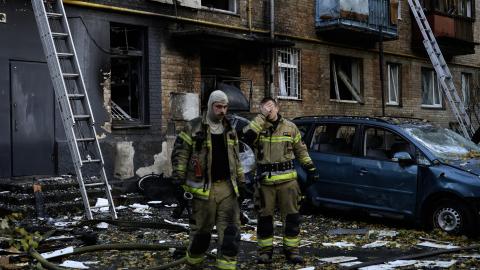
In another important development, Russia’s sustained ballistic missile campaign placed additional pressure on Ukraine’s depleted stocks of interceptors. On October 13, ballistic missiles struck Kyiv for the second time in 24 hours, hitting residential and energy infrastructure and slipping past the city’s ballistic-missile attack-warning system. Patriot missile shortages have already been straining Ukrainian defenses. Any disruption in Western intelligence sharing with would leave Kyiv more vulnerable to Russian long-range strikes.
Against this backdrop, Lockheed Martin reportedly announced that it is exploring partnerships with European countries for Patriot PAC-3 interceptors. These ventures include potential cooperation with Germany’s Diehl Defense to help meet Ukraine’s—and Europe’s—growing demand for air- and missile-defense magazine depth. The company is also considering cooperating with Ukraine on the less expensive Adapted Capability Effector interceptor, a weapon designed for less sophisticated threats than those addressed by the high-end PAC-3 Missile Segment Enhancement variant.
Given the vulnerability of Ukrainian factories to Russian strikes, Lockheed is examining the feasibility of producing these munitions in nearby countries, with a possible subsequent expansion into Ukraine. These options depend on many factors, including United States government approval, industrial capacity, and component availability. As a result, Lockheed’s contributions would expand supply rather than provide immediate relief for Ukraine’s interceptor shortage.
2. Ukraine Disrupts Russia’s Digital Backbone: Drone Strikes Target Data Centers
Between October 8 and 11, Ukraine struck three data centers belonging to the Russian internet company Yandex, disrupting cloud infrastructure, payment systems, transportation applications, and commercial platforms throughout Russia and across Central Asia and the Caucasus. Ukraine’s drone campaign against Russian data centers has exposed a vulnerability at the heart of Moscow’s digital economy: the concentration of essential services in only a few physical facilities. The consequences of this campaign extend beyond Russia, underscoring the region’s dependence on Moscow’s technology infrastructure. Russia’s digital reach has become a transmission mechanism for disruption beyond its borders.
Ukraine’s strikes unfolded in rapid succession. On October 8, a drone attack damaged the Sasovo data center southeast of Moscow, a facility that housed two supercomputers. The following day, Ukraine struck a larger complex in the Kaluga region, southwest of the capital. A third facility near Vladimir, east of Moscow, was hit on October 11.
Yandex acknowledged that operations at Sasovo had stopped entirely and that the strikes had disabled its infrastructure in Kaluga. After Ukraine struck the Vladimir facility, it also went offline. Ukrainian President Volodymyr Zelenskyy described the campaign as retaliation for Russian attacks on Ukraine’s own data centers. In September, Russian strikes on facilities in the Kyiv region interrupted internet access for tens of thousands of households.
Kyiv’s strikes introduced a new vulnerability into Russia’s economic hinterland. Often referred to as Russia’s Google, Yandex occupies a position in the country’s economic landscape that extends well beyond internet search functions. The firm provides services that encompass navigation, email, digital payments, ride-hailing, food delivery, and cloud computing. Yandex Go, an application produced by the company, combines functions that Western consumers associate with Uber and DoorDash, while Yandex Cloud supplies computing infrastructure to more than 64,000 customers.
This breadth gives the firm considerable commercial reach—and exposes it to unique vulnerabilities. Yandex’s extensive operations create channels through which damage to its infrastructure can propagate across otherwise unrelated sectors. These disruptions reportedly rippled across Russia yesterday, affecting 80 Yandex services, including the Alisa voice assistant, Yandex Music, smart-home applications, and Telemost video conferencing, as well as cloud storage, database platforms, and artificial intelligence tools.
Banking applications, retailers, and ride-hailing services also experienced connectivity problems. Reported bot traffic from the Yandex network fell to approximately 57 percent of its recent peak after the Sasovo strike and to 0.4 percent after the subsequent attacks. This figure suggests a sharp contraction of the company’s automated network activity, although it does not measure the overall proportion of computing capacity that Ukraine’s strikes disabled.
The practical consequences of these disruptions were immediate. Yandex Pay users reported difficulty transferring or withdrawing funds, while taxi drivers and couriers struggled to access their earnings. Some Yandex customers could not obtain refunds for failed purchases because verification messages could not reach their Yandex Mail accounts. Drivers using Yandex reported being advised to use Google Maps or Waze while the Russian company repaired its servers.
The disruptions also affected businesses throughout Central Asia and the Caucasus that depend on the company’s cloud infrastructure. The strikes disrupted the grocery retailer Magnit, the fast-food chain Vkusno i Tochka, and the electronics retailer M.Video. Users in Kazakhstan, Kyrgyzstan, and Uzbekistan reported difficulties accessing services, while outages in Yerevan, Armenia, pushed customers toward a competing taxi platform, straining its capacity.
As of October 12, Yandex Cloud remained in a state of emergency operations. Company engineers worked around the clock to restore capabilities, as customer service representatives directed customers to alternative hosting and backup locations and technical support operations faced delays. Some of the company’s applications had recovered by press time, but restoration remained uneven.
Rebuilding the firm’s damaged infrastructure could prove far more onerous than restoring its individual services. In reporting on the company’s difficulties, information-technology market participants estimated that replacing the equipment destroyed by Ukrainian strikes could take Yandex at least six months. Large server procurements are unlikely to be completed before the end of 2026.
Ukraine’s attacks on Russian data centers demonstrate how one drone strike can produce effects far beyond a damaged building by interrupting transactions, transportation, and business operations across a dispersed customer base. The Ukrainian strike campaign illustrates how deeply the digital economy depends on fixed infrastructure—and how quickly that dependence can become a wartime liability. Moscow now faces a race to restore capacity and build sufficient redundancy before further Ukrainian strikes turn temporary disruptions into a persistent economic burden.
3. What to Look For in the Coming Weeks
On October 8, the Telegraph indicated that Russian President Vladimir Putin has called upon General Sergei Surovikin, removed from his position as commander of the Russian Aerospace Forces in August 2023, to direct attacks on Kyiv’s bridges across the Dnipro River. Known as “General Armageddon,” Surovikin also previously commanded Russian forces in Syria and led Russia’s war effort in Ukraine, where he oversaw a sustained campaign against Ukrainian energy infrastructure. His reported return and assignment to target Ukraine’s bridges remain unconfirmed but warrant scrutiny.
The October 7 edition of this report detailed deliberate Russian attacks on Ukrainian bridge infrastructure. If confirmed, Surovikin’s return to lead a coordinated campaign against these crossings would carry significant military and logistical implications, and could threaten troop movements, resupply efforts, and connectivity across the river. In the coming weeks, this series will monitor evidence of Surovikin’s operational role, the frequency and geographic spread of Russia’s bridge strikes, and whether these attacks caused sustained transport disruptions.