



















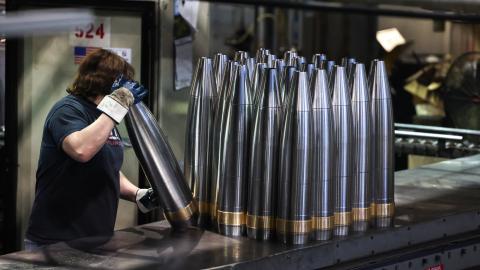
Politicians and pundits are sounding the alarm about America’s low stockpile of munitions. Although the concern for a well-armed military is welcome, it’s notably coming, for the most part, from those who oppose the Iran war. The sudden urgency from these corners rings hollow.
Take, for example, those politicians and analysts who have impeded rather than helped Congress in consistently passing defense bills, who have previously opposed supplemental funding to replenish armament stocks, and who spend more time arguing that we should accommodate our enemies than proposing ways to counter them. There’s reason to remain skeptical that their newfound concern over military readiness will lead to a speedy congressional vote for a defense spending boost.
The status of U.S. stockpiles differs greatly across the various categories of munitions. Stores of some kinds of munitions that the United States sent to Ukraine — and of certain other weapons that the U.S. has used against Iran — are running low, especially considering what it would take to deter Chinese aggression. But as President Donald Trump himself recently stated, in objecting to the new narrative about depleted weapons, the United States still has plentiful weapons in the categories necessary for the operation against the Iranian regime in the Strait of Hormuz. Moreover, the U.S. is moving quickly to produce other kinds of weapons using smaller manufacturers that can provide slightly less exquisite or capable systems but at a larger scale and for a fraction of the cost. For example, a reasonable estimate is that 10,000 lower-cost missiles similar to the Rusty Dagger and Barracuda-500 missiles will be delivered by 2030. It would be wrong to suggest that we are anywhere close to putting the country on the war footing that present threats demand. But if Congress makes and sustains the necessary investments, the trajectory is promising.
While partisans place the blame for the munitions crisis on U.S. efforts to support Ukraine and counter the Islamic Republic, they miss how these efforts have boosted military readiness. The United States is now set to produce 2,000 PAC-3 and 400 Terminal High-Altitude Area Defense (THAAD) missile interceptors a year, tripling and quadrupling their respective production rates since the 2022 Russian invasion of Ukraine. According to Lockheed Martin, PAC-3 production has increased by more than 60 percent in the past two years. The development and deployment of the Advanced Precision Kill Weapon System (APKWS), used to shoot down thousands of Iranian drones, was dramatically accelerated by U.S. support for Ukraine. Moreover, this support has led to improvements in the way the U.S. military implements software changes and manufactures modular weapons that are better suited for fast upgrades during war.
Many of us who agree that the country must prudently weigh the costs and benefits of intervention versus nonintervention argue that providing weapons and intelligence support to Ukraine is in our interest: Russia remains an acute threat to the United States and seeks to undermine Washington’s influence in Europe by weakening and ultimately breaking NATO. Enabling Kyiv to stop Moscow now would be less risky than confronting Russia later if it were permitted to subjugate Ukraine. By conquering Ukraine, Russia would gain control over shipping and commercial routes in the Black Sea. It would also benefit greatly from Ukraine’s agricultural and steel industries and its oil and natural gas reserves. A by-product of either selling or giving weapons to Ukraine has been the opportunity to rebuild the U.S. defense-industrial base that has atrophied over the past 40 years. Besides, since the United States did send weapons to Kyiv, even those who believe that Russia’s war is none of our business and now wring their hands about the munitions crisis should overwhelmingly support efforts to replenish those stockpiles. And yet such efforts face plenty of opposition.
The argument that the “restrainer” factions have settled on is that merely having stockpiles is a sufficient deterrent to foreign aggression. In their telling, the United States must retrench everywhere and accommodate the belligerence of our enemies — any use of weapons would be a waste of the stockpile. When I voiced my view on social media that the “restrainers” on the right and the left share the blame for our low stockpiles, critics responded that restrainers simply prioritize the U.S. national interest and seek to conserve scarce munitions for “wars of necessity.” That is the heart of the debate: What is the national interest, and what is necessary to defend it? I believe that it’s in the national interest to increase American military power so that political leaders can decide when to use force or act with restraint, rather than retreat and decrease American power so that politicians have no choice but to act with restraint. Increasing American power globally requires maintaining what Franklin D. Roosevelt called the Arsenal of Democracy — and using it to arm our vulnerable allies and to defend our forward-deployed bases. Doing so limits an adversary’s imperialism and imposes high costs on aggression.
Concurring with my view, historian Arthur Herman (whose recent book Freedom’s Forge provides a detailed account of how the U.S. became the dominant industrial power that emerged victorious from World War II) explained that merely having a stockpile is unlikely to function as a deterrent. The U.S. must also be capable of producing necessary weapons at scale. Moreover, Herman wrote, “Innovation comes from producing and using, not locking away, the tools of victory.” Demonstrating the political will to sometimes use these weapons, and use them competently, boosts the credibility of the threat to the adversary whom we seek to deter.
Those rightly worried about munitions stockpiles and the nation’s ability to produce the necessary weapons at scale should consider supporting the following measures. First, we need spending bills that propose to invest 5 percent of U.S. GDP in defense. For this year, that includes the defense authorization and appropriation bills, at $1.15 trillion, plus the budget reconciliation package of $350 billion. America currently spends only 2.8 percent of GDP on defense while spending 14.2 percent on entitlements. (The idea that defense spending crowds out entitlements is a myth that left-wing politicians, including Michigan’s Democratic Senate candidate Abdul El-Sayed, frequently push.)
Second, we must pass regular defense bills that keep defense spending at 5 percent or more of GDP year over year, which means taking inflation into account and increasing the top-line expenditure. A flat top line would amount to a cut in spending.
Third, we must extend to other allies arrangements similar to Pillar 2 of the AUKUS partnership between the U.S., the U.K., and Australia, which makes sharing technological advances with our allies standard practice while allowing exceptions to protect certain technologies. This knowledge-sharing is essential to expand defense manufacturing co-production and coordination initiatives with allies — the only chance we have to compete against China’s manufacturing base. Michael P. Duffey, the undersecretary of war for acquisition and sustainment, affirmed this point earlier this year:
In some cases there’s exquisite capability that our allies deliver that we don’t. . . . It’ll be important to create an integrated industrial base to think through where we can leverage those to support our own operational readiness and create interoperability with our partners.
To that end, his office is focused on opportunities for “co-production [and] co-sustainment” with our European and Asia-Pacific allies.
Since the end of the Cold War, the United States has failed to maintain the defense-industrial base necessary to defend American sovereignty and our way of life. Time is short. We have no choice but to look for ways to quickly and effectively manufacture key weapons. Sometime over the next decade, we’ll need them.