




















China has entered a new phase of strategic competition. After spending more than a decade exporting roads, ports, fiber-optic cables, and digital infrastructure through the Belt and Road Initiative (BRI), Xi Jinping is now seeking to export something even more consequential: China’s entire artificial intelligence (AI) ecosystem, from chips and cloud infrastructure to foundation models, standards, applications, workforce training, and governance.
Nvidia CEO Jensen Huang warned about China fusing the BRI and AI late last year. The deeper a country climbs into that stack, the harder it becomes to climb out. If the BRI created the debt trap, China’s latest initiative risks creating a far more consequential tech trap.
China’s AI Diplomacy and the Emerging Tech Trap
China’s emerging AI diplomacy centers on a proposed World AI Cooperation Organization (WAICO), supported by AI application centers, open-source models, technical training, digital standards, and infrastructure assistance. Together, these initiatives represent the next evolution of Beijing’s international strategy, aligning a diplomatic strategy with an AI technology stack. Built directly on the Digital Silk Road, already a major pillar of the BRI, this new effort carries implications that may prove even more profound.
Xi has made a cottage industry out of launching global initiatives. His Belt and Road Initiative, announced in 2013, became Beijing’s signature vehicle for courting the Global South by financing infrastructure, securing access to critical resources, and exporting connectivity to China’s digital architecture. Since then, Xi has unveiled a succession of increasingly ambitious frameworks: the Global Development Initiative in 2021, the Global Security Initiative in 2022, the Global Civilization Initiative in 2023, and the Global Governance Initiative in 2025. Each repackages Beijing’s vision for international order, while adding another layer to an expanding architecture of Chinese influence.
Washington should take this challenge seriously. Following the rapid dismantling of USAID, U.S. Secretary of State Marco Rubio has sought to preserve strategically valuable elements of American foreign assistance while shifting toward commercial diplomacy that advances economic security, technological leadership, and U.S. reindustrialization. Whatever one thinks of the broader retreat from traditional development assistance, the administration has begun to assemble important new instruments of economic statecraft. The next step should be to integrate these initiatives into a coherent AI development strategy that enables trusted partners to build sovereign AI capabilities while reinforcing U.S. technological leadership.
China and the United States remain locked in a managed competition across the Indo-Pacific, particularly over military access within the First Island Chain. Beijing seeks to deny U.S. power projection inside its expansive maritime periphery, while Washington seeks to preserve the ability to penetrate China’s anti-access strategy should deterrence fail. Yet the decisive contest between Washington and Beijing is no longer confined to a military balance in the Western Pacific. Increasingly, it concerns who will shape the technological foundations of future economies, governments, and societies.
Provided deterrence holds, the central competition is likely to be economic and technological. The nation that establishes leadership in AI and other critical technologies will enjoy advantages that extend well beyond innovation, conferring lasting economic, military, and geopolitical clout.
China’s AI diplomacy serves several strategic objectives simultaneously. It strengthens domestic technological self-sufficiency, expands the global market share of Chinese firms, creates long-term dependencies across the developing world, and enhances Beijing’s geopolitical influence relative to the United States.
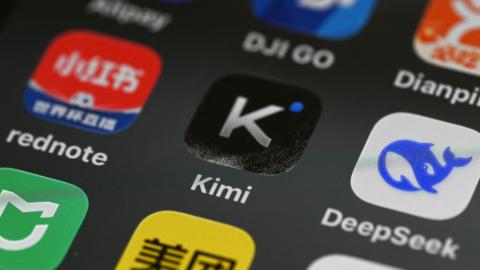
Recent advances suggest that these ambitions can no longer be dismissed. Moonshot AI’s Kimi K3 frontier model, following earlier breakthroughs such as DeepSeek and rapid progress by Alibaba’s Qwen and Zhipu AI, demonstrates that China is narrowing the gap with leading U.S. models like ChatGPT, Claude, and Grok. Britain’s AI Security Institute estimated that China’s lag behind the United States in frontier models has narrowed from roughly nine months to only four or five months in little more than a year.
But the decisive competition is not simply about producing the world’s most capable AI model. It is about determining whether dozens of emerging economies build their future digital infrastructure around an ecosystem ultimately shaped by the Chinese Communist Party. Beijing’s strategy rests on three mutually reinforcing pillars: shaping international standards, dominating domestic innovation, and expanding globally. If pursued successfully and left largely uncontested, this approach would advance not only Xi’s vision of national rejuvenation but also China’s long-term ambition to become the dominant power in Asia through AI-enabled technological leadership.
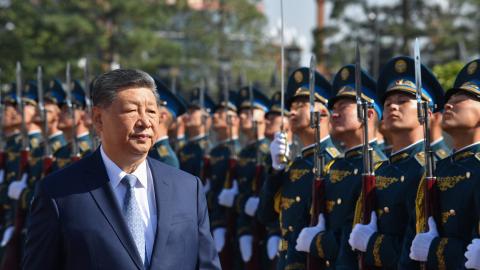
Xi’s speech at the World Artificial Intelligence Conference in Shanghai earlier this month presented this effort as a contribution to humanity, promoting a distinctly “Chinese solution” through what Beijing described as “non-monologue cooperation among Global South nations.” Yet the proposed system remains unmistakably China-centric. Chinese models would run on Chinese infrastructure, built by Chinese firms, governed by Chinese standards, and increasingly embedded in foreign digital ecosystems.
Countries that build their digital future around Chinese AI ecosystems may gradually become dependent on Chinese cloud infrastructure, foundation models, digital identity systems, surveillance technologies, smart-city platforms, payment systems, cybersecurity services, technical standards, and workforce training. The result is not merely commercial dependence, but lasting political leverage embedded deep within the operating systems of partner governments and societies.
Unsurprisingly, many developing countries have welcomed WAICO despite its strategic implications. Indonesia, for example, traditionally seeks to remain nonaligned in U.S.-China technology competition, yet Jakarta quickly endorsed Beijing’s new AI initiative. Chinese firms including Alibaba and JD.com have already invested heavily in Indonesia’s largest e-commerce platforms, deepening commercial integration and technological dependence. Huawei’s dominant position in Indonesia’s – and much of the developing world’s – 5G network infrastructure provides a foundation upon which Beijing can now layer AI services and governance institutions. management systems and automated vehicles supplied by other Chinese state-owned enterprises. COSCO’s controlling ownership stake has already raised concerns about data collection, surveillance, and the strategic implications of embedding Chinese digital infrastructure into critical overseas logistics hubs. Chancay is more than a port; it is a preview of how physical infrastructure and AI ecosystems can reinforce one another in China’s expanding global influence strategy.
Winning the Contest for the World’s AI Ecosystem
Competing effectively will require the United States and its allies not only to offer competitive technologies but also to develop coordinated standards, financing, infrastructure, and long-term strategic planning. Fortunately, the foundations of such a strategy are already beginning to emerge.
Recent initiatives such as Pax Silica, designed to secure trusted semiconductor and critical mineral supply chains; FORGE, which seeks to expand allied industrial and technology ecosystems; and the Genesis Mission, focused on accelerating frontier AI partnerships and innovation, provide important building blocks. They are reinforced by the United States’ unmatched innovation ecosystem, led by companies including Nvidia, OpenAI, Anthropic, Microsoft, Amazon, Google, Oracle, and many others.
Yet these initiatives remain largely supply-side policies. They strengthen U.S. technological competitiveness but do not yet amount to a comprehensive strategy of AI diplomacy.
If the administration follows through on the emerging AI Spark initiative, it should become the centerpiece of U.S. AI diplomacy. Rather than offering trusted partners isolated technologies, AI Spark could provide access to the entire AI stack: advanced semiconductors, compute capacity, cloud infrastructure, secure data centers, resilient networking, reliable energy (including small modular reactors where appropriate), AI software, cybersecurity, developer tools, workforce education, digital governance expertise, technical standards, financing mechanisms, and regulatory assistance.
ASEAN should be among AI Spark’s highest priorities. By partnering closely with Southeast Asian nations to deliver affordable, trusted, and interoperable AI infrastructure, the United States and its closest allies can help countries build sovereign technological capabilities while deepening long-term strategic partnerships with Washington. With the Philippines in the ASEAN chair this year and handing off to Singapore at year’s end, this is a propitious time for gaining regional support.
In effect, Washington should offer the AI equivalent of a Marshall Plan for the digital age. The objective is not to create dependence on the United States. It is precisely the opposite: to help countries develop sovereign digital capabilities without becoming captive to any single authoritarian technology ecosystem. Like the old proverb about teaching someone to fish rather than simply giving them a fish, AI diplomacy should empower nations to sustain their own technological development. Helping build a wider constellation of technologically capable partners is not charity; it is enlightened self-interest.
Achieving that vision, however, requires more than rhetoric. It demands a coherent industrial strategy capable of mobilizing U.S. innovation, attracting allied investment, and leveraging initiatives such as AI Spark. Washington should establish a dedicated AI Stack Development Fund to help trusted partners finance secure, interoperable AI infrastructure. Such a mechanism could attract bipartisan support because it simultaneously advances U.S. competitiveness, strengthens alliances, and expands opportunities for U.S. and allied technology companies.
The strategic stakes are difficult to overstate. The countries that build AI infrastructure today will shape tomorrow’s technical standards, software ecosystems, government procurement decisions, cybersecurity practices, digital governance frameworks, military applications, and ultimately long-term economic growth. Artificial intelligence is rapidly becoming foundational infrastructure, much as electricity, telecommunications, and the internet once were. First movers will enjoy enduring influence.
Writing for Foreign Affairs in 2021, Kurt Campbell and Rush Doshi argued that strategic competition would determine the world’s operating system. Increasingly, AI is becoming that operating system. Whoever helps countries build their AI capabilities will shape the rules, standards, and relationships that govern the 21st century.
Here, the United States possesses significant comparative advantages. Unlike China, it can offer not only frontier technology but also trusted partnerships grounded in private-sector innovation and a network of democratic allies. It offers openness rather than coercion, interoperability rather than exclusivity, and resilient partnerships rather than political leverage.
The United States’ allies are central to that advantage. Japan, South Korea, Australia, Taiwan, and other trusted partners contribute world-class capabilities in semiconductors, advanced manufacturing, cloud infrastructure, AI applications, and digital governance. Together they can offer something Beijing cannot: an open, resilient, and genuinely pluralistic AI ecosystem rather than one dominated by a single authoritarian power.
China clearly understands that artificial intelligence is becoming an instrument of geopolitical influence as much as technological innovation. The United States should understand the same. AI Spark, if properly resourced and sustained across administrations, could become the foundation of a durable strategy that advances U.S. interests while helping partners strengthen their own technological sovereignty.
If the Belt and Road Initiative created fears of debt dependence, AI Spark should become the United States’ answer to China’s emerging tech trap. The objective is not to force countries to choose Washington over Beijing. It is to ensure they have a meaningful choice.
The United States cannot prevail simply by building the world’s most advanced AI. It must also become the world’s preferred partner in helping others build, deploy, and govern AI on their own terms. The contest is no longer simply about who builds the most powerful AI models. It is about who builds the world’s AI ecosystems, and whether those ecosystems expand freedom or entrench authoritarian influence.