Caption
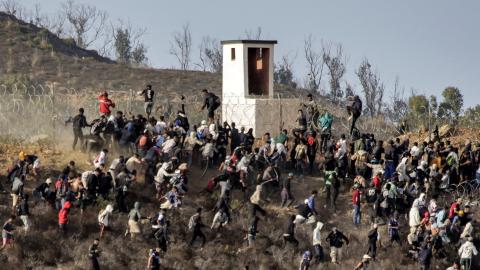
Migrants storm a barbed-wire fence as they attempt to cross the land border with Spain's African enclave of Ceuta near Fnideq in northern Morocco on September 15, 2024. (Getty Images)


Few countries in central and eastern Europe have as much influence in the Balkans as Austria.
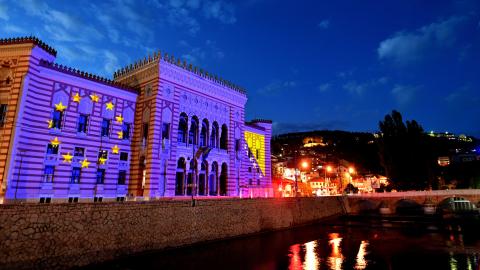
For centuries, Austria has forged deep personal connections with the region. The imperial legacy of the Austro-Hungarian Empire is visible in the architecture of Zagreb and Sarajevo, and during the Yugoslav Wars of the 1990s, refugees fled into the heart of the Alps. More recently, Vienna has been to the Balkans what Miami is to Latin America: a gateway facilitating trade and movement. Among Balkan hands in the United States, Vienna’s Schwechat airport is familiar terrain.
While the US has supported programs that promote economic connectivity in the region, like the Three Seas Initiative (3SI), Austria plays a unique role in the Balkans through such areas as financial services. Moreover, Austrian officials like Valentin Inzko have shaped diplomacy in the Balkans, while the Austrian Bundesheer has deployed to the region as part of the Common Security and Defence Policy and other missions. Today, officials in Austria and elsewhere are discussing how the Western Balkans can be brought into the European Union.
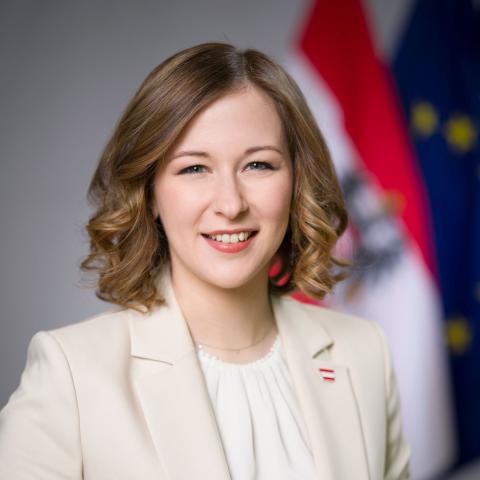
Join Senior Fellow Peter Rough as he welcomes Claudia Bauer, minister for Europe, Integration, and Family in the Federal Chancellery of Austria, for a policy address followed by a fireside chat on how Austria sees EU enlargement in the Western Balkans.
Listen on Spotify and Apple Podcasts.
Transcript
This transcription is automatically generated and edited lightly for accuracy. Please excuse any errors.
Peter Rough:
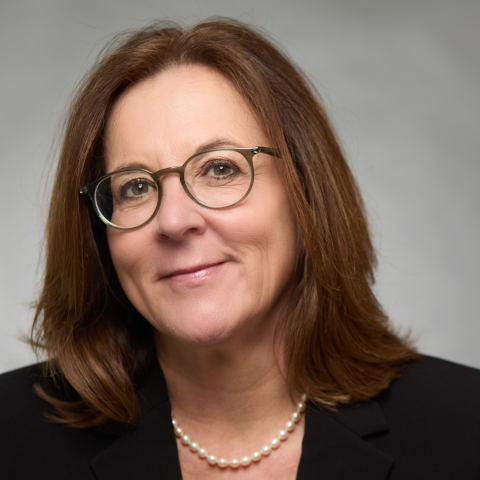
Well, good afternoon, everyone, and welcome to the Betsy and Walter P. Stern Conferencing Center here at Hudson Institute. My name is Peter Rough. I’m a senior fellow and the director of the Center on Europe and Eurasia here at the Institute, and I’m absolutely delighted to introduce our distinguished guest for today’s event, the Western Balkans, a view from Vienna with Federal Minister for Europe, Integration and Family and the Federal Chancellery, Claudia Bauer.
For centuries, Austria has forged deep personal connections with the Balkans. Today, it is a major economic player in the region, especially in financial services, and hosts a significant population of emigres who fled the Yugoslav wars of the 1990s, among other important ties. Vienna has been to the Balkans what Miami is to Latin America, a gateway facilitating trade and movement. Among Balkan hands in the United States, Vienna’s Schwechat Airport is familiar terrain.
Today, we are joined by Minister Bauer, who has risen to leadership positions in the center-right Austrian People’s Party, the Österreichische Volkspartei, having served as state secretary in the parliament, and in leadership positions in her home region of Upper Austria.
It is a real thrill on a personal note, given my own familial ties, to host a representative of the Austrian government. And so to those of you watching from around Washington and those of you here in person, welcome. But to you, Minister Bauer, and to those of you who may be tuning in from across the Atlantic, [foreign language 00:01:29]. The floor is yours for your remarks after which we’ll engage in a fireside chat. Please join me in welcoming the minister to Hudson Institute.
Minister Claudia Bauer:
Thank you very much, dear ladies and gentlemen, dear representatives of Hudson Institute. It is a great pleasure to be here with you today and to discuss about a region that has always been much closer to Austria than some of you might think and that some maps might suggest. In Vienna, we sometimes joke that the Balkans do start within Vienna, the Austrian capital city.
And that might sound a little bit strange to a non-Austrian audience, but it can easily be explained. The Western Balkans are not only our neighborhood, very often, they are part of our extended family. Few regions demonstrate more clearly that European stability does not end at the classic European borders and it does not end within the European Union. Although geographically small, the Western Balkans have repeatedly shaped the strategic landscape of Europe. And the fundamental truth is, the Western Balkans matter.
They matter for Europe’s security, they matter for our prosperity, and increasingly, they matter in the global competition between democracies and authoritarian powers. To borrow a quote that is very often attributed to Winston Churchill, the Balkans produce more history than they can consume. Perhaps that observation remains true.
But today, our task is different. It’s not about consuming, it’s not about the past, it’s not about the history, but it is about shaping the future. And the future of the Western Balkans lies within Europe, at the heart of Europe, and especially within the European Union. And against this backdrop, I would like to offer three reflections today.
First, why Austria’s commitment to the Western Balkans is so deeply rooted. Secondly, why the United States remain an indispensable partner in the region. And thirdly, where the European debate on enlargement stands today and where it will lead to. I will start with my first thoughts on Austria’s commitment to the Western Balkans.
This commitment is not driven by nostalgia, but by responsibility. History connects us, economy connects us, families connect us. And for centuries, Vienna served as one of the political, economic and cultural gateways between Central Europe and Southeast Europe.
The Habsburg monarchy shaped parts of today’s Western Balkans, leaving behind institutions, infrastructure, legal traditions and cultural connections that continue to influence our relations. And following the Yugoslav wars of the 1990s, Austria again assumed responsibility, welcoming refugees from ex-Yugoslavia, supporting reconstruction, investing in economic recovery, and consistently advocating for the region’s European future.
Today, these historic links are reflected in vibrant human connections. More than 600,000 people living in Austria, not just within Vienna, have family roots in the countries of the former Yugoslavia, making this one the largest and most dynamic diaspora communities in our country in Austria. And they contribute every day to Austria’s prosperity while maintaining close family, cultural and economic ties across the whole region, across the continent.
They are not simply a diaspora; they are a living bridge between Austria and the Balkans. These societal links are completed by remarkably strong economic ties. Austria is among the largest foreign investors in the Western Balkans, with Austrian companies having invested almost seven billion euros across the region. Austrian banks are deeply integrated into the region’s financial sector.
Austrian businesses have become trusted partners in telecommunications, in manufacturing, in infrastructure, in renewable energy, and in tourism. Trade has also grown steadily while Austrian experts to the region, exceeding two billion euros annually. These figures illustrate clearly a simple reality. Our prosperity and the prosperity of the Western Balkans are increasingly interconnected.
Austria has been one of the biggest supporters of EU enlargement, and the EU integration of the Western Balkans has long been a priority for the Austrian government. And for good reason, given the current geopolitical situation, current geopolitical conflicts, and as well wars.
The integration of the Western Balkans is not only a matter of economic and cultural relations, it is above all about Europe’s security and about the stability of our continent. Our support is not a mere act of charity; it is our firm conviction that the European Union is not complete without the countries of the Western Balkans. And we must not fool ourselves. If the US influence declines, if our presence in the region is not felt, this void will immediately be filled by other actors.
We know that, and its reality. Secondly, my second thought, sometimes in Europe, we hear the argument that the Western Balkans are Europe’s backyard, and therefore Europe should manage everything on its own. I understand totally this sentiment, but I believe it is the wrong conclusion because history teaches us another lesson.
Whenever Europe and the United States acted together in the Western Balkans, progress became possible. And if Austria has been one of the strongest European advocates of the Western Balkans, the United States has long been one of the most fundamental guarantors of its security.
Without American leadership, the history of the region over the past three decades would have looked very different. The Dayton Peace Agreement ended one of Europe’s darkest conflicts after the Second World War. American diplomacy, together with our European partners, laid the foundations for peace. And successive American administrations have consistently supported the region’s Euro-Atlantic ambitions.
Today, this partnership remains more relevant and important than ever. Current discussions, for example, regarding the debates about the succession of the high representative in Bosnia-Herzegovina, show that close transatlantic coordination remains imperative. And what matters is maintaining our shared objective, preserving stability and prosperity for the region, which naturally does also mean preserving our own stability and prosperity. But of course, geopolitics has become more challenging in the past few years. And the influence of other actors in the region leaves no doubt that we must make progress in living up to our promises, because geopolitics does not tolerate strategic vacuums.
If somebody leaves a void, others will swiftly step in. My third thought on the situation in the moment as a minister for European affairs within the Austrian federal government, one of my main tasks is our joint work on how to improve Europe and shape the future of our continent. And in my job, you cannot talk about Europe’s future without talking about the future of the Western Balkans, without talking on the enlargement of the European Union.
And for many years, enlargement has been viewed primarily through a technical lens, through a technical process. Today, it is increasingly understood as a geostrategic necessity. The Russian aggression against Ukraine and the ongoing war have, despite all the tragedy, brought a new momentum to the EU enlargement table. The start of accession negotiations with Ukraine and Moldova have triggered a new dynamic also for other candidate countries. And the Western Balkans have, rightfully so, moved up to European leaders’ priority list.
That is a very good sign, although it took some time and although it took the war of aggression in Ukraine as a new momentum. And while we appreciate this development and also support a European perspective for both Ukraine and Moldova, of course, one thing is very clear from an Austrian perspective: there is no fast-track procedure in the accession process.
EU accession needs to pursue a merit-based approach with tangible results and a concrete enlargement perspective for the candidate countries, especially the six countries of the Western Balkans. And we must deliver on our promises that we gave to the Western Balkans more than 20 years ago at the summit of Thessaloniki. This is also about the credibility of the European Union.
Enlargement cannot be an end in itself. If the candidate countries implement the necessary reforms, there must also be progress in the way to European membership, to EU membership.
Austria believes that one important answer lies within gradual or step-by-step integration, because the idea of gradual integration into the European Union is very simple: participation in selected EU policies in reward for implemented reforms before full EU membership.
Of course, gradual integration can never be a substitute to the full membership, but EU accession is a two-way street. Both sides need to deliver. And on the way to Brussels, both sides need the support of their citizens. Gradual integration is the kind of soft launch we might need.
Dear ladies and gentlemen, the Western Balkans do not need empty promises. There have been enough of them the last few years and decades. They need reliable partners. And Austria will continue to be one of them, supporting their European perspective with determination and also with consistency.
We will support reforms, we will foster regional cooperation, and advocate for a credible, merit-based enlargement process that rewards progress and delivers tangible results for the people, for the citizens and the candidate countries, because we firmly believe that the future of the region, the future of the Western Balkans, lies within Europe.
Geographically, it is right in the heart of Europe, and we see it as our joint task to make this future right within the European to our task and a reality. Thank you very much.
Peter Rough:
I’ll just take this. Let’s see how strong my colleagues are.
Claudia Bauer:
Mostly female.
Peter Rough:
Female power. Well, thank you, Madam Minister. Those are really excellent remarks. And before I get going, I failed to say in my introduction, but I’d like to say so now that you really have an excellent team here in Washington, thanks to the Austrian ambassador, Petra Schneebauer, who is here today, Hans, Seb, the entire team.
And we have some wonderful Balkan analysts here in the audience as well, not least of which is Dan Kochis, who’s a Europeanist writ large, but has done a lot of work for us on the Balkans. And for any of you who would like to talk to the minister after this Q&A, we will reward you for coming in person and not just watching online by having sandwiches out back, and you’ll have a chance to pick the minister’s brain.
Let me begin with an issue that’s always the issue du jour when it comes to Europe here in Washington: that is Ukraine and Moldova.
You’ve mentioned in your remarks, and I don’t think this is a new position for the Austrian government, that there’s no fast pass for Ukraine and Moldova, jumping the queue as it were ahead of the Western Balkans countries.
Now, some Western Balkans countries, maybe Montenegro, are further ahead than others; there’s talk of Montenegro joining in 2028, North Macedonia maybe a little bit further behind, but Thessaloniki was in 2003, which you referenced. So that’s a long period of time. Is there a way to almost vector the urgency over the war in Ukraine to accelerate the accession process for the Western Balkans, or how do you read the connection between the two?
Claudia Bauer:
I think the tragic war of aggression in Ukraine kind of took enlargement policy of the European Union back on the agenda. And unfortunately, it needed an event like this, but I think it is so important to use this new momentum and to not just focus on Ukraine and Moldova, which is, of course, a geopolitical necessity, but also to talk about EU enlargement on the existing candidate countries.
There are existing candidate countries that are in the waiting room for far too long for more than 25 years. And we see there are some different progress within all these countries. You mentioned Montenegro. Montenegro is truly a front-runner. They want to become full member of the European Union by 2028. 28th member of the European Union by 28, I think that it is a good motto. It is realistic, it is ambitious, but I truly believe in it.
And I think it is so important that we all succeed with these success stories. The European Union, for far too long, had no success story in enlargement. And I think it has a very positive effect on other candidate countries.
We underestimate that at the moment because Montenegro is a country with 620,000 inhabitants, actually. So that’s, from an Austrian perspective, and you know that we are a small country, it is a smaller federal state of Austria, actually. So I think this is manageable, even in times like these. It is manageable, and we need it, and it has way more positive effect, not just to the European Union, but especially to the candidate countries that it can happen.
And it’s also about the credibility of the European Union, because we have this very long process. We have clear rules; they are objective, it is merit-based, and that is very important for us.
There are no two classes of candidate countries. And of course, they have to fulfill the reforms on a national level, but we have to live up to our promises as well from a Brussels perspective. And Montenegro might be that next success story.
Other countries, you mentioned North Macedonia; I hope that there will be progress now. So Ukraine and Moldova opened their first negotiating clusters on enlargement, and North Macedonia is stuck within this process. North Macedonia was just recognized as a candidate country, for in a few years, they celebrate 10 years of renaming the country.
Before, they were called Macedonia; now they are North Macedonia. And there are, once again, some bilateral issues now with Bulgaria, with minorities living there. That’s all okay, and we have to discuss about that, but it’s not relevant in my view on the EU accession process. Bilateral issues shall be solved bilaterally and not on process level.
And I think we need there some progress as well, especially after Ukraine and Moldova, see this progress, they opened new clusters. And yeah, maybe we will talk later about Serbia as well because that’s completely different situation again. So every country has a different status, and yeah, different support.
Peter Rough:
One of the most interesting parts of your remarks, I thought at least, was this reference to a potential gradual or sectoral integration. I think Beate Meinl-Reisinger, the Austrian foreign minister, was relatively recently in Bratislava where this issue, I believe, came up. I think there’s a non-paper circulating the Austrians have developed with the Italians, the Czechs, the Slovaks and the Slovenians urging the European Commission to think about this issue more. Tell me a little bit about this idea of staged or gradual accession rather than all-or-nothing EU membership.
Claudia Bauer:
It is actually an Austrian idea. Our former chancellor, and before he was Minister for Foreign Affairs in Austria, Alexander Schallenberg, kind of invented this idea and this proposal of gradual integration. I think it has many objectives to fulfill.
On the one hand, it is kind of a reward and an incentive for progress with the national reforms, for progress within the process to European Union. And I think on the other hand, and that’s, I think slightly more important, it’s also supporting the pro-European citizens within the candidate countries, because we mentioned it more than 25 years with the promise on the summit of Thessaloniki, well, people that are now 25 years old or even younger grew up with the promise that they will be, sooner or later, EU citizens. They grew up in peace within the Western Balkans, but they now want some concrete answers. They want a perspective; otherwise, many of them will continue to leave the country.
And that’s something where we must also deliver on these promises, where we have to get quick clear during the process by using instruments like gradual integration. And to give a concrete example, for instance, roaming free zone is something we all benefit in the European Union since many years now. I remember when I had a trip after my A-levels, after I finished school, and we had a trip to Croatia, and everyone turned off its phone.
We had no reason to call our parents; it was good like that that we did not give a call back to Austria because we had a good reason. Everyone was afraid of high bills at that time. And now, we do not have this reason anymore, so unfortunately, for students who go abroad within the European Union. And that might be something where citizens of EU candidate countries see tangible results.
They see that it pays off to stay on track and to continue implementing the reforms. And I think these incentives are very important also to keep the momentum, to keep them motivated, but it’s never a substitute to the full membership.
That’s the main goal for everyone. But I think we can get quick, clear also by opening some parts, maybe of single market where there was an enlargement of SEPA, so the Single European Payment Area. That’s also something where people see the real benefits, why it is so important to stay on track and that it pays off.
Peter Rough:
Well, one place where tangible results sometimes have been lacking is in Bosnia. We’re not quite in Serbia yet, but Republika Srpska features large in the Bosnia discussion and debate. And here, I was really taken aback by an interview that Christian Schmidt, the now former high representative, gave to one of Europe’s most important newspapers, the Frankfurt Daily, the Frankfurter Allgemeine Zeitung, where, under, I would say, relatively aggressive questioning, he kept responding with what almost amounted to a rhetorical question: what’s Europe’s strategy for Bosnia? So if I could just put it in the way that Christian Schmidt did to his interlocutor and pass it along to you, does Europe have a strategy on Bosnia? Are we two at odds, the Americans and the Europeans on Bosnia? Where do things stand there?
Claudia Bauer:
Well, Bosnia has the official status of being a candidate country. That’s it, actually, at the moment. So it has a very different structure in the organization of the country of Bosnia-Herzegovina. And yeah, that makes it maybe sometimes more difficult also to set reforms, to have the majority politically within Bosnia-Herzegovina to implement these necessary reforms and to take the next steps. Well, the office of the higher representative is a very difficult job, and it’s always easy to criticize it, and it’s never an easy task to kind of represent there as well. Our interests, our common interests here within Bosnia. . .
Peter Rough:
If you want to make some news, you can criticize here as well. That would be good for Hudson’s page views.
Claudia Bauer:
So, there are discussions now who will follow. And of course, I acknowledge all the competencies of the candidates that are named at the moment. From a European perspective, I want to tell you something new: we want a candidate, and then a higher representative that has the full support of the European Union as well.
We have a clear interest within the Western Balkans. It was not always like that. It was not always like that within Austria, but also within the European Union. We, for far too long, neglected also that responsibility after the Yugoslav war in the 1990s. And I think it is now high time that we still keep this focus despite other conflicts that exist.
And I think we have a good common interest in the stability of the region, in stability concretely within Bosnia-Herzegovina. And therefore, the office of the High Representative will be important in future as well, even though it is not easy, of course not.
Peter Rough:
Well, let’s stay in Bosnia then because Austria has played a major role in the EU Althea mission. I think you’ve, since the mission kicked off in 2004, essentially deployed troops there continuously. Tell us a little bit about the relevance of the troop. Is that deployment still necessary? Does it remain essential? Do you foresee a time when it can be drawn down? How does the International Force and Austria’s role within it function?
Claudia Bauer:
It remains essential, and it is very important for us in Austria to keep this commitment high, to bring kind of our expertise in form of our troops to Bosnia-Herzegovina, but as well to other missions there. I think it is important to contribute also to civilization of the region, and especially of Bosnia-Herzegovina.
This will be one instrument to do so. I hope that there will be soon a time sooner than later where we don’t need any troops anymore, any missions anymore. But for now, it is important to be present there. And we have a clear interest as Europe, but especially as well as Austria, since we are very connected to the Western Balkans, as well as to Bosnia-Herzegovina; we have many Bosnians living within Austria, families that are connected.
So, we have every reason to be present there, and to help them stabilize, and also make some progress with their internal policy.
Peter Rough:
Of course, you’re also part of the K4 mission. Of course, the K4 mission is much larger than the EU mission. But that takes us, I suppose, in an elegant transition to the Serbia-Kosovo question and issue set.
The EU-mediated Belgrade-Pristina dialogue has more or less been frozen over the past few years. What are your hopes for it? Are there alternative formats that you have in mind? How does Vienna think about that problem or that dynamic?
Claudia Bauer:
It’s also part of the accession process to the European Union. And maybe to start with Serbia, Serbia is right in the middle of the accession process. But unfortunately, there is some skepticism in opening the next clusters and then making the next steps.
The European Commission has repeatedly stated that Serbia is ready for the next chapters and clusters. I think the next one is about competitiveness, so the next steps to set reforms on a national level. And unfortunately, all the 27 member countries of the European Union are not united in that question of opening the next chapters. And it’s also a reason why Austria supports the initiative of Slovenia and Germany to use more qualified majority voting within the accession process.
It does not always need all the 27 to agree in opening clusters. Of course, in the end of successful accession process, there must be unity in these questions.
But I think we can quicken this process up and speed it a little bit, and we need that. It’s also, for us, on credibility, and we have to do that homework as well from a Brussels perspective. Maybe these reforms are seen likewise, not just within the countries, the candidate countries, but also from the Brussels perspective.
And of course, the question on recognition of Kosovo is one that has also an influence on the accession process. It’s not just about Serbia; five EU member countries do not recognize Kosovo. That’s why Kosovo is not yet a candidate country because it’s not recognized as a country. And yeah, every step we can make there is important. It starts with dialogue, of course. It is neighborhood, and there are some conflicts existing there.
It’s a very sensitive topic, but we need to see their progress as well. And wherever we can support, we are here, not just from the European Union’s perspective, but also from Austria.
Peter Rough:
There’ve been rumors in Washington about the American force posture writ large in Europe, but in particular as it pertains to American participation and missions in the Balkans. We are just a few blocks away here from the White House. The US unfortunately lacks confirmed ambassadors in nearly every Balkan country.
Maybe if you speak loud enough, the president will hear you, although I’m sure there are officers at the State Department and others watching this and taking notes, or even to the American people who are listening to this or might see it: why should the Balkans be important to the United States? Clearly you believe it is you said as much in your remarks. Give us an argument for why the Americans should stay engaged in this European backyard, as you put it in your opening comments.
Claudia Bauer:
We have there, many common interests there. I mentioned it before: it’s about prosperity, it’s about stability of the region, and the war in ex-Yugoslavia is now around 30 years ago. So I think it is also high time to set the next steps, also to stabilize the whole region. And I think we have there, many common interests.
Also, when we talk about migration policy, of course, we have there a clear interest to have the countries of the Western Balkans as a partner, as a reliable partner in these questions. We have close economic ties, and those are interests we follow. And I’m totally not against the interest driven foreign policy.
But I think if you want to succeed there and implement some reforms, you need reliable partners. And the Western Balkans can be our partners in these questions, not just on our continent, but also within our transatlantic cooperation.
And I think it is important to strengthen this partnership. We cannot be naive in this question. Of course, we need the United States there as well to also contribute to the security and stability of the region. We do, and I think we learned that in the last few years: we do everything to speed up our resilience there and to do our homework when it comes to security policy, to defense policy. But I think it is our common interest to have a stable region there and a stable partner we can rely on.
Peter Rough:
Let me ask you a bit of a niche question, and that is the Balkans are known for some of its aging infrastructure, its heavy reliance on coal. It has some of the worst air quality in all of Europe. Are there any Austrian approaches, initiatives, or ideas about how to help improve that part of the Balkans without furthering dependencies on China, which is something we Americans always worry about?
Claudia Bauer:
We worry about that as well. So we are there totally on the same page. We think that dependencies in general are something we have to reduce, of course, especially when it comes to the energy sector, but also in other questions. And it’s also part of becoming more resilient, not just in defense questions, but as well in energy sources and diversification might be an answer. And in Austria, we progress there. We are there on a good way. So we bring some expertise there as well through our businesses and enterprises to the region of the Western Balkans.
I think it is important to bring expertise on green technologies right there in the region. I’ve been there a few months ago in North Macedonia, actually. I met the Minister for Energy, and an Austrian company works there and works on the energy infrastructure.
And from an European perspective, the European level of this question is also partly answered with the growth plan on the Western Balkans. So we support financially the countries of the Western Balkans in infrastructure questions with concrete projects. And I think that’s also a need also, to heighten the infrastructure, to speed the process also of alignment to the European Union up.
Peter Rough:
Second-to-last question. Let’s fast-forward 10 years from now, and Chancellor Claudia Bauer comes back to Hudson Institute to deliver a speech of some sorts, and I’ll hold you to that.
Claudia Bauer:
I’m not sure if that is a goal, actually, for me personally at least.
Peter Rough:
Well, anyways, in 10 years from now, you come back, and you’ve given a talk on the Western Balkans. Tell us what you hope to find. What’s your vision, or what’s Austria’s vision for the Western Balkans 10 years from now?
Claudia Bauer:
I hope that we are more than 27 EU countries 10 years from now. I hope that we made it happen, that Montenegro became a member, Albania became a member, and that we see as well this progress within the other countries. So I hope that we are more than 27.
We have been once 28, actually, a few years ago. And I think it is good when we have also the perspective of the Western Balkans sitting at the table at the European Council. We talked before about gradual integration, so I hope we improved and got use of this instrument as well. But I hope not that we used it in the way some suggestions are discussed, like maybe Ukraine gets a commissioner without portfolio as part of gradual integration. I don’t see the benefit of this. I think there is no added value in this question from both sides, actually.
So, I think and hope that we have some good measures where both sides benefit, where we have this merit-based approach, which is underlined, and we focus on that. There are no two classes of candidate countries, and we follow this process. And enlargement is, again, on the agenda of the European Council, is on the agenda of the European Union, and that it makes us stronger and more reliable as well in all directions, especially given we are in Washington DC, especially when it comes to the transatlantic partnership.
Peter Rough:
Last question, Spain or Argentina, what’s the final score?
Claudia Bauer:
Austria would be. We played against both of them, actually, within the FIFA World Championship. I already choked the last few hours; I’m very happy that. . . Well, I don’t want to have a conflict with England, but I’m happy that Argentina made it because whoever wins, Austria is vice world champion, actually, because we played against both of them. We lost twice. We are very happy that we have been part of this World Cup. That’s not usual within Austria. It’s historic for us that we stayed that long, that we made it to the second round. That’s historic. We are very proud of the Austrian national team and whoever will win. I think it’s a very sportif motto. I think you have clear rules there as well. It’s merit-based, actually.
Peter Rough:
Very diplomatic.
Claudia Bauer:
We can learn from that.
Peter Rough:
You can get her actual final score prediction at the reception that follows. So please stick around. But before we do have that reception, join me in thanking Minister Bauer for coming to Hudson today. Thank you.
Claudia Bauer:
Thank you.
The United States Congress will have a full defense agenda in the months ahead, with the National Defense Authorization Act, the reconciliation package, and a supplemental funding request on the docket. Join Hudson Institute for a conversation with Fellow Jeremy Hunt and Jimmy Byrn, the US Army’s chief legislative liaison and the service’s lead on Capitol Hill, on what this legislation could mean for the Army and how his office maintains its relationship with Congress.

Join Hudson Institute for a conversation with US Ambassador to the EU Andrew Puzder and Senior Fellow Harold Furchtgott-Roth on America’s interests in reducing the harmful effects of CS3D and CSRD.
Join Hudson Institute for a conversation with Lazarus, founder of Lazarus Consulting and former speechwriter to the Commander of the US Southern Command.
Join Hudson Institute for a conversation with the author on the eve of the book’s release. Babb, Director of The Promised Land Project at the Macdonald-Laurier Institute and an associate fellow at the Institute for National Security Studies in Tel Aviv, will discuss the book’s central argument and the practical ways Jews and non-Jews alike can embrace Zionist ideas in their own lives.