














Rereading the 9/11 Commission Report triggers a flood of memories for anyone over 30. The “just-the-facts” description of the attacks brings back the agony and heartbreak of that terrible day and the days following as we searched desperately for the victims and then laid them to rest.
Looking back, the Report’s recommendations seem a bit underwhelming and even naïve (for example, reorganizing the committee structure of Congress). Some of them were implemented, and others were not. Some were better ideas than others. They were not nearly enough, however.
With the experience of 25 years, what should the 9/11 attacks and their aftermath teach us today?
First, the attacks might make us wonder if the notion of a divided America is more superficial and circumstantial than it seems. Under the sudden threat of terrorism, America united. We were all embattled brothers and sisters. Our common ideals almost instantly came to the fore as a wellspring of strength and unity. And we were inspired by the heroic acts of some of the victims and the first responders.
Before the attacks, George W. Bush won a divisive election so close it required a Supreme Court decision to settle the result. Bitterness and division lingered, prompting such comments as, “He’s not my president.” But when President Bush spoke to a Joint Session of Congress on September 20 and when he walked alone to the mound in a packed Yankee Stadium on October 30, 2001, and threw a strike to start Game 3 of the World Series, he was everyone’s president. He was the undisputed leader of a united America. The enemy sought to make us afraid, divided, and weak. They failed spectacularly. Americans—and our enemies today —should reflect on this lesson from 9/11.
Such intense unity could not—and did not—last, of course. Political differences are the stuff of American democracy. As the Founders explained, they are the natural result of freedom, self-interest, and political ambition. The terrorist attacks of 9/11 did not keep us from eventually returning to normal. But the second crucial lesson of 9/11 is that this did not matter in the decisive sense. As my friend Tod Lindberg recently reminded us in the pages of Commentary, we won the Global War on Terror even as we debated and disagreed about the means and ends. We still changed our routines, reduced vulnerabilities, and transformed our military, intelligence, and law enforcement institutions to fight terror. The result, as Lindberg notes, is, “There aren’t many terrorist groups of global reach left in business. That’s impressive in its own right,” even though “the question is whether we can maintain our vigilance.”
At times, we may have won ugly, but we won—there were no more successful mass-casualty attacks. We created a new normal to preserve that victory and indeed our liberty. Every 9/11 we should remember, with the deepest gratitude, those who sacrificed for this victory and those on the front lines who sustain it each day.
The third lesson from 9/11 is embedded in how we won. After examining the vulnerabilities of our free and open nation and recognizing that ruthless homicidal enemies cannot be stopped with defensive and deterrence methods alone, America changed the rules and took the fight to them. Many still do not like preemption or a global policy of “finding, fixing, and finishing” those at war with America. But we faced the reality of the threat, and we did what had to be done. Republican and Democrat administrations alike achieved this. We deprived our enemies of financial resources and arrested many of those who could be apprehended. Most of all, however, we deployed old and new techniques to kill the worst, in large numbers.
We hear the mocking phrase, “You cannot win playing whack-a-mole.” Actually, we did. If you find and isolate or eliminate an enemy’s key leaders and fighters, you weaken that enemy. This works as a strategic policy only if you can find, fix, and finish enough of the enemy’s critical personnel, at a pace sufficient to degrade and ultimately collapse its offensive capacity. This is not “body count” or “dumb whack-a-mole.”
How we won is what we need to remember most this 9/11. Why? Because we are going to have to do it again. We may not have to go to war the same way against today’s enemies as we did against Al-Qaeda in 2001, but they must be confronted with the same resolve and many of the same tactics.
Those who seek to collapse the American-led order are powerful, sophisticated, and united. They use criminal and terrorist proxies as well as large arsenals of state-of-the-art weapons. They are already using some of them—in Ukraine, in the Indo-Pacific, in Europe, and even within the United States. Information warfare, cyberattacks, probing by drones, and the subversion of institutions are only part of the ongoing attacks.
As we saw on 9/11, terrorism breaks the rules. It kills and harms not as an unavoidable excess in war, but as a fundamental goal. This thinking—call it the strategic immorality of terrorism—makes all means of inflicting harm welcome tools.
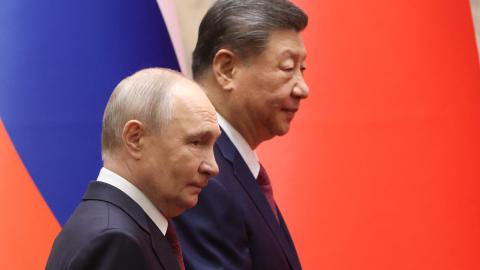
Twenty-five years later, individuals associated with the regimes of Xi Jinping and Vladimir Putin continue to embrace this morality. Their militaries have published and celebrated documents that portray victory in war as requiring the breaking of existing moral constraints. The goal is to use our self-imposed, civilized limitations as a strategic weapon against us and our allies. These arguments within Putin’s military explicitly include the use of nuclear weapons to create and then use fear. Iran and North Korea similarly anchored their highest hopes on such weapons. Moreover, Putin has kidnapped Ukrainian children and regularly uses terror strikes on civilian targets. Putin uses banned chemical weapons in ground combat in Ukraine, and he has notoriously killed enemies, sometimes using dangerous poisons. We also know that Xi and Putin are pursuing military research on biological pathogens that are now becoming targetable to specific populations and individuals.
Today, our enemies in Putin’s Russia, Xi’s Chinese Communist Party, Iran’s Islamic Revolutionary Guard Corps, and Kim Jong Un’s North Korea are more dangerous than the terrorists of 9/11. They are seeking and testing means of attack in all domains, from the heavens to the depths of the sea and from inside our bodies and minds. Their sophistication makes it difficult to track all evolving threats and develop countermeasures. The wars in Ukraine and Iran are a form of preemption, even as Putin and Iran’s leaders probe for new means of attack for strategic advantage. These wars are weakening dangerous enemies.
Is America more ready than it was on September 10, 2001? Yes, I think it is. But is it ready enough?
On the morning of 9/11, we knew Osama bin Laden and Al-Qaeda were going to strike the United States, but we did not know precisely when and how—we could not stop those attacks, and we followed rules that made Americans victims.
Now we know better. May our leaders use that knowledge in the face of today’s enemies and may the American people support such leadership.
The anniversary of 9/11 is also an occasion to reflect on the words of Victor Davis Hanson in his book Carnage and Culture:
Western civilization has given mankind the only economic system that works, a rationalist tradition that alone allows us material and technological progress, the sole political structure that ensures the freedom of the individual, a system of ethics and a religion that brings out the best in humankind—and the most lethal practice of arms conceivable. Let us hope that we at last understand this legacy. It is a weighty and sometimes ominous heritage that we must neither deny nor feel ashamed about—but insist that our deadly manner of war serves, rather than buries, our civilization.
This anniversary, may our enemies and we reflect on the fate of the 9/11 terrorists and remember that America’s great heritage includes “the most lethal practice of arms conceivable.”