Caption
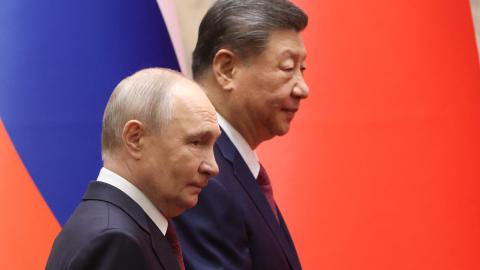
Russian President Vladimir Putin and Chinese President Xi Jinping enter the hall during a signing ceremony on May 20, 2026, in Beijing, China. (Getty Images)







Policymakers and business leaders are looking for signals about where the broader economy is headed as the US economy navigates rapid technological change, geopolitical risks, and a monetary outlook shaped by tensions between inflation and a cooling labor market. From the Trump administration’s efforts to reindustrialize key sectors of the American economy and reshape trade relationships to persistent pressures in housing and stubborn mortgage rates, the current outlook is also underscored by an increasingly uncertain geopolitical environment.
Please join Acting Chairman of the Council of Economic Advisers Pierre Yared for a conversation with Senior Fellow Tom Duesterberg on the first year of the Trump administration’s economic agenda and the key factors shaping the US economy’s outlook.
Listen on Spotify and Apple Podcasts.
Thomas J. Duesterberg:
Okay. Welcome everyone here to the Hudson Institute and to those who are paying attention remotely, we’re honored and pleased to have Pierre Yared, who’s the acting chair of the Council of Economic Advisers. He previously, in his academic career, was the MUTB Professor of International Business at Columbia Business School. And he previously served as senior vice dean for Faculty Affairs and vice dean for Executive Education at Columbia.
Pierre was educated at Harvard and MIT and Economics. His research has been published in all the leading academic journals, covers macroeconomics, government debt, central banking and inflation, and the international role of the dollar. He’s now in charge of trying to understand the world economy and the US economy and giving sage advice to the leaders of our country.
Pierre, welcome.
Pierre Yared:
Great to be here. Thanks for having me.
Thomas J. Duesterberg:
Let me start by just asking a general question. What is the state of the US economy and what can we expect going forward for growth, jobs, inflation, and wages?
Pierre Yared:
Great. Maybe I can talk a little bit about the state of the economy prior to the current conflict, and we can talk maybe later about the consequences or what may happen in the aftermath.
In terms of the economy, the economy is extremely strong. It was very strong in 2025, very strong going into 2026. The underlying factors that are behind that strength are a combination of the One Big Beautiful Bill Act, which enhanced in particular incentives for investment and work. And so that’s the first piece of it. In addition, the administration is currently engaged and has been engaged in a very rapid deregulatory effort that is consistent with the deregulatory effort that was undertaken in the very first term, the first Trump term. And that also includes a program of unleashing energy abundance, which has been helping the economy. And third, the international policy has resulted in a combination of tariffs that serve as a way to protect certain key industries while simultaneously raising revenue, combined with a lot of investment into the United States from a lot of the investment deals, as well as reduction in non-tariff barriers abroad in order to enhance the competitiveness of our experts to the rest of the world.
So all of these underlying forces have resulted in GDP growth for 2025, which exceeded all expectations. And that was despite a shutdown that did shave off some growth. Those expectations were defied before the election and even after the election. So that’s number one. Number two, that growth has been broad based in the sense that when you look at the sectors, the value added across sectors, it’s been very uniform and in particular in critical areas that this administration cares about like manufacturing. You have seen a strong growth in manufacturing value added in 2025, and there’s numerous other indicators I can add on that. You’ve seen a surge in productivity across all sectors, and in particular in manufacturing where it was weak prior to this administration.
And that surge in productivity in the economy has resulted in strong wage growth. So, it’s trickling down to the workers. And if you look at real wages, they have grown significantly. They have outpaced up until this point right now where we have a temporary blip in inflation. They have outpaced inflation. And in particular, they’ve been very strong in areas that are strategic, like manufacturing, where you see wages, wage growth actually that is faster than in other sectors.
Thomas J. Duesterberg:
So I want to dig in a little bit on some of the subtopics that went into your overall analysis. For manufacturing, how do you attribute the productivity growth? And do we count artificial intelligence as part of manufacturing?
Pierre Yared:
That’s a great question. It’s always hard to know what underlies productivity growth, but we can take a look a little bit at the data and try to look at what’s under the hood. I think that it’s a combination of the adoption of AI for certain processes. And this is more coming from some anecdotal evidence that we get from manufacturers. But I also think that a lot of manufacturing is highly exposed to regulation. And so having a deregulatory push that either involves killing regulations or alternatively not being as aggressive in their enforcement can mean that you can unleash manufacturing more easily. So a combination of AI and deregulation combined with some incentives for investment, of course, where you see a very strong investment going into the year, that can help with manufacturing.
What we have done internally when it comes to measuring the sources of productivity growth is we’ve looked across sectors and done some cross-sectional analysis to try to see what is underlying productivity growth and what can we glean from looking at the cross-section. And it does seem, and again, this is not causal, it’s just correlation, but if we just look at correlation, it looks like productivity growth across sectors is heavily correlated with AI intensity and it’s heavily correlated with deregulatory exposure.
Thomas J. Duesterberg:
Okay. Some commentators have suggested that recent growth trends rely too much on investment in AI and related data centers. A WTO study recently said that AI in quotes, “AI related trade accounted for half of US trade growth in goods and new investment in AI for 70 percent of the growth in investment.” Perhaps a better way to phrase the question is whether or not we can expect balanced growth going forward with contributions from consumers, investment outside of high technology and trade.
Pierre Yared:
So if you look at AI, the US is leading in AI. It’s leading on multiple dimensions in terms of the investment in AI. It’s also leading in terms of the adoption of the US AI stack globally. So it would be natural given that this is the frontier technology that is facilitating human flourishing, that this would be where the focus of investment is. If you consider some of the concerns that you raise, I think it’s natural to anticipate that some companies are going to do well and others are not going to do well. That’s the nature of competition and that’s the nature of the fact that we don’t live in a centrally planned society and we’re going to have a lot of tinkering and experimentation along the way.
But if I look more broadly at a macroeconomic level, I think the fact that we have had this strong investment in AI is a testament to the fact that as an administration, this administration is leaning into AI. It’s not taking an economic safetyist approach of the Europeans, for example. And as a consequence of this approach, we can expect a lot greater economic growth.
And then if you think about what’s underlying the investment, a lot of the investment I would think about as actually not only creating jobs in the immediate while these data centers are built out and so on. But I also think about it as having positive externalities in the sense that as we build more energy capacity as a consequence of this, that that can serve dual use and that can benefit everybody.
Thomas J. Duesterberg:
Are you worried about energy prices, especially electricity as a result of the build out of data centers?
Pierre Yared:
That’s a great question. That’s a great question. And the way to deal with that is to facilitate the building. And the President recently created a rule that basically said that anyone who’s building a data center has to do it behind the meter, and that makes it so that we’re actually building additive capacity above and beyond what’s currently available so that we’re not drawing on current energy capacities. So that’s the sense in which the data build out actually has a lot of positive externalities in terms of increasing the amount of investment in energy capacity in the country overall.
Thomas J. Duesterberg:
Is it going to be a strain on our domestic energy production capacity? Are we going to be able to use domestic resources primarily to power these-
Pierre Yared:
Look, along the way, as we engage in this transition, you need a price signal in order to create incentives for that additional build out, and what we are seeing is partly reflecting that. What’s true is that there’s a difference across states as we see that build out. In general, energy inflation and electricity prices are much higher in states that are heavily regulated, in particular blue states relative to red states. And so the way to deal with the challenge that you raise is to just ensure that there are no impediments, artificial impediments to that build out. We’re doing everything we can at the federal level, but of course, the onus is also at the state and local level. Given these energy needs, it’s important for states and localities to ensure that they are not hampering the build out.
Thomas J. Duesterberg:
One of the components of the President’s trade policy has been working with other countries to try to incentivize them to invest more in the United States, including in the energy sector. Are you seeing positive results from that? For instance, we have lots of oil and gas in Alaska, but it’s going to take an incredible amount of investment to get it to market, to build out the infrastructure. It would be in current circumstances and probably going forward extremely valuable to the Pacific Rim countries to have these resources available. Are you seeing signs that those sorts of resources are going to be supported by our allies?
Pierre Yared:
I mean, there’s been a number of commitments that have been made already, and a lot of those commitments have manifested, have led to further conversations about the details of how these investments will be made, where they will be made and where they have panned out. But I don’t want to get ahead of that, but certainly these are conversations that are happening.
Thomas J. Duesterberg:
Okay. Digging down into the growth path of the United States, there’s been a spade of articles and commentary recently suggesting that the US is in a longer term pattern of, quote-unquote, “K-shaped growth.” The Mamdani wing of the Democratic Party seems to have grasped this idea. It consists of in their argument that wages and consumption growth are skewing towards the upper deciles of the wage distribution rankings while lower deciles are mired in a cycle of stagnating real wages and slow consumption growth.
If this is plausible, is such a structure sustainable and capable of driving overall growth, or is it a recipe for slower growth?
Pierre Yared:
So, if you look at the data and some of the data for 2025 and more recently in ‘26, this isn’t government data, but we have some data from private sources on that. And there’s been some studies like the New York Fed recently did a study where it does not seem like there is evidence of K-shaped growth, at least certainly in 2025 and 2026. It looks like if anything, it looks like there may be a reversal from some of that K-shaped growth that we saw between 2020 and 2024. If you look at 2020 to 2024, there’s a little bit of evidence, if anything, of a slight U-shape in the sense that consumption shares shifted towards the very top and towards the very bottom, but then you had a loss in the middle. But these are quantitatively small and this was happening prior to this administration.
If you look at the more recent data, some of that more recent data has been studied, we don’t have the Consumer Expenditure Survey since that time, but if you look at attempts to forecast that, like for example, Barclays has done that, or if you look at the New York Fed study that I cited, it looks like there is no acceleration of that trend. And if anything, there may be a deceleration of that trend since 2025.
And that’s actually consistent with some other things you can look at, particularly on the labor market. So, on the labor market, you can look at the percentage growth rate in employment by sector, and you can compare the variance, you can look at what’s happened to the dispersion of that. And then you can also look at the percentage growth rate in wages by sector. And what’s happened actually in 2025 and into 2026 is that you see a significant shrinking in that dispersion. So that tells you that the growth is actually much more balanced and much more broad-based than it was in the previous administration.
So when I look at this criticism, I would say that if anything, this administration is ensuring that we have much more broad-based growth versus more narrow growth.
Thomas J. Duesterberg:
There’s a study by Scott Winship, I think at AEI, but I may have that wrong, that suggested that one of the things that’s going on in at least the middle, what we define as the middle class, which is kind of an elastic concept, but is that lots of people in the lower two deciles have moved up to the upper levels of the middle class and that in fact, some of the shrinkage of the middle class, which the Mamdani wing seems to focus on, is a chimera of sorts.
Does your study of the data support the movement of people into the higher levels of the middle class?
Pierre Yared:
So I think I have a vague recollection of looking at that study. We haven’t looked at that specifically, but if I remember correctly, a lot of that had to do, pardon me, with looking at how pre-tax income intersects with taxes and transfer system, and it examines the extent to which issues like benefits, cliffs, and so on can make it so that the middle can be worse off than the very bottom. And it’s certainly the case that these are issues that are constantly being . . . That we study at the Council of Economic Advisers, because what’s very important is ensuring that no one is penalized for working. And in fact, we’re coming out today with the economic report of the president, and part of one of the chapters in that report is actually going to focuses on the non-economic benefits of work and the importance of ensuring that people who work are able to reap the fruits of their labor, but also experience some of the benefits that come along with working.
Thomas J. Duesterberg:
Tomorrow here at Hudson, we’re going to have Senator Phil Graham, who’s been a longtime actor in the economic side of US policy, but in recent years since he’s retired, he’s been a very active commentator and analyst, he has been concerned for a while about the declining labor participation rate, especially in the lowest quintiles of the income level. And he has been actively advocating for something that happened in the mid ‘90s when the Clinton presidency and the Newt Gingrich Congress, which was an agreement on welfare reform with a work requirement. So the labor participation rate in March was the lowest in 40 years.
Pierre Yared:
For prime age workers, it was the highest in 20 years.
Thomas J. Duesterberg:
For prime age workers, 50 to 20 . . . Or what is it? 15 to 45 to 54?
Pierre Yared:
16 and above.
Thomas J. Duesterberg:
16 and above?
Pierre Yared:
Oh, no. Sorry. On the spot, I don’t . . . We’re excluding 55 and above, so it might be 16 to 55, or I’m not sure—
Thomas J. Duesterberg:
Okay. Well that’s—
Pierre Yared:
. . . 20 to 55. Yeah.
Thomas J. Duesterberg:
. . . a good corrective.
Pierre Yared:
And so if you look at prime age workers, both female and males were at the highest level since 2000. So that tells you that the economy is healthy and we’re able to get a lot of people off the sidelines to work.
Thomas J. Duesterberg:
Okay. Well, since you mentioned the economic report of the President, maybe we can look ahead. Is it out yet or is it in—
Pierre Yared:
It’s coming out today at noon.
Thomas J. Duesterberg:
At noon?
Pierre Yared:
Yeah.
Thomas J. Duesterberg:
Okay. Well, maybe we can—
Pierre Yared:
I guess in 10 minutes.
Thomas J. Duesterberg:
Does it say anything about work requirements?
Pierre Yared:
Yes, that’s going to be discussed, and that’s in there as part of the various measures that were in the One Big Beautiful Bill Act to enhance incentives for working.
Thomas J. Duesterberg:
Okay. Well, we’ll look forward to that, and we’ll try to get Phil Graham to weigh in on this.
Pierre Yared:
Yeah. Sure.
Thomas J. Duesterberg:
All right. Another general question about where we’re at. Two of the President’s economic priorities are rebalancing global economic growth and trade, and strengthening the manufacturing sector. You already talked about the manufacturing sector. Could you comment on the progress in sort of global rebalancing of duties and responsibilities and who’s taking . . .
Pierre Yared:
Yeah, this is a great question. There’s both a trade dimension to it as well as a national security dimension to it. The national security dimension, which is outside of my purview, has to do with ensuring that our allies are doing their jobs in terms of their defense spending obligations. When it comes to trade, the rebalancing is really about ensuring that other countries don’t have non-tariff barriers that preclude us from being able to sell our exports into their markets and because that just creates a very unbalanced situation where our markets are open to them, but then their markets are not open to us. And a lot of the bilateral negotiations, many people often just focus on the investment components of it.
But what’s really important is to note the fact that a lot of these negotiations resulted in agreements regarding non-tariff barriers, ensuring, for example, that certain sectors where we’re extremely strong, for example, in medical devices, that they don’t have artificial regulatory barriers that are preventing our medical devices from entering their markets. And this is ultimately just . . . This is productivity-enhancing for everybody, because if we’re really good at making things, there’s no reason why they should be excluding our exports from their markets. And I think that we have succeeded in that regard over the past year as part of all of these trade negotiations, because what’s embedded in every single one of them is an agreement for these other countries to drop their non-tariff barriers.
And what that does, if you sort of want to think about it the way I think about it as an economist is that what that does is that raises income. It raises national income for Americans, as we sell goods abroad. And when you raise national income, that raises US savings relative to investments. So that closes the deficit here and it closes and would expand it over there as they’re buying our import. So that’s a type of rebalancing, that’s a force for rebalancing through these trade deals.
Thomas J. Duesterberg:
So do you expect that we will be seeing this reflected more fulsomely in the numbers as we?
Pierre Yared:
Yeah. So the way I would think about the trade deficit is as follows. In the near term, what you can see is that there are some changes in the trade deficit, but we continue to have a lot of imports. But the key part of that equation is that a lot of these imports are actually in capital goods versus final goods, which is consistent with the idea that there’s a lot of reinvestment into the industrial capacity of America. So in the near term, you should actually see a surge in capital goods imports while we do a lot of this reshoring. And then in the longer term, when you produce more here, you should anticipate less of those particular types of goods imports because we’d be producing more of them over here.
What you do see in general, because one of the goals of the trade agenda has also been to de-risk the supply chain, is that the supply chain has also been de-risked away from China, because it was heavily dependent on China. And today, for example, the bilateral trade deficit with China is at the lowest level since prior to China’s entry into the WTO.
Thomas J. Duesterberg:
Right. Well, since you raised the question, another point of contention in the United States and globally is industrial policy. And as a purely economic matter, there’s been a lot of debate on whether or not it actually works, if you will. The Federal Reserve Board, surprisingly to me, weighed in on this subject with regard to China, and the IMF also recently put out a new study on global balances and how to evaluate them, but both of them suggested, using different methodologies, that the extensive use of industrial policy in China has actually had a real impact on their balance of trade. The Fed said that, I’m quoting from memory here, something like three-quarters of the trade deficit that China enjoys with the rest of the world is in the top 10 or 15 most sectors most affected by their industrial policies.
Does your research support those sorts of conclusions and is there a policy recommendation that your administration has taken or will take to address that problem?
Pierre Yared:
I think the way to think about this is that the Chinese government pursues a slew of policies, capital market policies, industrial policies, currency policies, et cetera, which in their totality have resulted in a large current account surplus, but it’s not necessarily just vis-a-vis the United States; it’s vis-a-vis the rest of the world. And these are policy decisions that have been made by the Chinese government that have ramifications for the rest of the world. And part of what has inspired those studies by the IMF and the Fed is simply that, but I’m not going to get ahead of whatever negotiations ensue in the next . . .
Thomas J. Duesterberg:
Okay.
Pierre Yared:
Yeah.
Thomas J. Duesterberg:
Purely at the macroeconomic level, many have argued, including myself, that the Chinese economy is really a lot weaker than their official statistics suggest, but real economists have made that argument as well. It’s clear too that the European economy is in a long-term slowdown. The Japanese economy we know has been slowing for 30 years, and they can’t seem to quite break the cycle. In the long run, well, short to medium run even, is the lack of dynamic growth in the major industrial economies of the world a real problem for our growth in the United States?
Pierre Yared:
I think we can focus our attention on making sure that we grow, and that’s what the administration is doing with the slew of policies that I mentioned. What’s true is that as a share of GDP, trade is still low in the United States relative to some of these other countries, and it’s relatively diversified, which means that in general, the exposure to other countries can be mitigated, to other countries’ economic cycles.
There’s many different reasons for some of the slowdown in China as well as the relative stagnation in Europe. In Europe, a lot of it has to do with a significant emphasis on red tape in the sense that deregulation is a dirty word, and that’s part of the challenge. Even though they all understand it, there have been numerous reports and communications, meetings and speeches, and so on about it, but what’s important is trying to figure out ways to move forward, given that they have recognized that a lot of this red tape is stifling economic growth in Europe.
In the case of China, the slowdown comes from multiple sources that are well documented in the academic literature. A lot of it is because it gets harder to grow as you get richer. A lot of it is because of demographics. Some of it is the overhang from the overbuilding of real estate, and some of it is likely a consequence of moving away from a more of a market-based system towards a top-down system of innovation. And so a combination of all of these factors can reduce the degree of economic growth as well in other countries. But what we can do is to ensure that the US continues to be a place with significant economic growth and can attract investment from abroad, which it has been because of the amount of innovation activity that’s happening here domestically.
Thomas J. Duesterberg:
I saw a figure today that indicated that the first quarter of this year, the initial public offerings in the United States reached a new record. And the trend over the last, I don’t know, 10 years or so has been for incoming investment in the United States to be very strong. Are you confident that we can maintain this? I mean, this is a great source. I know economists think about this in a different way, as it’s sort of a balancing of trade balances. But, it seems like the gravitational pull that the Chinese like to think they enjoy is really in the United States because we’re just a more dynamic economy.
Does the evidence support that?
Pierre Yared:
Does the evidence support that we are a dynamic economy?
Thomas J. Duesterberg:
No. No, no. Is inward-bound investment, which was really strong in the last 20 years, likely to continue?
Pierre Yared:
I mean, I would argue that it would if we continue to be a place where we are leaning into the future, where we continue to innovate as we have been. If you look at productivity growth, as I’ve mentioned, has been very strong. We’re the leaders in the most recent innovative technology, and that innovative technology is not being only just used in the United States, it’s being used globally. We have very deep liquid financial markets, and that’s an advantage that we have relative to other countries, which is part of why we are able to attract so much investment.
Thomas J. Duesterberg:
Okay. I want to ask a few questions about China, because that’s an area of particular interest to me, but also because they are the major rival competitor, whatever the term we want to use is. So China’s public and private sectors are highly indebted, returns on capital are weak, and its banking sector is constantly in need of recapitalization. In recent years, in the 21st century, China has created six times more money in M2 equivalent than the United States, and its total money stock is now larger than that of the US and the EU combined. Last year, China created about eight times more M2 equivalent than the United States, yet its economy is beset by deflation.
Would this be possible in a market-oriented system, and how do they sustain this?
Pierre Yared:
Well, so I have to confess that we haven’t actually studied that particular question the way you phrased it. But I’ve been an economist for many years and I’ve been teaching for many years. So if I was asked this question by a student and trying to think through broadly what are the patterns in history about financial crises, it’s not obvious that when you have, let’s say maybe a financial, let’s not say crisis, but a financial disruption where there’s a lot of leverage in the system and some non-performing assets, it’s not obvious whether that’s inflationary, deflationary. There are examples where it’s inflationary and the currency drops. There are other examples where it’s deflationary, like in the aftermath of the Japanese financial crisis.
And so, there’s a lot of patterns. Those patterns are a function in part about . . . They’re a function in part depending on the size of the economy, depends who that debt is owed to, whether it’s internal or external. And it’s a function also of domestic policies regarding capital markets and the relationship between domestic capital market and the international capital market. And with all of those things in mind, I think it would make sense that if there is some financial stress and that stress is manifesting itself with non-performing loans and so on, that attempts to remedy the situation also come hand in hand with continuing deflation. Which is part of what we saw in the aftermath of the Japanese financial crisis.
What it means for the rest of the world is that we do have a lot of exports that are ending up in the rest of the world, and those exports are relatively cheap because that deflation is manifesting itself in very cheap exports for the rest of the world. So a lot of that overcapacity is leading to a lot of exports elsewhere.
Thomas J. Duesterberg:
Well, I mean, it’s part of the Chinese model now that it’s mercantilist export-oriented growth. You don’t have to comment on that, it is my characterization.
Let me ask another question about China, and realizing that you’re an economist giving economic advice, you’re not trying to run the financial system in the United States, which is the job of the US Treasury. But China is trying to create an alternative payment system to rival and undermine the dollar-based system. Recently, many countries, and most recently, France and Germany, have moved gold bullion out of the US, out of Fort Knox, and out of New York, and back to Europe. And some suggest this is a sign of lower confidence in the ability of the US to sustain the global dominance of the dollar. Some attribute the ballooning price and the sustained high price of gold to not only the efforts of China, but some decline in global confidence about the dollar as the reserve currency.
So how do you evaluate these questions? And is China’s challenge to the dollar-based payment system an attempt to make the yuan competitive with the dollar in foreign reserve holdings, gaining any real traction? And I would note to our audience that Pierre is an academic expert on the role of the dollar. So as a purely academic question, how would you characterize what’s going on?
Pierre Yared:
Before saying anything, I just want to be clear that the President has stated on numerous occasions the importance of the US dollar maintaining reserve status. And moreover, Secretary Bessent has also talked about the fact that a strong dollar policy does not mean that we manage the currency. It means that we maintain an open capital market where we’re open to the world and everybody can invest in America. And our job is to ensure that we facilitate supply-side growth that makes investing in America attractive. And that’s the most important way to move forward on these international financial issues.
I have written about the subject in the past in my personal capacity and the US dollar . . . And again, this is what my research has shown: this is not an administrative position, but my research happens to have shown that the dollar is an insurance mechanism, particularly when there are geopolitical shocks, and that’s what’s shown in some of my research. And looking now at the data, nowadays, it seems consistent with that particular view.
But like I said, the purview of currency policy and exchange rates is that of the Treasury, and the President has been very clear that it is imperative to preserve reserve currency status.
Thomas J. Duesterberg:
Have you seen any hard evidence that the Chinese are being successful in luring other countries to join their own alternative payment system and to move reserves out of the dollar and into the Chinese currency?
Pierre Yared:
I’d rather not comment on that question.
Thomas J. Duesterberg:
Okay. Well, one final question on China. I mean, as an academic question, they have a closed financial system, and the currency is foreign exchange is not convertible, except by several banks that China uses to operate the payment system. Is it possible for them to have an alternative currency system with a closed financial market as an academic matter?
Pierre Yared:
Listen, I’d be very happy to examine these ideas over drinks. But in general, I would say that part of what’s important for a reserve currency is having a large, deep, and liquid market, and that’s what the US dollar is able to provide to the rest of the world.
Thomas J. Duesterberg:
Has the greatest financial system in the world, and it’s attractive.
Pierre Yared:
Exactly.
Thomas J. Duesterberg:
Okay. Turning to current events, we have seen in the last six weeks an increase in the price of oil and gas, and supplies seem to be constrained. One item that is perhaps understudied and under understood, including by myself, but is natural gas. And the natural gas market has been growing by leaps and bounds in the last couple decades, led by the United States with our shale resources and our LNG export resources. Partly because of that, there seems to be a huge discrepancy in the price of natural gas right now, but also historically between the US and most other parts of the world, the price of natural gas in Europe is four to five times that of the United States, which is as a purely competitive matter for our industrial economy helps us, but China has also been able to access through Russia and its allies or friends in other authoritarian countries, some supplies of cheap oil and gas, but that’s changing now in recent times.
But just in terms of the price of gas, is the United States going to . . . Is the price of gas here going to remain different by such margins with the rest of the world? Is there ever going to be a global market for natural gas?
Pierre Yared:
Look, it’s a good question. Since when this administration came in, we started facilitating exports of natural gas, and that’s in part to ensure that we’re not artificially hampering our own LNG exporters, and we make sure that they’re able to sell their product into the rest of the world. Right now, the markets do still look segmented, but you can anticipate that over time, if the market does become more integrated, that the prices can become more integrated.
Thomas J. Duesterberg:
Do you see in around the world more efforts to build the infrastructure for LNG? Qatar has some of the biggest resources, natural gas resources in the world, but they were always reluctant to build out the LNG export capacity. They drive a hard bargain. The Australians also have huge supplies of natural gas, but for I think more political reasons, they’ve chosen not to develop those resources. We have more resources than we know what to do with, but there has been reluctance partly for economic reasons, but some political reasons as well.
Do you anticipate further development of LNG, let’s say here, but also amongst some of our allies, so that this discrepancy in prices gradually dissipates or narrows. And you mentioned several times the efforts of this administration to promote more gas development and LNG development, but maybe you could give us a few details on that as well.
Pierre Yared:
I think that the way to think about this question more broadly is that a lot of our allies, and particularly the Europeans, have artificially hampered their ability to harness their own homegrown energy, shutting down nuclear plants, shutting down coal-powered plants, and not engaging in any energy exploration. Now, can I forecast the future? The future is going to depend on their own policy decisions. It’s possible, one would hope, that given the geopolitical shocks that we have experienced over the past few years that should serve as a kind of a wake-up call to maybe engage in more exploration of finding alternative energy sources that are readily available. And the ones I just listed are there and available to them. So, it’s possible that those are the directions they go into, but fundamentally, these are political questions.
Thomas J. Duesterberg:
One final question on this subject, the trade system as articulated by US trade representative and the entire administration seems to be moving towards what the trade geeks call plurilateral agreements among like-minded countries, and amongst those are efforts to build out safe supply chains like in rare earth minerals. Do you anticipate that, or do you think it would be a good idea to try to do something with energy as well, so that going forward, there aren’t choke points as they’ve existed in the last hundred years or so in the Middle East? Should we pursue these sorts of plurilateral agreements with our friends in the energy sector?
Pierre Yared:
Look, that’s up to the President. In general, the focus has been on ensuring that we have a diversified supply chain for the defense industrial base. And certainly one of the . . . There are multiple tools in the toolkit to make that happen. And one of the tools in the toolkit to make that happen is the one that we see with the Critical Minerals Alliance, where there are agreements for free trade in critical minerals, as well as agreements on price floors, to ensure that there’s sufficient incentives for the production and refining of critical minerals. But in general, one can imagine such a model for other critical goods as well.
Thomas J. Duesterberg:
Okay. Well, Pierre, I know you have to get back to the White House for a meeting, and you’ve got the release now of your annual report. So, let’s call this meeting to a close. And please join me thanking Dr. Yared for a wonderful overview of economic policy and some lessons in pure economics.
Pierre Yared:
Great. Thank you.

Hudson welcomes Karel Řehka, former chief of the General Staff of the Czech Armed Forces, to discuss the changing security environment in Europe and its implications for the Czech Republic, the North Atlantic Treaty Organization, and the transatlantic alliance.


Bill Frauenhofer, executive director for semiconductor investment and innovation at the US Department of Commerce, will join Hudson Institute Senior Fellow David Feith for an invitation-only fireside chat on semiconductor onshoring and the role of government capital in strengthening America’s technological and industrial leadership.


Please join Hudson Institute for a special address on the current state-of-play by Ukrainian President Volodymyr Zelenskyy, who will join remotely, followed by a question-and-answer session on the war with Hudson Institute President and CEO John Walters.

Join Hudson Institute Senior Fellow Ken Moriyasu for a panel with Chaim Martin, Israel’s minister of economic affairs to the United States; Aslı Aydıntaşbaş of the Brookings Institution; Soner Cagaptay of the Washington Institute; and Director of the Center for Peace and Security in the Middle East Michael Doran as they examine the logic behind each framework and what their rivalry means for US policy.