












In the early hours of February 26, 1990, Daniel Ortega walked into a Managua auditorium to concede an election he had been widely favored to win. He was 44, a guerrilla who had governed a country at war for a decade, and had campaigned on the premise that U.S. imperialism was to blame for Nicaragua’s woes.
While parallels were already surfacing between Ortega and Anastasio Somoza, the right-wing dictator he helped overthrow 11 years earlier, he assuaged fears of a power struggle and told the room the government would “respect and abide by the popular mandate.” In a pointed remark aimed at the Somoza regime’s intergenerational cronyism, he stated that his movement was composed of those who “never sought to cling to power, who were born poor and will be satisfied to die poor.”
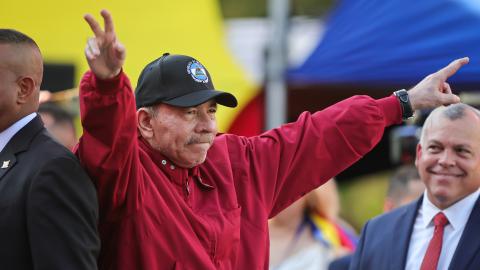
More than 19 years into the five-year term he won in 2006, Ortega drove one of his Mercedes-Benz vehicles into Managua’s Plaza de la Fe on the evening of July 19, 2026, for an event commemorating the 47th anniversary of the Somoza dynasty’s fall. Now 80, Ortega had not been seen in public for the previous 61 days, but he still managed to channel some revolutionary bluster. In a fiery speech, he vowed there would be no more elections for the opposition to use to return to the presidency — “jamás, jamás, jamás” (never).
The reaction from abroad was swift. Within a day, Secretary of State Marco Rubio accused Ortega and his wife and co-president, Rosario Murillo, of dropping “even the pretense of popular consent”; Panama recalled its ambassador, and by week’s end even Lula da Silva’s government in Brazil had objected.
Regime officials soon qualified Ortega’s declaration. Gustavo Porras, president of the National Assembly, told state media that Nicaraguans would vote after all, provided the ballot excluded “traitors to the homeland” and parties financed from abroad. Porras also announced that legislation to approve election reforms would be ready in the first week of August.
While pressure from abroad may be able to alter the nature of these reforms, major changes will be needed to reverse the damage Ortega has already inflicted on Nicaraguan democracy.
Digging into power.
After the 1990 defeat, Ortega spent 16 years clawing his way back into power. In 2000, he negotiated a pact with then-President Arnoldo Alemán that cut the threshold for an electoral victory to 35 percent and divided the courts between their political parties. While Ortega lost in previous attempts to regain the presidency in 1996 and 2001, in 2006 the pact’s reforms returned him to the presidency with only 38 percent of the vote.
Ortega wasted little time in entrenching his increasingly authoritarian rule. In October 2009, a Supreme Court panel packed with his supporters ruled that the constitutional ban on reelection did not apply to him, and in January 2014 the Assembly wrote the ruling into the constitution, abolishing term limits outright.
Ortega’s second act was financed by Caracas. Under an oil accord he signed with Venezuelan leader Hugo Chávez in 2007, Venezuela shipped crude and fuel to Nicaragua while letting Managua defer payment on roughly half of every invoice as a long-term loan at token interest. Everyday Nicaraguans paid the full price at the pump, but the deferred half stayed inside the country and accumulated in Albanisa, a joint venture between Venezuela’s oil company and a holding company controlled by the Ortega family. The central bank recorded this as a private investment rather than a public debt to place it beyond the reach of auditors, and the Ortegas used the funds to establish a $2.5 billion family business empire spanning fuel, banking, and television.
The extent to which Ortega was willing to go in order to remain in power became clear in April 2018, when the government used live fire to suppress student-led protests following an unpopular pension reform. The Inter-American Commission on Human Rights counted 325 dead by late November, 24 of them children.
With his popularity waning, Ortega took steps to ensure that he would not be democratically removed from office again. In the summer of 2021, police arrested several potential presidential candidates, beginning with Cristiana Chamorro, whose mother had beaten Ortega in 1990. That November, the electoral council declared Ortega the winner of a vote the observer group Urnas Abiertas found 4 in 5 Nicaraguans abstained from. Between February 2023 and September 2024, the state stripped 452 people of their citizenship, including the novelist Sergio Ramírez, and by 2025 it had dissolved more than 5,600 civic organizations, closed 61 news outlets, and confiscated some 26 universities.
A near-total rewrite of the constitution took effect in February 2025 and further limited the possibility that Ortega could be peacefully or democratically removed. The new provisions saw Murillo installed as co-president, stretched presidential terms to six years, moved the next general election from November 2026 to November 2027, and demoted the legislature, courts, and electoral council from branches of government to organs the presidency “coordinates.” Ortega’s latest attempts to extinguish or formally tamper with elections are the latest stage in a sequence in which every domestic institution capable of removing him has been captured, rewritten, or abolished.
What changed after Maduro’s fall.
After American forces captured Venezuelan dictator Nicolás Maduro in January, Ortega’s behavior underwent a temporary but telling shift. Despite Nicaragua’s close ties to Venezuela, Managua took half a day to issue a statement on Maduro’s capture. When it came, it was brief and lacked the regime’s usual caustic and anti-imperialist rhetoric. Within a week, the government released roughly two dozen political prisoners, and by early February it had revoked visa-free entry for Cubans, shutting down a popular path for irregular migration to the United States. For those five weeks, the regime conducted itself like a government that believed it might be the Trump administration’s next target.
That posture did not hold. After the U.S. Treasury Department issued sanctions against two of his sons and seven Nicaraguan gold companies in April, Ortega called the American president mentally unhinged, and by July he felt emboldened enough to call the Maduro operation a monstrosity and announce the end of elections. Evidently, Ortega has concluded Washington is not coming for him. In order for conditions in Nicaragua to change, the United States has to convince Ortega that he’s wrong.
Why act now?
For U.S. policymakers, there are three major time-sensitive considerations. The first is that the window between the August vote on electoral reforms and their ratification in January is when American policy can still shape the outcome of the law. The second is that Moscow is building out machinery that will help keep Ortega in power. In addition to its satellite station outside the capital, Russia ratified a military cooperation agreement with Managua in May that formalized joint training and intelligence sharing. Wider or further defense agreements with Russia in the future would drive up the cost of imposing deterrence.
The third is that Ortega’s health appears to be faltering; he has appeared in public only eight times this year. Ortega would be succeeded by his wife, who is widely unpopular (many in Nicaragua believe her to be an actual witch, and she has done little to prove them wrong). Murillo’s hold on power would be weaker than Ortega’s, which in turn could make her less likely to negotiate with the United States or the exiled democratic opposition and more likely to resort to desperate measures to stay in power.
What should Washington do?
While American policy toward Nicaragua will inevitably be compared to its policy toward Cuba and Venezuela, Nicaragua’s circumstances are distinct. Unlike Nicolás Maduro and Raúl Castro, Daniel Ortega has not yet been named in an unsealed U.S. indictment, which makes his capture in an American operation highly unlikely.
Nicaragua is also in a better position than Cuba or Venezuela to withstand economic pressure. While Havana and Caracas remain vulnerable due to the decrepit state of their economies, Managua is solvent. The International Monetary Fund closed its latest review in January by noting the Nicaraguan economy’s resilience: Growth has averaged 3.9 percent since 2022, inflation runs under 3 percent, public debt sits near 45 percent of GDP, and reserves stand at record levels.
Despite this, there are a number of areas where the regime could be susceptible to U.S. pressure. Nicaragua’s own energy ministry reports that every barrel of its crude and roughly half of its refined fuel come from U.S. suppliers; two companies, Puma Energy and UNO, bring in some 97 percent of that fuel. Nearly half of the country’s exports go to the American market, and the overwhelming majority of the remittances that keep many household incomes afloat in Nicaragua are earned in the United States.
The first move should come before the August vote. Treasury has designated six of the couple’s children for sanctions since 2019, but the family’s fortune has survived because it sits behind frontmen rather than in the family’s own name. Washington can still reach the two children who remain off the list—Luciana and Carlos Enrique Ortega Murillo, who run the family’s television stations—and designate them alongside any of the family’s known frontmen and holding companies in real estate, advertising, and media that have yet to be designated.
Every designation should carry a way out. When Manuel Cristopher Figuera, Venezuela’s intelligence chief, broke with Maduro in April 2019, Treasury delisted him a week later and said plainly that sanctions need not be permanent. Given how fickle and punitive the Ortega regime has been toward its supporters, there is a realistic path for laying the groundwork for defections at the elite level.
If the Nicaraguan assembly approves the electoral reform in the first legislature, the U.S. should target Nicaragua’s gold next. Gold earned Nicaragua $1.35 billion in 2024, and it has historically gone to the American market; Treasury’s April action documented one firm in the family’s network shipping $25 million of it here last year. The G7 ban on Russian gold serves as a precedent, and gold shut out of the deepest market will have to be sold at a discount through gray market channels. This loss will be borne by the Ortega family and its loyalists while sparing everyday Nicaraguans.
Other instruments should stay in the drawer for now, but should not be ruled out. Suspending Nicaragua’s trade preferences, restricting remittances, and cutting off fuel should be kept as visible options and used as potential leverage in future negotiations with the regime.
It would also be a grave mistake to make a point of ruling out direct military intervention. The most significant shift in Managua’s behavior occurred when the regime feared that the U.S. might be willing to use force against it. In order for there to be any hope for an end to Ortega’s brutal regime, the U.S. has to convince him that our policy is aimed at getting him out by peaceful means if we can, and by other means if we must.