
















Executive Summary
More investments from Taiwan are flowing into the United States than ever before, and they are supporting US national security interests by building up domestic semiconductor and technology production. The White House should recognize the significant progress that has been made toward implementing the US-Taiwan investment agreement signed in January, and it should also seek to create a bilateral tax agreement with Taiwan to further support new investments. At the same time, the Trump administration’s artificial-intelligence and trade policies have worsened the US trade deficit with Taiwan. The White House perceives large trade imbalances as a threat it must address, but directly addressing the growing trade imbalance with Taiwan would threaten the US goal of building the largest and greatest AI ecosystem in the world. Taiwan is America’s most important trade partner right now, and US trade policy should support America’s AI ambitions.
Introduction
On July 16, 2026, the Commerce Department announced that Taiwan Semiconductor Manufacturing Company (TSMC) will invest $100 billion in the United States in advanced semiconductor manufacturing capabilities.[1] This is in addition to the $100 billion investment the company announced in March 2025 and the $65 billion it has been investing in Arizona since 2020, which will bring its total foreign direct investment (FDI) in the US to at least $265 billion.
TSMC’s investments, even without other investments from prominent Taiwanese tech companies like Foxconn and GlobalWafers, put the total amount of Taiwanese FDI in the United States at well over the $250 billion minimum agreed to, according to the Commerce Department, in the US-Taiwan investment deal announced in January 2026.[2] More FDI from Taiwan has been flowing into the US tech sector than ever before. At the same time, the US trade imbalance with Taiwan has grown significantly worse due to insatiable American demand for AI. Taiwan is the largest source for servers imported to the United States as well as the advanced semiconductors on which the servers are based. Because of the high value of Taiwanese imports, by the end of 2026 Taiwan could become the country with which the US has the largest annual goods trade deficit—a symbolic designation historically held by China or Mexico.
Addressing US trade imbalances is one of the White House’s most important priorities.[3] The administration has been using aggressive trade policy to reduce trade deficits while creating bespoke trade and investment agreements with the largest US trading partners, including Taiwan.
However, ensuring that the United States maintains its leadership in AI is another White House priority, and taking punitive action against Taiwan because of the trade imbalance would throw the US off its path toward AI dominance.
Growth in AI demand has been very good for the US and Taiwanese economies, and the benefits have far outweighed the harm the United States has suffered from its trade deficit with Taiwan. Nearly 50 percent of growth in US domestic demand over the last two years as well as the majority of gains on the S&P 500 are attributable to the AI boom.[4] The strategic importance of American investments in AI is enormous; President Donald Trump has called the AI race “a test of our capacities unlike anything since the dawn of the Space Age.”[5]
The United States needs to win the AI race, and it needs Taiwan in order to do so. Taiwan may very well be the most important US economic and strategic partner right now. While balancing trade deficits is an important goal for this administration, it should not come at the risk of jeopardizing America’s competitive edge in AI development. Washington should therefore make accommodations to take advantage of this important relationship.
American Tech Interests and Taiwan
The United States is in a race to build the world’s largest AI ecosystem. The White House sees this as an imperative and believes that success will usher in a golden era of prosperity. As part of its efforts, in July 2025 the Trump administration released America’s AI Action Plan, which explains the strategic thinking on the regulatory, energy, infrastructure, talent, and technology elements that affect AI development in the US.[6]
AI development has already proven important for the US economy. Investments in computers, data centers, and software have all contributed meaningfully to US gross domestic product growth through the first half of Trump’s second term and will likely continue to boost the country’s GDP for years to come.[7] Estimates project that AI investments will add anywhere from 1–20 percent to US GDP in the next 10 years.[8]
In the future, America will probably produce more of the components necessary for this AI buildout. But for now it relies heavily on Taiwan for the manufacture of the advanced semiconductors and servers.[9] In 2023, Project 2049 Institute and the US-Taiwan Business Council estimated that losing access to Taiwan’s semiconductor industry would cost the US economy $1.6 trillion (roughly 8 percent) of annual US GDP.[10] Today, with the growth in demand for AI, that figure would likely grow to well over $2 trillion, according to estimates by this author.[11]
US Trade Policies Affecting Taiwan
The US-Taiwan economic relationship primarily involves trade in goods, and since “Liberation Day” on April 2, 2025, the administration has used a variety of laws to impose tariffs on these imported goods (see table 1). It has also announced exemptions from tariffs on goods such as semiconductors, servers, electrical parts, agricultural goods, aircraft components, and other commodities, leading importers to deal with a patchwork of trade policies and compliance requirements.
Two trade laws currently affect imports from Taiwan: the Trade Act of 1974 (Section 301) and the Trade Expansion Act of 1962 (Section 232). Under Section 301, the Office of the United States Trade Representative (USTR) can investigate and act “to enforce US rights under trade agreements or respond to certain foreign trade practices.”[12] Section 232 authorizes the commerce secretary to investigate to determine whether an import threatens US national security.[13]
USTR has conducted two Section 301 investigations that included Taiwan. The first considered whether Taiwan had failed to impose and effectively enforce a prohibition on importing goods produced with forced labor.[14] The office found that it had failed, and that this benefited its economy. However, in February 2026 the US and Taiwan signed an agreement on reciprocal trade (ART) in which Taiwan agreed to address this problem,[15] so USTR will impose only a 10 percent cap on imports, other than exempt imports and commodities covered by Section 232. This is in contrast to the 12.5 percent that the US has placed on imports from other countries that failed to address the forced labor problem. The White House has also continued tariff exemptions for commodities like semiconductors and smartphones.[16]
The second Section 301 investigation looked into whether Taiwan and several other countries have structural excess capacity and production in their manufacturing sector.[17] No determination has yet been made.
A dozen Section 232 investigations have led to the application or adjustment of tariffs on imports of certain metals, vehicles, minerals, chemicals, semiconductors, and drones.[18] Section 232 tariff rates range anywhere from 10 percent to 100 percent, depending on the commodity. However, these rates do not stack on top of the Section 301 tariffs. Except for the commodities that are exempt through the US-Taiwan investment deal, these tariffs affect more than $5 billion worth of annual imports from Taiwan.
Table 1: Tariff Timeline Affecting Imports from Taiwan

Source: Author’s research.[19]
The Growing Trade Imbalance
The White House believes that US trade deficits are the result of other nations’ “taking advantage” of the United States.[20] The initial justification for the Trump administration’s barrage of tariffs since April 2025 was that “large and persistent annual US goods trade deficits” are “an unusual and extraordinary threat to the national security and economy of the United States.”[21] While the US trade imbalances with trade partners like China and the European Union have shrunk, the US trade in goods deficits with countries like Taiwan, Mexico, and Vietnam have continued to grow (see figure 1).
Figure 1. Change in Largest US Trade Deficits
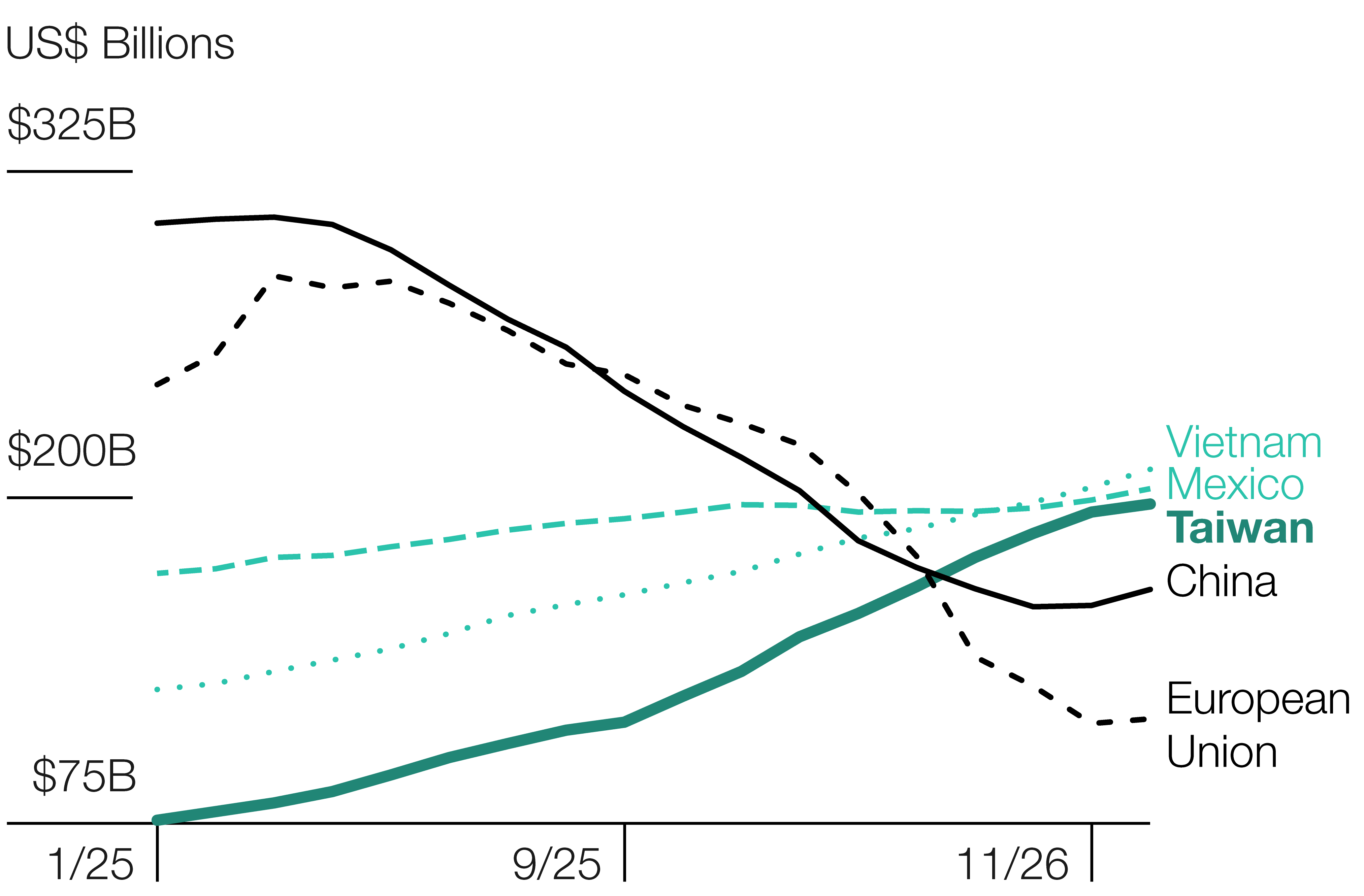
Note: Chart shows trailing 12-month total.
Source: Data compiled by author via “USA Trade Online,” US Census Bureau, accessed September 1, 2026, https://usatrade.census.gov/.
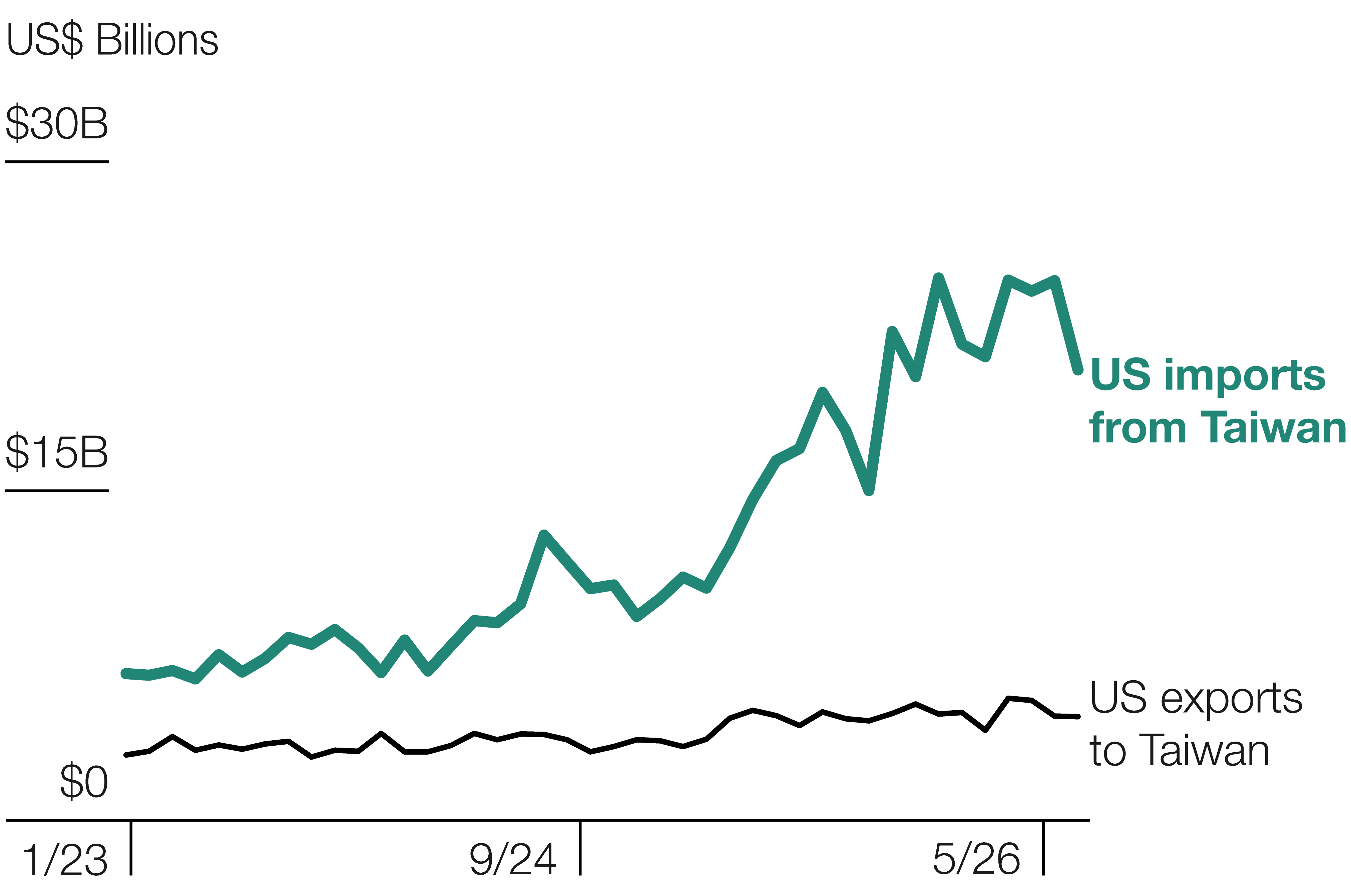
US-Taiwan trade has grown dramatically over the last few years. US imports from Taiwan have increased by 250 percent, from $7 billion to $24 billion a month. Meanwhile, US exports to Taiwan have increased by more than 60 percent, from $3 billion to $5 billion a month. While the two countries trade different commodities (e.g., semiconductors from Taiwan and energy from the United States), the growth in US imports from Taiwan has continued to outpace exports to Taiwan, leading to a large increase in the trade in goods deficit (see figure 2).
Figure 2. Monthly US-Taiwan Goods Trade, Jan 2023–Jun 2026
Source: Data compiled by author via “USA Trade Online.”
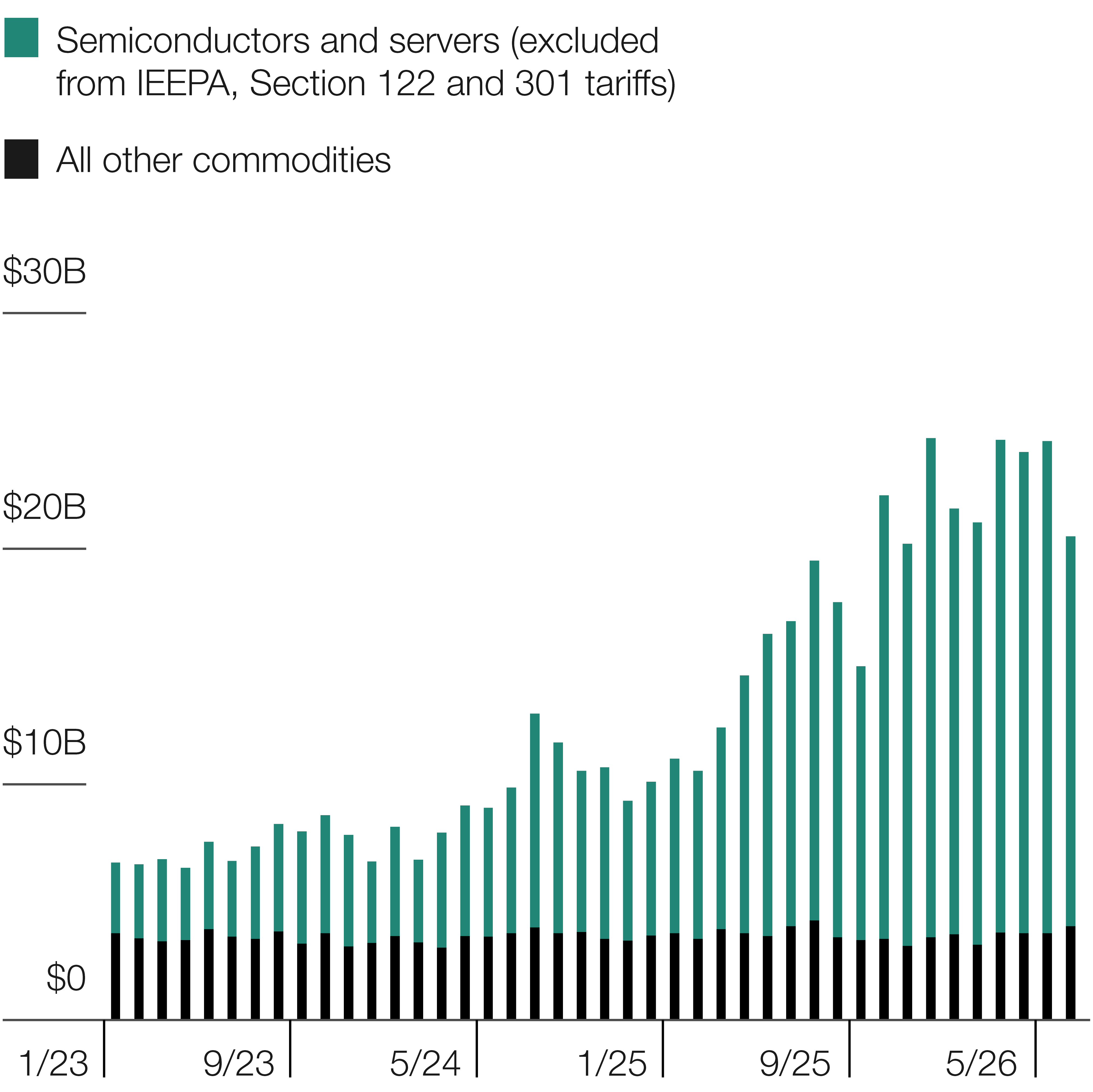
The United States is importing more tech- and AI-related commodities than ever before. The value of these imports from Taiwan has increased by well over 200 percent in the last two years (see figure 3). The textbook way to address a growing trade deficit is to apply tariffs on imports to make them more expensive than domestically produced goods. However, the Trump administration has excluded semiconductors, servers, smartphones, and other electronics and semiconductor-related products from tariffs, and these have increased to more than 75 percent of the total value of imports from Taiwan. Meanwhile, the value of all other imports from Taiwan has remained at a consistent level, despite tariffs (see figure 3).
Figure 3. US Monthly Imports from Taiwan of AI Technologies, Jan 2023–Jun 2026
Source: Data compiled by author via Office of the US Trade Representative, “Notice of Actions in Section 301 Investigations,” July 23, 2026, news release, https://ustr.gov/sites/default/files/files/Press/Releases/2026/FLIP%20301%20Investigation%20Final%20Action%20FRN%207-23-26%20FINAL.pdf; “USA Trade Online.”
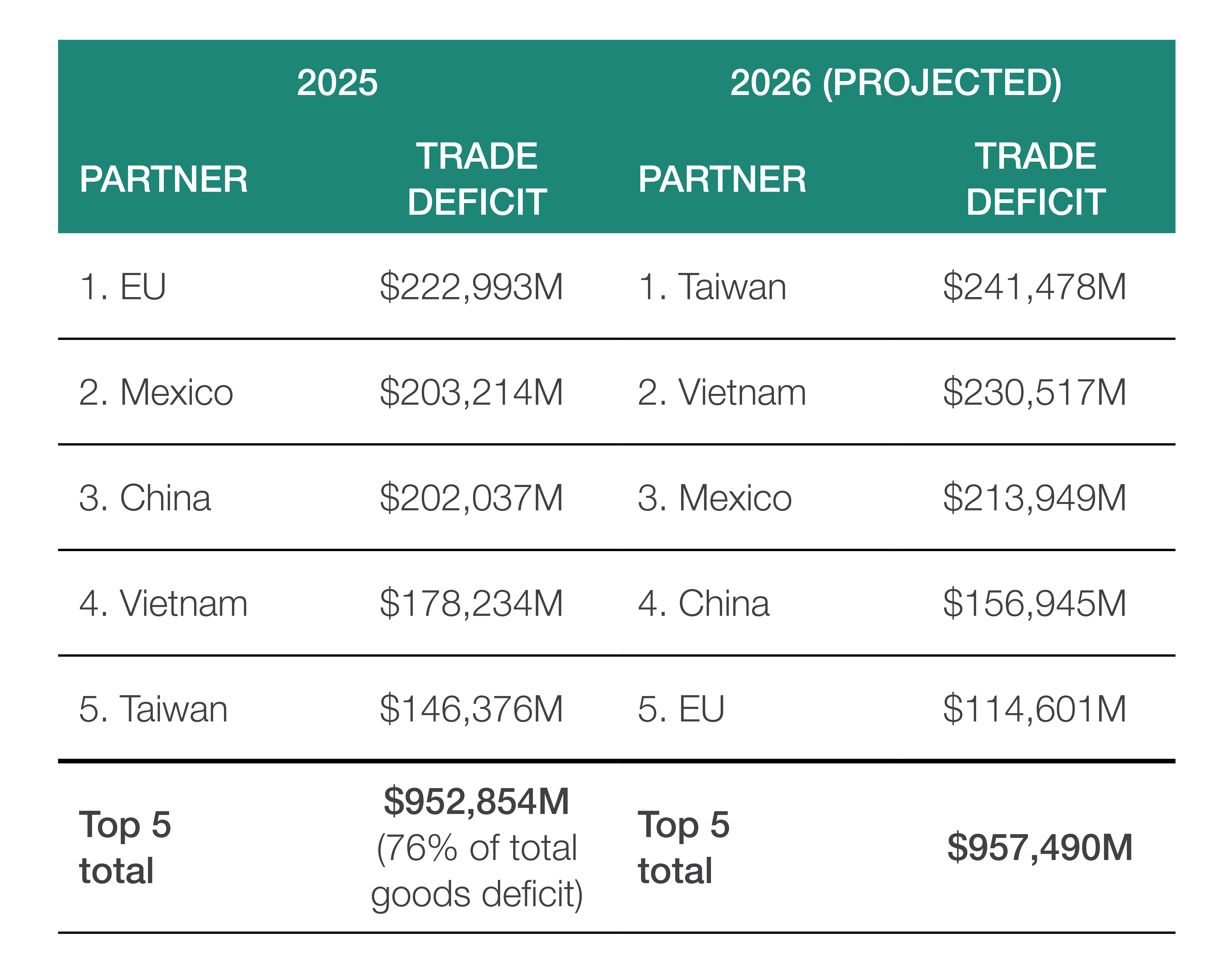
At the end of 2025, the US trade deficit in goods with Taiwan was valued at $146 billion, making Taiwan the fifth-largest partner with which the United States has a trade deficit.[22] The US trade deficit with Taiwan has the potential to grow between 57–65 percent this year.[23] By the end of 2026, Taiwan could rise to become number one, with the US trade deficit potentially reaching $241 billion (see table 2).[24]
The designation of trading partner with which the United States has the largest goods trade deficit is mostly symbolic. The value of the projected trade deficit is meaningful for those concerned about the US or Taiwanese balance of payments. But for policymakers in Washington and Taipei, the greatest risk of the growing trade deficit is how political leaders will perceive it.
Table 2. Top Five US Trading Partners by Goods Trade Deficit, 2025 and 2026 (Projected)
Source: Author.
Trade and Investment Agreements
Trade deficits are not always a result of government policy, but trade and investment policies can address them. The Trump administration is attempting to reduce trade deficits through higher tariffs while also using tariffs to encourage other countries to commit to new trade and investment deals with Washington. In fact, earlier this year in response to Trump’s tariffs, the United States and Taiwan announced trade and investment agreements.
With the ART, the Taiwanese negotiators agreed that, once it was implemented, Taipei would reduce 99 percent of its trade barriers to US exports and reduce many of its non-tariff barriers for US products, including agricultural, aquatic, poultry, and dairy products as well as medical devices and passenger vehicles. Taiwan also agreed to try to align more closely with the United States on regulatory matters such as export controls and issues of forced labor. In addition, the negotiators agreed that the island nation would purchase up to $85 billion worth of US energy, power infrastructure, and civil aircraft and engines by 2030.[25]
The ART has not yet been implemented, and Taiwan will have to pass legislation to do so, given the changes that will be required in its tariff rates. But the agreement will first need to be updated to reflect the current tariffs that are affecting imports from Taiwan. Congressional approval of the agreement is not required, since its terms are based on tariffs the Trump administration has imposed through its executive authorities.
Trade is important, but investment can be just as important as trade. More investment may reduce some of the US reliance on Taiwan-based manufacturing, thereby reducing the US trade deficit. It would also allow the United States to increase domestic manufacturing of semiconductors and AI-related products, bring industry knowledge and training to America, which has a shortage of electrical engineers,[26] and help alleviate some security concerns, given China’s growing belligerence in the Asia-Pacific, especially toward Taiwan.
In January 2026, a month before signing the ART, Washington and Taipei signed an agreement to increase Taiwanese investment in the US. Officials from both countries released a fact sheet that outlines a memorandum of understanding on US-Taiwan trade and investment and became a companion agreement to the ART. [27] In this, Taiwan’s trade negotiators agreed that Taiwan would:
- Provide $250 billion in FDI, to be invested by Taiwan’s semiconductor and technology enterprises
- Provide $250 billion in credit guarantees, to be used by Taiwanese enterprises for building the US semiconductor supply chain and ecosystem
- Build industrial clusters, working with industry and local governments in the United States to establish industrial and science parks like those in Taiwan that support the local US semiconductor ecosystem[28]
American trade negotiators agreed that, in exchange, the United States would:
- Reduce Taiwan’s reciprocal tariff rate to no more than 15 percent
- Grant reciprocal tariff exclusions for generic pharmaceuticals, generic pharmaceutical ingredients, aircraft components, and some natural resources
- Cap Section 232 national security tariffs on auto parts, timber, lumber, and wood derivatives at no more than 15 percent
- Establish a quota for future Section 232 national security tariffs on semiconductors[29]
Taiwanese companies have already made significant progress toward these goals. Over the last several years, they have proposed investing more than $300 billion in the United States. This includes the $265 billion from TSMC, $4 billion in semiconductor wafer manufacturing by GlobalWafers, and $55 billion in potential investment from semiconductor and server companies like UMC, Foxconn, Quanta, and Wistron.[30]
Recommendations
The US trade deficit with Taiwan is increasing, but this does not mean the White House should take more aggressive action, as it is doing with Vietnam to address the growing US trade deficit with that country.[31] Taiwan’s enterprises are essential for American AI development, and US technology and trade policies have made the trade imbalance with Taiwan worse. Two steps should be taken this year to improve the US-Taiwan economic relationship, one by the United States, the other by Taiwan:
Congress should pass a bilateral tax agreement with Taiwan. Taiwan is one of the few major economies with which the United States does not have a tax treaty. Such agreements reduce the tax burden on American and Taiwanese companies with financial interests in both countries. At a time when the White House wants more Taiwanese FDI in the US and more Taiwanese companies are willing to invest, reducing the tax burden would allow these investments to be used for operations rather than tax expenses.
Taiwan should promptly pass implementing legislation for the ART. Once the White House has finished its Section 301 investigations and sent Taiwan’s trade negotiators an updated version of the ART, Taiwan’s legislature should swiftly implement the agreement. This will open up Taiwan’s market to more US exports and potentially decrease the goods trade deficit. Otherwise, Taiwan may lose the preferential treatment the ART and investment deals have given it.
Taiwan may be the most important US partner right now as the White House seeks to usher in a golden age through AI dominance. Though the growing trade deficit with Taiwan could become a problem, it should not overshadow the US need to build the largest and greatest computing power in the world.
Endnotes
- US Department of Commerce, “Trump Administration Secures an Additional $100 Billion U.S. Semiconductor Manufacturing Investment for a Total of $265 Billion from TSMC,” news release, July 16, 2026, https://www.commerce.gov/news/press-releases/2026/07/trump-administration-secures-additional-100-billion-us-semiconductor. ↑
- At the time of publication of this report, the US-Taiwan investment agreement had not been publicly released. However, the Commerce Department released a fact sheet on it, from which the data here are taken. The fact sheet does not mention a deadline for these Taiwanese investments. “Fact Sheet: Restoring American Semiconductor Manufacturing Leadership Through an Agreement on Trade & Investment with Taiwan,” US Department of Commerce, January 15, 2026, https://www.commerce.gov/news/fact-sheets/2026/01/fact-sheet-restoring-american-semiconductor-manufacturing-leadership. ↑
- “Regulating Imports with a Reciprocal Tariff to Rectify Trade Practices That Contribute to Large and Persistent Annual United States Goods Trade Deficits,” White House, April 2, 2025. https://www.whitehouse.gov/presidential-actions/2025/04/regulating-imports-with-a-reciprocal-tariff-to-rectify-trade-practices-that-contribute-to-large-and-persistent-annual-united-states-goods-trade-deficits/. ↑
- Michael Cembalest, “Smothering Heights,” Eye on the Market Outlook 2026, J.P. Morgan Asset Management, January 1, 2026, https://am.jpmorgan.com/us/en/asset-management/liq/insights/market-insights/eye-on-the-market/outlook-2026/. ↑
- Michael Kratsios, “Remarks by Director Kratsios at the APEC Digital and AI Ministerial Meeting,” White House, August 5, 2025, https://www.whitehouse.gov/releases/2025/08/remarks-by-director-kratsios-at-the-apec-digital-and-ai-ministerial-meeting/. ↑
- America’s AI Action Plan (White House, July 2025), https://www.whitehouse.gov/wp-content/uploads/2025/07/Americas-AI-Action-Plan.pdf. ↑
- Paul E. Soto, Mason Thieu, and Jeffrey S. Allen, “The AI Buildout and the Economy: Publicly Available Data to Assess AI’s Impact,” FEDS Notes, Board of Governors of the Federal Reserve System, July 17, 2026, https://www.federalreserve.gov/econres/notes/feds-notes/the-ai-buildout-and-the-economy-publicly-available-data-to-assess-ais-impact-20260717.html; Hannah Rubinton and Bontu Ankit Patro, “Tracking AI’s Contribution to GDP Growth,” On the Economy (blog), Federal Reserve Bank of St. Louis, January 12, 2026, https://www.stlouisfed.org/on-the-economy/2026/jan/tracking-ai-contribution-gdp-growth; Satyam Panday and Paul Gruenwald, “Data Center Investments Are Increasingly Moving the Macro Needle,” S&P Global, November 4, 2025, https://www.spglobal.com/en/research-insights/special-reports/look-forward/data-center-frontiers/data-center-investment-moves-macro-needle. ↑
- Artificial Intelligence and the Great Divergence (Council of Economic Advisers, January 2026), https://www.whitehouse.gov/wp-content/uploads/2026/01/Artificial-Intelligence-and-the-Great-Divergence-5.pdf. ↑
- AI servers are generally based on American design, with semiconductors manufactured in Taiwan and South Korea and assembled by Taiwanese companies. ↑
- Final Report: US, Taiwan, and Semiconductors: A Critical Supply Chain Partnership (Project 2049 Institute and US-Taiwan Business Council, June 21, 2023), https://www.us-taiwan.org/wp-content/uploads/2023/06/2023.06.21-Final-Semiconductor-Report.pdf, 47. ↑
- Estimate based on real value added to GDP by industry. ↑
- Danielle M. Trachtenberg, “Section 301 of the Trade Act of 1974,” Congressional Research Service, updated July 2, 2026, https://www.congress.gov/crs-product/IF11346. ↑
- “Fact Sheet: Section 232 Investigations: The Effect of Imports on the National Security,” US Department of Commerce, https://www.commerce.gov/news/fact-sheets/2017/04/fact-sheet-section-232-investigations-effect-imports-national-security. ↑
- “Section 301—Failure to Impose and Effectively Enforce a Prohibition on the Importation of Goods Produced with Forced Labor,” Office of the United States Trade Representative, accessed September 17, 2026, https://ustr.gov/trade-topics/enforcement/section-301-investigations/section-301-failure-impose-and-effectively-enforce-prohibition-importation-goods-produced-forced. ↑
- “Fact Sheet on US-Taiwan Agreement on Reciprocal Trade,” Office of the United States Trade Representative, February 2026, https://ustr.gov/about/policy-offices/press-office/fact-sheets/2026/february/fact-sheet-us-taiwan-agreement-reciprocal-trade. ↑
- “Annex” in Actions by the United States in the Investigations under Section 301 of the Trade Act of 1974 of the Acts, Policies, and Practices of 60 Economies Related to the Failure of Each Economy to Impose and Effectively Enforce a Prohibition on the Importation of Goods Produced with Forced Labor (White House, July 23, 2026), https://www.whitehouse.gov/wp-content/uploads/2026/07/ANNEX.pdf. ↑
- “Section 301—Structural Excess Capacity and Production in Manufacturing Sectors,” Office of the United States Trade Representative, accessed September 17, 2026, https://ustr.gov/trade-topics/enforcement/section-301-investigations/section-301-structural-excess-capacity-and-production-manufacturing-sectors. ↑
- “Section 232 Investigations: The Effect of Imports on the National Security,” US Department of Commerce, Bureau of Industry and Security, accessed September 17, 2026, https://media.bis.gov/about-bis/bis-leadership-and-offices/sies/section-232-investigations. ↑
- Executive Order No. 14257, 90 Fed. Reg. 15041 (April 2, 2025), https://www.federalregister.gov/documents/2025/04/07/2025-06063/regulating-imports-with-a-reciprocal-tariff-to-rectify-trade-practices-that-contribute-to-large-and; “Modifying Reciprocal Tariff Rates to Reflect Trading Partner Retaliation and Alignment,” White House, April 9, 2025, https://www.whitehouse.gov/presidential-actions/2025/04/modifying-reciprocal-tariff-rates-to-reflect-trading-partner-retaliation-and-alignment/; “Clarification of Exceptions under Executive Order 14257 of April 2, 2025, as Amended,” White House, April 11, 2025, https://www.whitehouse.gov/presidential-actions/2025/04/clarification-of-exceptions-under-executive-order-14257-of-april-2-2025-as-amended/; Executive Order No. 14324, 90 Fed. Reg. 37775 (July 30, 2025), https://www.federalregister.gov/documents/2025/08/05/2025-14897/suspending-duty-free-de-minimis-treatment-for-all-countries; “Further Modifying the Reciprocal Tariff Rates,” White House, July 31, 2025, https://www.whitehouse.gov/presidential-actions/2025/07/further-modifying-the-reciprocal-tariff-rates/; Executive Order No. 14346, 90 Fed. Reg. 43737 (September 5, 2025), https://www.federalregister.gov/documents/2025/09/10/2025-17507/modifying-the-scope-of-reciprocal-tariffs-and-establishing-procedures-for-implementing-trade-and; Executive Order No. 14360, 90 Fed. Reg. 54091 (November 14, 2025), https://www.federalregister.gov/documents/2025/11/25/2025-21203/modifying-the-scope-of-the-reciprocal-tariffs-with-respect-to-certain-agricultural-products; “Fact Sheet: Restoring American Semiconductor Manufacturing Leadership Through an Agreement on Trade & Investment with Taiwan”; “Fact Sheet on US-Taiwan Agreement on Reciprocal Trade”; Learning Resources, Inc., et al. v. Trump, President of the United States, et al. 607 U.S. 229 (2026), https://www.supremecourt.gov/opinions/25pdf/607us2r12_8nj9.pdf; “Imposing a Temporary Import Surcharge to Address Fundamental International Payments Problems,” White House, February 20, 2026, https://www.whitehouse.gov/presidential-actions/2026/02/imposing-a-temporary-import-surcharge-to-address-fundamental-international-payments-problems/; Office of the US Trade Representative, “Initiation of Section 301 Investigations: Acts, Policies, and Practices of Certain Economies Relating to Structural Excess Capacity and Production in Manufacturing Sectors,” 91 Fed. Reg. 12886 (March 17, 2026), https://www.federalregister.gov/documents/2026/03/17/2026-05214/initiation-of-section-301-investigations-acts-policies-and-practices-of-certain-economies-relating; Office of the US Trade Representative, “Initiation of Section 301 Investigations of Acts, Policies, and Practices of Various Economies Related to the Failure to Impose and Effectively Enforce a Prohibition on the Importation of Goods Produced With Forced Labor,” 91 Fed. Reg. 12884 (March 17, 2026), https://www.federalregister.gov/documents/2026/03/17/2026-05151/initiation-of-section-301-investigations-of-acts-policies-and-practices-of-various-economies-related; Department of Commerce, “Implementing Certain Tariff-Related Elements of a Trade and Security Agreement Between the American Institute in Taiwan and the Taipei Economic and Cultural Representative Office in the United States,” 91 Fed. Reg. 31818 (May 28, 2026), https://www.federalregister.gov/documents/2026/05/28/2026-10571/implementing-certain-tariff-related-elements-of-a-trade-and-security-agreement-between-the-american; Office of the US Trade Representative, “USTR Takes Action in Forced Labor Section 301 Investigations,” news release, July 23, 2026, https://ustr.gov/about/policy-offices/press-office/press-releases/2026/july/ustr-takes-action-forced-labor-section-301-investigations. ↑
- Ian Schwartz, “Watch: President Trump’s Super Bowl Interview with Bret Baier,” RealClearPolitics, February 9, 2025, https://www.realclearpolitics.com/video/2025/02/09/watch_president_trumps_super_bowl_interview_with_bret_baier.html. ↑
- “Regulating Imports with a Reciprocal Tariff.” ↑
- Trade deficit in goods, not services. Bureau of Economic Analysis, “US International Trade in Goods and Services, June 2026,” news release, August 4, 2026, https://www.bea.gov/news/2026/us-international-trade-goods-and-services-june-2026. ↑
- The US trade in goods deficit with Taiwan from January to June this year was $107 billion—well on track to be more than $200 billion by the end of 2026. ↑
- Estimates calculated by the author. ↑
- Riley Walters, “What’s in the New US-Taiwan ‘Agreement on Reciprocal Trade’?,” Global Taiwan Institute, February 25, 2026, https://globaltaiwan.org/2026/02/whats-in-the-new-us-taiwan-agreement-on-reciprocal-trade/. ↑
- Chipping Away: Assessing and Addressing the Labor Market Gap Facing the US Semiconductor Industry (Semiconductor Industry Association and Oxford Economics, July 2023), https://www.semiconductors.org/chipping-away-assessing-and-addressing-the-labor-market-gap-facing-the-u-s-semiconductor-industry/. ↑
- “Fact Sheet: Restoring American Semiconductor Manufacturing Leadership.” ↑
- “Fact Sheet: Restoring American Semiconductor Manufacturing Leadership.” ↑
- Taiwanese companies building new capacity may import 2.5 times that planned capacity during the construction period without paying tariffs. Companies that have completed new construction may be able to import 1.5 times that production capacity without paying these duties. ↑
- “初步盤點對美投資約350億美元 經濟部與電電公會簽署海外產業合作MOU” [Preliminary survey identifies approximately $35 billion in planned US investment; MOEA and Taiwan Electrical and Electronic Manufacturers’ Association sign overseas industrial cooperation MOU], Taiwan Ministry of Economic Affairs, International Trade Administration, May 7, 2026, https://www.moea.gov.tw/mns/populace/news/News.aspx?kind=1&menu_id=40&news_id=122620; “SEMICON美國館開幕 經濟部宣布臺廠啟動新一波赴美投資” [SEMICON US Pavilion Opens as Ministry of Economic Affairs Announces a New Wave of Taiwanese Investment in the United States], Taiwan Ministry of Economic Affairs, September 2, 2026, https://www.moea.gov.tw/Mns/populace/news/News.aspx?kind=1&menu_id=40&news_id=123858. ↑
- Office of the US Trade Representative, “USTR Announces Section 301 Investigation of Vietnam’s Acts, Policies, and Practices Related to Intellectual Property Protection and Enforcement,” news release, May 29, 2026, https://ustr.gov/about/policy-offices/press-office/press-releases/2026/may/ustr-announces-section-301-investigation-vietnams-acts-policies-and-practices-related-intellectual. ↑Executive Summary