
















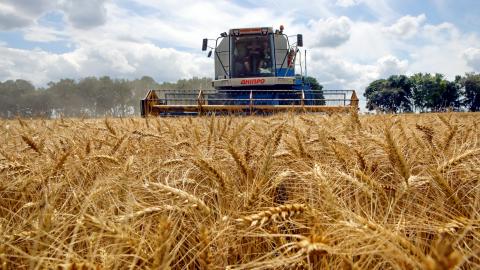
Ukrainian drones knocked out three of Russia’s largest grain terminals last week. One of them Novorossiysk handled up to a third of Russia’s grain exports, or at least it did until missiles and drones put some five million tonnes off the global market, a third of the port’s yearly output.
The Kremlin claims that Kyiv is trying to provoke chaos. Extraordinary. From the nation that invaded Ukraine and continues to murder their farmers and sailors, it’s a bit rich to blame others for the consequences.
For years Moscow has attacked fields and farms, cities and docks. The past month has seen vicious attacks on Odesa, the Black Sea port that feeds so much of the Middle East, and now Russian drones have hit Izmail near the Romanian border, damaging Ukraine’s largest harbour on the Danube and one of its last shipping routes out.
In July, alone Russia launched 35 attacks against ships in port, 22 against ships at sea, and 67 against port infrastructure. But it didn’t stop there.
A German bulk carrier had its steering disabled off the coast of Odesa and shipowners have stopped asking their crews to risk their lives by calling into Ukrainian waters. Traffic into Ukraine’s ports stopped for a fortnight at the peak of harvest time, leaving grain at risk of destruction by Moscow and dragging exports down 76 per cent in the first half of August.
Russia, the world’s biggest wheat exporter, fared little better, shipping 1.5 million tonnes in July against a five-year average of 3.1 million. That’s not just down to Ukraine. In a self-own of epic proportions, Russia has hit Turkish ships and Ankara has responded by withholding Dardanelles transit permits.
This isn’t just about the belligerent nations. Grain from the region feeds mouths around the world and the effect is already being felt far away. Wheat prices are up 30 per cent this year and the UN’s Food and Agriculture Organisation Food Price Index averaged 131.1 points in July, its highest in over three years.
For context, and to bring home the warning that should be flashing in capitals across the world, in February 2011 it read 137.7, shortly before Hosni Mubarak of Egypt was toppled. That may not have been directly Russia’s fault, but the heatwave of 2010 led to Moscow banning grain exports, triggering an increase in prices in the streets of Cairo and Tunis.
British crop yields are expected to be down because of the heatwave and the war in the Persian Gulf raising the cost of fertiliser.
Wheat is a carbon crop, at least it is if we want the amounts needed to feed half the world. For the kind of output that keeps prices low and volumes high, farmers need nitrogen, and industrial nitrogen is made from natural gas.
This year, that’s been a problem for everyone. The Strait of Hormuz closed on Feb 28, isolating roughly a third of the world’s traded urea, a widely used nitrogen-release fertiliser. In April, the price of urea nearly doubled to $850 a tonne.
To date, food prices have not spiked as they did in 2022, but it’s worth understanding why. A lot of fertiliser was bought before the Gulf closed, the gas market has behaved better than it might have, and lorries have trucked product overland around the choke-point. But the grim truth is that all this is in the past.
A fertiliser shortage or a shipping disruption doesn’t raise the price of bread immediately. The former lowers the yield of next year’s harvest and the latter draws down the grain silos and doesn’t see them refilled.
With the Arab Spring, the bill took a year to arrive. In Britain, next year may be tougher than it should be. Not just because our last ammonia plant closed years ago but because our carbon border adjustment mechanism means we’ll be paying for the carbon in imported fertiliser, discouraging farmers from spreading it on their fields and boosting yields. That’s another reason to listen to Kemi Badenoch when she says net zero isn’t delivering a lower-carbon future but is costing us all.
It would be too simple to say food prices cause revolutions, there’s always more going on before someone suggests that the peasants eat cake, but prices can be a trigger. From Paris to Cairo, rising prices of staple foods have brought down leaders.