Caption
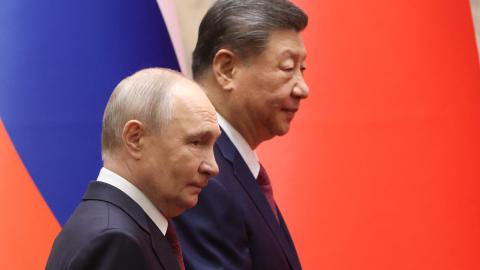
Russian President Vladimir Putin and Chinese President Xi Jinping enter the hall during a signing ceremony on May 20, 2026, in Beijing, China. (Getty Images)



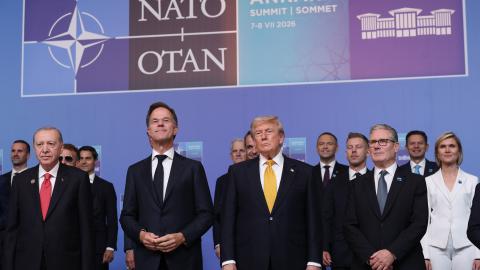
The 2026 North Atlantic Treaty Organization summit in Ankara, Turkey, provided significant deliverables: a €70 billion pledge of military assistance for Ukraine, President Donald Trump's announcement that Kyiv would be licensed to manufacture Patriot air defense systems, and a declaration reaffirming allied commitment to The Hague defense spending targets.
But questions remain over America's evolving role in the alliance and broader European security architecture.
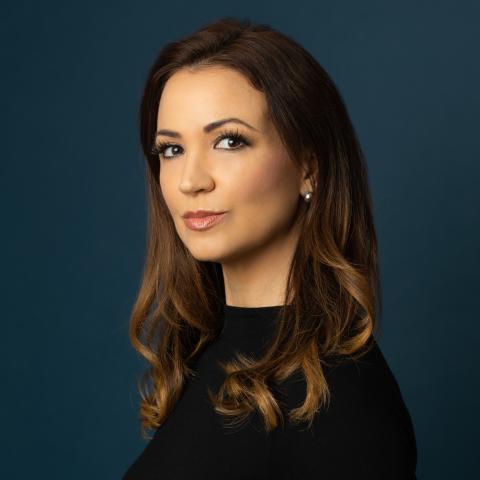
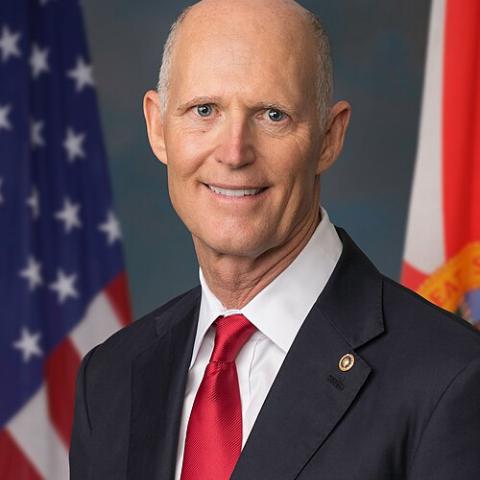
Please join Senior Fellow Dr. Rebeccah Heinrichs and Representative Mike Turner (R-OH) to discuss the summit following his return from Ankara, where he served as part of a bipartisan congressional delegation.
Listen on Spotify and Apple Podcasts.
Transcript
This transcription is automatically generated and edited lightly for accuracy. Please excuse any errors.
Joel Frushone:
Well, good afternoon and welcome to Hudson Institute. I’m Joel Frushone, Director of External Affairs. Thank you for joining us in person and online for today’s timely conversation.
The NATO Summit in Ankara earlier this month marked another important moment for the Transatlantic Alliance. Leaders reaffirmed commitments to higher defense spending, announced new military assistance for Ukraine, and took additional steps to strengthen collective deterrence amid Russia’s ongoing war with Ukraine and intensifying strategic competition with China. Yet the summit also underscored larger questions about the future of European security, burden sharing within the Alliance, and America’s evolving role as sustaining transatlantic stability.
We’re fortunate enough today to have with us Congressman Mike Turner, who was in Ankara as part of a bipartisan congressional delegation that engaged directly with allied leaders and policymakers during the summit. Congressman Turner is in Ohio and, through and through, after practicing law at Dayton for two decades, he served two terms as mayor before he was elected to Congress in 2003.
He represents Ohio’s 10th congressional district and serves as a senior member of the House Armed Services Committee while also serving on the House Oversight Committee. He previously chaired the House Permanent Select Committee on Intelligence, where he oversaw some of the nation’s most sensitive intelligence and national security matters. Throughout his congressional career, he’s been a leading voice on NATO transatlantic security and support for Ukraine.
Joining him is my colleague, Hudson’s senior fellow Dr. Rebeccah Heinrichs. Rebeccah directs Hudson’s Keystone Defense Initiative and recently returned from Ukraine, where she assessed frontline realities and alliance support efforts firsthand.
She’s a leading voice on nuclear deterrence, missile defense, and American strategic policy, and her analysis helps shape debates on strategic alliance and national security every day. And she’s also from Ohio. Together they’ll discuss the Ankara Summit outcomes, the state of the NATO Alliance, implications for US leadership and European security.
Please join me in welcoming Congressman Turner and Dr. Rebeccah Heinrichs.
Rebeccah L. Heinrichs:
Well, thank you all for being here with us for this really timely conversation. We’re really privileged to have the congressman here with us to talk to us about the summit. So, I’m just going to kick it off with that. And just, Congressman, if you could just tell us what do you think the big headline is coming out of the NATO summit?
Congressman Mike Turner:
Well, thank you, Dr. Heinrichs. And so of course you and I are close enough. I’m so used to calling you Rebeccah.
Rebeccah L. Heinrichs:
You can call me Rebeccah. I’m going to call you Congressman.
Mike Turner:
I apologize for that. But first off, I have to begin by thanking, of course, Hudson, but also, I want to thank you for your contribution to the dialogue for national security. The work that you do personally is so incredibly important. And the contribution that you make to the dialogue on the issue of deterrence, the issue of the NATO and the Atlantic dialogue, and really a strong national defense is so important. And you take up these issues both for Congress and for the Pentagon and for really decision makers. And thank you for your contribution to that.
I think we really can’t begin this discussion without first acknowledging the loss of Senator Lindsey Graham. Lindsey was traveling with us to the summit. He was traveling with Senator Coons and Shaheen and Rounds and Durbin. And Senator Graham was traveling also at the summit and was in and out of the meetings with us.
He was with us with Zelenskyy and with my Secretary General Rutte and, of course, and others. And his contribution is just enormous to the issues of not only just our nation’s security, but also the issue of NATO and Ukraine, and some of the legacy issues that we’ll be trying to address this year are his. And he leaves us a very strong to-do list this year as we’ll try to complete those.
So, coming out of the NATO summit, one of the things that, as we talk about what happened and to some extent what didn’t happen, I’m struck by the fact that I think it’s almost newsworthy that what came out of the NATO summit is the issue of stability. There are actually articles that are written that the communique that came out of the NATO summit was boring. And it’s like, I don’t think that was boring. I think it was exciting. It was exciting that there was such a coalescing around such important issues.
There was an incredibly strong statement, a multilateral statement of all of the allies on Article Five, but on Ukraine, one of the strongest statements on Ukraine I think that the administration has even stated. Then there was the statement of multi-year funding from our allies with respect to supporting Ukraine and the United States efforts with Ukraine. And then the administration was able to obtain a very strong statement from our allies with respect to Iran and that Iran shall not have a nuclear weapon and that the Strait of Hormuz will be international waters. And those are very, very strong statements.
But also, there were a number of things that came out of the summit that I think are legacy issues of this summit, and that is the things that happened around it. The president of Syria came and made very strong statements that he is not under the orbit of Iran, and he’s breaking from Iran; he had many bilateral meetings that were incredibly important. Turkey, in addition to the fact that they hosted the summit and embraced their bilateral relationships as part of the multilateral relationship of NATO. Many of those relationships, remember, they were balking as people were entering NATO. They embraced fully, had a very, very successful summit.
They made an announcement that they want to reenter the F-35 program and to solve the problem of the S400s being an impediment. That’s a huge development. You had the president meeting with Zelenskyy and not only making a number of policy decisions or the announcement of what might resolve into some real advancements for Ukraine, but even saying he had a very good meeting and that he thought that Ukraine was making advancements on the battlefield and that he thought the advantage was for Ukraine.
And then with respect to Patriots, saying, I think that we ought to allow them to have the technology to be able to license and make Patriots. And then saying that we’re going to enter into a data agreement with them with respect to drones where we’ve been cooperatively working with them. So here you have a number of ancillary discussions that were happening around the summit that showed that a NATO summit could be this site where people, as a magnet, come together and do a number of things.
So, I think it showed that this was not only a summit where NATO accomplished a great deal, but other nations felt the need to come there and make announcements and do deals also.
Rebeccah L. Heinrichs:
I wanted to dig a little bit into what the Europeans are actually doing in terms of their defense investments. You mentioned the Patriot deal where President Trump is not going to authorize it’s not NATO, but it’s Ukraine, Ukraine to be able to produce their own Patriots.
But the Europeans are also making no. . . It’s not just about rhetoric or communiques. I mean, the last couple of years especially, the Europeans have really stepped up for their own defense industries and in allocating budgets to buy American weapons. So, can you give us your sense coming back from there on how encouraged you are or if you think like, look, we got to keep the pressure on and make sure Europeans continue to do this? Or do you think that they really are just going to move in the right direction and that trajectory is going to continue?
Mike Turner:
Well, this is again another huge win for President Trump with respect to the relationship between the United States and NATO. If you recall in prior administrations, it was very, very difficult to get our NATO allies to even reach their agreed two percent of their GDP spending levels that they had agreed at the Wales Summit.
This was not a US-imposed amount of spending. This is what they had agreed at the Wales Summit. And they were not making those levels of spending. In Trump One, Trump had made it a part of his cornerstone of that our allies were going to have to start making these milestones. Now, as part of Trump Two, he has said, we’re going to raise that to five percent.
All the allies agreed to it. No one thought the allies would agree to it, that NATO would rise to that level. And now our allies are putting together a plan to do so. And that investment level is also being focused on production and investment. And a part of that, as you just indicated, is, of course, with respect to American weapon systems and also shifting to this new technology that we’re seeing of the shift in the battlefield as a result of what has happened on the Ukraine battlefield.
So, this technology shift, this interoperability, this investment in American weapon systems is going to be very, very important. It also lowers our overall cost, allows us to go to the next generation of weapon systems. This is a very, very important investment in both our allies going forward in both volume, stockpiles, munitions, weapon systems, but also capabilities that will also be transitioned to US capabilities.
Rebeccah L. Heinrichs:
So, this is really interesting because I thought there’s been some national security commentators or analysts who look at what the Europeans are doing and say, look, the Europeans are pulling away from the United States because they’re building their own defense industrial bases. But if you look at what they’re also buying through the Pearl program, they’re also buying American weapons.
In other words, everything is increasing. Yes, their own defense industrial bases are increasing, but they’re also increasing American weapons, their purchase of American weapons. And the United States is improving our own weapon systems as we reiterate and sell to the Europeans, which go into the Ukrainian battlefield. So, it’s still pretty synergistic. I don’t see a pulling away. I see NATO getting stronger and the United States even directly benefiting from these changes. Is that the way-
Mike Turner:
And this is the Western economy. I mean, this is all of us in the ecosystem together being able to advance. And everyone is looking to, again, our interoperability and the systems that we have. And they’re still looking at our advanced weapon systems as being the premier weapon systems. Everyone’s talking about the F-35 and the Patriot as being the top systems. And those systems are the ones that we’re all looking at. How do we lower costs? How do we increase production? How do we get greater munitions? But also, then for the drones and drone capabilities that we’re seeing that are advancing Ukraine on the battlefield, how do we implement that across the board so that all of our allies in the United States can implement those new technologies so that as we look to the battlefields of tomorrow, we’re ready.
Rebeccah L. Heinrichs:
Yeah. And on my trip to Ukraine too, I was also really impressed by the presence and the leadership of the Germans there. The Germans have really stepped up to enable Ukraine to have the weapons they need, again, by purchasing American weapons also. But to me, I was struck by, look, President Trump actually shifted this so that Ukraine is still getting the weapons it needs, but they’re purchasing. . . These
Europeans have stepped up to buy them, but they’re purchasing them from the United States. So, it’s not just the American taxpayer that are just sending weapons. Our own defense industrial base is improving, and the Europeans really are, no kidding, in a pretty serious way in country in Ukraine, making sure the Ukrainians have what they need.
Mike Turner:
And we have not walked away from Ukraine. I mean, there’s that misnomer that continues to be said, which is not correct. I mean, the administration, through the parole programs you’ve indicated, where we’ve required that our European allies fund the program of weapon systems that are going to Ukraine.
We’re still in the game and actively supporting Ukraine. And it’s great for the president to have said he had a great meeting with Zelenskyy, and he sees that Ukraine is advancing on the battlefield. This gives us an opportunity, which is what President Trump’s goal all along has been: an opportunity for peace negotiations to go forward.
Rebeccah L. Heinrichs:
Yeah. And to work. And so now Ukraine is doing so well in the battlefield. Europeans are stepping up in a major way and the Russian economy is now really suffering. And so, it looks like we’re in a much better place to sort of take another bite at the apple to get a ceasefire.
Mike Turner:
And Lindsey Graham made the case in our meeting with President Zelenskyy, and he made the case when he got back. The House has already passed legislation to provide sanctions against those who are buying Russian energy. This would give President Trump an additional tool and would give the threat to Russia that their economy that is fueling their murderous aggression against Ukrainian citizens, because again, they are killing Ukrainian citizens.
It’s not just on the battlefield between two militaries. We see it on our news at night where they are lobbing murderous drones and missiles into Ukrainian cities, killing innocent civilians. This has got to come to a stop. One way to do that is to place sanctions against their energy sector gas and oil and give it the opportunity to have a cost that would make it more difficult for them to fuel their military that’s fueling this military aggression.
Rebeccah L. Heinrichs:
Yeah, exactly. I was in Kyiv; that was during one of the. . . At the time there’s been even more bigger and more aggressive assaults even then. At the time, it was the largest drone and missile attack against Kyiv while we were in the country. And the Russians were firing at apartments, apartment complexes where Ukrainians are firing at military targets against the Russians, and yet the Russians retaliate by hitting civilian targets.
And Secretary Rubio made the point, I think very recently actually in a congressional hearing where he said, look, to your point about US leadership in Ukraine, we are sanctioning only one side and we’re helping only one side and that’s the side that we would like to enable to end the war on terms that are good for Ukraine and good for NATO. And it seems to me like we’re even turning up the pressure to make that happen now, it seems.
So, you already mentioned this a little bit. How do you see the US role in NATO? Again, just to even just explain it to everyday Americans. They say, like, does NATO really even matter anymore? Look, if Ukraine is having these successes on the battlefield, is Russia really that strong? Does Russia pose a threat to the United States? Why does the United States need to keep this leadership role in the NATO alliance? How would you respond to that? And how do you see where our role in the Alliance stands today?
Mike Turner:
Well, in NATO, when you look at all of our allies, someone still has to lead, and that is still the United States. And when we have testimony before the Armed Services Committee and our military is testifying as to what we’re accomplishing around the world, I always ask them the question: tell the committee how we’re accomplishing this worldwide footprint, this worldwide presence that we have. And usually, some portion of our ability to have an effect that is a worldwide footprint, a worldwide accomplishment, is because of our NATO allies and our worldwide footprint.
Even what we’re doing today in the Middle East, what we’re doing in Africa, what we do in Europe, what we do around the world, even intelligence gathering that affects the Indo-Pacific. Our operations around the world are in part always supported by what we have in our footprint that includes our operations that are embedded in part in what we’re doing in NATO.
So, our interoperability, our facilities that are our worldwide footprint are essential for our own security as they are for our allies and really for liberty and freedom that we enjoy.
Rebeccah L. Heinrichs:
Yeah. I mean, I explain to people, look, if the United States is a superpower, we are a superpower because we’re able to project power so far from our shores to keep everybody here back at home safe. And so, if you look at what we’re doing in the Middle East right now, we’re still launching those strikes and conducting a lot of that refueling operation, et cetera. It’s taking place in Europe. We’re from Europe.
It’s being projected from power from Europe. And so, a lot of what we do, even in peacetime, is still intelligence gathering with our NATO allies. Our counterterrorism that we do is with our NATO allies. And so, there’s a lot.
On the Russia piece, you have been a really, I think, very compelling voice in explaining that the threat from Russia is not just about Ukraine. I mean, the Russians, their counter space activities. I mean, they’re threats to the United States in the high north.
If you could just talk to us a little bit about Russia’s view of us. Russia doesn’t just want to subjugate Ukraine. Russia’s trying to kick the United States out of Europe and weaken the United States and harm Americans in our security.
Mike Turner:
Well, every day Russia is developing, even just, I mean, you start with the top. As you indicated, space. Russia is developing, and it’s fielding anti-satellite weapon systems that seek to degrade and attack our satellites that are in space.
Secondly, they are fielding nuclear weapons, new nuclear weapons that are intent on attacking the United States. We are not developing new nuclear weapon systems, but Russia is designing, developing, and deploying new nuclear weapons systems designed to attack the United States. On a cyber basis, every day Russia is attacking the United States.
Our infrastructure systems, our military, our allies- they are poised and are focused every day on ways in which they can attack and diminish the United States and our reach. So, they are a self-identified adversary. And we have to be prepared for the fact that every day that they’re doing that, we have to defend ourselves.
Rebeccah L. Heinrichs:
Yeah. I completely agree. And given just the nature of technology, we don’t really have the option to turn inward and say, “Well, if we just sort of leave Europe, maybe Russia won’t be so hostile to us.” As you pointed out, they are threatening us in all domains: cyberspace, underwater, undersea.
Mike Turner:
Underwater cables are on a regular basis being attacked and severed by Russian actions.
Rebeccah L. Heinrichs:
And in particular, that’s a great point. And I remind people, Russia, though it’s focused on the Ukrainian battlefield, conducts these other hostile activities that people call sort of hybrid operations or gray zone. I mean, I think they’re pretty close to acts of just outright war, but everybody kind of has their hands full. So, we’re not calling it that.
But in the Baltic Sea, it was a Russian ship that was there with a Chinese ship. I’d point out too that was dragging its anchor along the bottom of the seabed in the Baltic Sea, which severed that cables. And so, they’re doing it there, and they’re increasingly collaborating with the Chinese. So even though Russia is a much weaker country militarily or economically than China, they’re focused on these particular means at which they can target the United States and our core interests.
Mike Turner:
We just have to be prepared. When someone identifies themselves as they’re our adversary, we have to be prepared.
Rebeccah L. Heinrichs:
Okay. So, we’ve got some good things coming out of the summit. You mentioned too, it’s not even that the communique had some great stuff on commitment to Article Five, really strong language on that. Good stuff on Iran that the NATO Alliance wants to help with. So how do we keep this momentum going? We’ve got the late Senator Graham left us with; he was really, a really powerful engine to kind of keep everybody moving to do what is necessary, to put pressure on our adversaries to get to a place of peace and enable President Trump to get the peace agreements he wants. So, what do we do? What do we do to keep this momentum going? And what can Congress do in particular?
Mike Turner:
Well, what’s really great here is it shows that this is a great win by the Trump administration, that there was a significant amount of preparation that was put in place before the summit and that Secretary General Rutte had worked very clearly with the Trump administration.
You mentioned the provisions with respect to Iran where there was concerns as to whether or not our NATO allies would rise to the occasion. There was a clear statement that Iran will not be permitted to have a nuclear weapon, should not be permitted to have a nuclear weapon, and that the Strait of Hormuz should be open and navigable free waters.
Those types of statements and the language in the communique, having been negotiated, is the type of win that shows that the administration works not only just with the Secretary General, but with all of the allies leaving I think, the great opportunity to continue that work post-summit to now that it has many of those allies working toward a plan for the five percent of GDP spending on defense.
The issue of increased spending on munitions, hardware innovation, and shifting to the drones and technology. Now we have to be able to deliver to them, I think, opportunities in a plan. And I know the Pentagon is actively working to be able to deliver them opportunities for spending those additional dollars and giving them incentives to be able to reach those dollars with a plan for those spending opportunities. That’s going to deliver real opportunities for NATO to transform into that next strengthened opportunity of a very, very strong ally.
Rebeccah L. Heinrichs:
Yeah. I even have the language from the communique here, which is on Iran, which I think is just really strong to your point. It says, “Allies reiterate that Iran must never have a nuclear weapon and call on Iran.” So, blaming Iran as the aggressor and call on Iran to fully respect freedom of navigation in the Strait of Hormuz because Iran continues to try to use this opportunity not just to weaponize this choke point that’s so critical for the global commodity for energy, but they want to manage it.
They want to basically reassert their hegemonic desires over the entire region by controlling the Strait of Hormuz. And our European allies, plus Canada, have said in Turkey. They’re very clear. No, it’s not going to happen, which is really important.
So now just how do we make good on that? And how do we bring in the Europeans to help us make sure that we can get the Strait of Hormuz completely open and free? And if you have any thoughts on that and how to bring in the Europeans and when to bring in the Europeans. I know that the Europeans have said, look, we’ve got mine clearing capabilities, but so far, it’s been the Iranians that have prohibited the Europeans from helping clear the mines through the Strait of Hormuz. I
Mike Turner:
Think it’s a real commercial opportunity here also. We had in the initial days some concern as to whether or not individual European nations might try to broker side deals to get their ships through. And those ships are headed toward, in part, Western markets. And each of those Western markets also has leverage overall. I think this communique has an opportunity to begin to, from a commercial standpoint, put pressure on Iran so that it’s not just a military aspect, but it’s a commercial aspect also: Iran cannot be successful if it doesn’t have commercial success. And it has to be told, one, there is not going to be control over the straits in any way that’s going to have tolls or any types of assessments. But also, you’re not going to be commercially successful from your energy sales are not going to be successful and they’re going to be tied to whether or not you’re going to recognize that the straits need to be free.
Rebeccah L. Heinrichs:
The other thing I thought was remarkable, to your point about other individuals who were at that NATO summit actually doing work, you said that new leader of Syria. I mean, Secretary Rubio has been very busy sort of diminishing the value of the SRATO Hormuz too.
So, you see now the United States making deals with Iraq and then also Syria and trying to get other European help. Basically, it’s the West. It’s the West working together to coalesce behind the United States in order to isolate our shared adversaries. I mean, it was really a working NATO summit that actually had no-kidding deliverables, I thought.
Mike Turner:
And that block, that dialogue makes a huge difference. When a group like this is working in unison, it has a tremendous impact.
Rebeccah L. Heinrichs:
So, then what would you say for critics who would say, okay, but there’s all of this. The president’s rhetoric is so unhelpful, and he makes these different remarks and threats, and so NATO is diminishing. How do you respond to that in light of all of these successes here?
Mike Turner:
Well, I think the great response is to communicate, right? I mean, that’s what I love about the issue of rhetoric because here you have the rhetoric. Donald Trump makes extreme rhetoric statements, and this is the Richter scale of rhetoric. But the reality is, then you have the plot, the policies that come out of the administration.
The policies plot actually very linear. And I think what you see so many times is that the rhetoric is intended to pull or push. And people are pulled or pushed in a different direction based upon perhaps where they want this line of the policy to go, which in turns out to be than linear. What’s also interesting is to see the various people who jump off whenever the rhetoric either peaks or shallows.
And that’s always interesting because sometimes those people are in his own administration. Some people go amen, amen. And those people embarrass themselves. And some of these people They absolutely also freak out on the outside. And those people embarrass themselves too because the Richter scale of the rhetoric usually doesn’t always reflect reality.
The reality is this plotting of what usually is relatively linear policies. And if you actually, all the way back to Trump won, even on Iran, went to plot the policies, it’s actually relatively linear. This summit communique and what’s been happening with NATO, if you get rid of the rhetoric and just plot what’s been happening, it’s very, very linear.
For example, I’m the head of the NATO parliamentary assembly delegation from the US Congress, and I got many calls when there were news stories that were coming out that the White House was considering withdrawing from NATO. Now, mind you, there was no Trump quote that there was a statement of, “We’re going to withdraw from NATO.” Well, it was also the very same day that the Pentagon sent over the budget to Congress that actually had an increase of our commitment to NATO, an increase of European presence of troops.
So that’s why Congress was quiet. It’s because we weren’t jumping off on the reporting of issues of rhetoric. We were watching—
Rebeccah L. Heinrichs:
Budget.
Mike Turner:
. . . the plotting of the policy curve, which was actually quite linear. The budget was part of the policy linear plot, which said this is straight.
Rebeccah L. Heinrichs:
It’s also interesting too, because when there has been your point about how even some people in the administration tend to get it wrong sometimes. And when that has happened—
Mike Turner:
I can think of quite a few.
Rebeccah L. Heinrichs:
I can think of a few too off top of it. When there have been moments where I thought, “This doesn’t seem right. We’re going to block a US troop deployment to Poland.
Mike Turner:
Yeah.
Rebeccah L. Heinrichs:
That doesn’t seem like what President Trump wants.” So, when those sort of outlier things have happened very calmly, or maybe not so calmly, but maybe calmly publicly, Congress has been able to say, “Look, Mr. President, this is going on. This is inconsistent with your other priorities. It undermines what you’ve been saying, and then it gets fixed.” Or sometimes Congress has to keep the pressure up to make sure that the building does do exactly what the president wants. I can think of another one where there was the pause in sale of the Tomahawk weapons to Germany, but President Trump has wanted the Europeans to step up. We’re still going to keep the coalescing role we’ve played as a leadership role in Europe, but we want the European to do more, especially on conventional defense. And so, we want the Germans to have Tomahawks.
And then I saw in the news that somebody in the building was ending that sale, and President Trump talked to Chancellor Merz in Ankara. Chancellor Merz in Ankara said, “We’d like Tomahawks. You said we’re going to get him.” Trump was like, “Sure. I mean, you got to get in line. Everybody wants Tomahawks, but we’ll be having...” So, I think that that is very supported by the evidence, the point that you just made, that on the policy that continues to be delivered, it’s pretty consistent from Trump one even on these issues.
And it’s hard to argue that NATO is not going to be much more capable now at the end of Trump two than it was even the beginning of this term.
Mike Turner:
In retrospect, when you look at the actual linear policy of the administration, what’s extraordinary is the linear aspects of the policy accomplishments. I mean, one of the reasons why Secretary General Rutte has got to be excited is he’s been one of the most successful secretary generals of NATO because not only is he going to be able to say, “Not only did I get everybody to two percent that no one was achieving, getting the nations to achieve the Wales agreement, but I’m part of getting them to go to five percent that no one would have thought they would have done and I’m likely to get them there.” That’s pretty extraordinary.
Rebeccah L. Heinrichs:
Yeah. And he’s been right on President Trump’s commitment to NATO as well in spite of everybody sort of trying to get—
Mike Turner:
He’s been a great advocate, and he can articulate better than anybody what’s important about Ukraine.
Rebeccah L. Heinrichs:
Yeah. Yeah, I totally agree. One more though on the Ukraine piece too. I thought the Secretary of the Army, Secretary Driscoll, has been also just continuing to point out how much our own military continues to gain from Ukraine. And that also has resonated, I would have to think so, especially with President Trump, who wants the United States to be stronger and doesn’t want Ukraine to just be a challenge for us, but also be a force multiplier for us, which is what Ukraine has become.
Mike Turner:
Absolutely.
Rebeccah L. Heinrichs:
Yeah. Well, this is great. I think we’ve got time for just a couple of questions from the audience. If you can just, please state your name and affiliation before a brief question. We’ll do it right here.
Alexandru Manda:
Thank you very much, Congressman. My name is Alexandru Manda. I’m from Romania, and I’m very thankful to be here today. I’m representing a think tank, Agora Center for Democracy.
Congressman, first of all, thank you very much for all your work in straightening the Transatlantic Corporation and the cooperation with Romania, as being the chair of the congressional group for friendship to Romania. On both sides of the Atlantic, we face a common threat to our security, dominance of the world’s supply chain on critical raw materials by China. Do you consider that the Transatlantic cooperation can be straightened around common solutions for this shared threat? Thank you very much.
Mike Turner:
Thank you. Well, certainly China remains a pacing threat in so many issues, and both in data issues, AI, in what we see in hacking, in just even our security for our data in sourcing, as you have said. And I think that’s certainly in the defense side, one of the reasons why, as Dr. Heinrichs was saying, as we go into this period where we’re going to have increased spending in NATO, where it’s going to be very, very important that we work cooperatively on our increased productions because we’re going to have to be looking at those areas where we have vulnerable supply chains and try to find ways where we can cooperatively identify areas where we individually excel and that we individually invest to ensure that we can plug in those holes. So very good point.
Rebeccah L. Heinrichs:
Really, really great quick question. And also, kind of goes back to if we could make a list of all of the reasons for Americans that Americans should care about NATO. It’s not just our forward projection and our ability to project power there. It’s also that we want our alliances to do things like askew dangerous supply chain vulnerabilities. And if we’re going to get the Europeans to not jeopardize our own supply chains with buying Chinese parts, then you also have to strengthen the alliance in other ways that are good for them too. So, it’s very, very helpful to have all these alliances collectively together.
And one more point on Romania. I believe it was Secretary Rutte who said it was Romania that even temporarily closed its civilian airspace in order for us to increase the number of warplanes that we need to get through for Operation Epic Fury. So, there’s other ways in which our European allies have been instrumental. And that was an example—
Mike Turner:
Well, if you look at, for example, tanks, like for Romania, tanks are cheaper, and we have greater technology because our allies are sharing in the production of tanks. The F-35, same thing. Technology and the costs are cheaper because we’re able to advance the production because we’re doing it all together.
Rebeccah L. Heinrichs:
Collective economies, collective defense industrial basis. It’s very useful. Yeah. Right here. If you just wait here, we’ll just say your name and affiliation and then a brief question.
Joe Clark:
Hi, I’m Joe Clark from the National Council on US Arab Relations. You mentioned how the administration was fully behind Ukraine, but about a year ago that wasn’t necessarily apparent. The US in February 2025 voted against the UN resolution condemning Russian aggression.
Just a year ago, Trump said he was on, I quote, nobody’s side regarding the Russia-Ukraine war. And of course, there’s that much-publicized spat between Zelenskyy and Vance. But as we’ve seen, that’s changed. Does this represent a change, natural change in the administration’s policies, or were the policies always consistent in that rhetoric was meant to achieve something else?
Mike Turner:
Well, you sort of answered your question, didn’t you? The United States was always supporting Ukraine and Ukraine’s efforts. And in the efforts of NATO and NATO’s supplies and working with our allies in supplying weapon systems and defensive weapon systems to Ukraine, the United States assistance was essential.
Joe Clark:
Thank you.
Rebeccah L. Heinrichs:
We’ll do one up here in the front, right here in the middle.
Aitan Monet:
First of all, thank you so much to the both of you for this conference and this talk. I’m Aitan Monet. I’m about to start law school in Durham. And that’s my—
Mike Turner:
Congratulations.
Aitan Monet:
Thank you. In the context of Taiwan and NATO, we saw South Korea for the first time coming to the summit, and we saw more cooperation between the Europeans, Americans, and partners in Asia. How do we ensure that continues? Obviously, there’s the famous moment between the Korean and Japanese prime ministers playing the drums together.
How do we continue that cooperation long term so it’s not a temporary thing? It can blow up over, for example, a court case that happened between South Korea and Japan a few years ago.
Mike Turner:
So, this is one of those cool things that I was talking about: the summit has become this scene of bilateral meetings and multilateral meetings around the summit for which additional announcements and additional work is done.
While you have all these world leaders and ministers of foreign affairs, our Secretary of State, ministers of defense that are there, there’s a tremendous amount of work that gets done that’s not necessarily just the summit and the summit document itself, but that involves all of those individuals that are there. So, the synergy of these world leaders coming together and the fact that the United States there causes so many other derivative actions and work to occur. And I think that is one of the things that is different in this summit than other summits.
There’s been a little bit of that. It’s not like the meetings didn’t happen, but there’s not been that energy of showing that there were productive things out of it. So that you, for example, can cite something that you saw that happened. And that, appending that to a NATO summit, I think was a turning point. And we’ve got to make certain that happens.
Rebeccah L. Heinrichs:
Because there’s one message that’s really been consistent from Trump one, Trump two. It’s just that all of our allies have to do more for their own security and take the initiative for regional stability. And so, you do see countries like Japan.
Japan has condemned Russia’s invasion of Ukraine, even though it’s all the way over there in Europe, because it understands its own benefit in stopping imperialistic aggression and defending those who are defending their own hearth and home like Ukraine is. And so, you do see these cross-geography efforts to collaborate in important ways. But it’s still, to your point, Congressman, it still has required US leadership.
I mean, we’re still the superpower, and we’re still a coalescing force. But you see, I think as we do here talking about it, this interest in these other democratic nations. Some of them are not democracies, but most of them, many of them are, but they prefer a world in which the United States is the strongest economic military power.
And not one in which it’s China, it’s Russia, it’s Iran.
Mike Turner:
Oh, absolutely.
Rebeccah L. Heinrichs:
And so that’s where you see a lot of motivation to say, okay, well then how can we cooperate with these other powers to make sure that we’re defending those who are most vulnerable?
Mike Turner:
Right. I mean, to give you an example, so I’m sitting with the president of Syria, with the four other senators. And as you just described, I’m thinking there was a time when people were saying, “Is NATO brain-dead?” And he wouldn’t have been coming to the NATO summit if people’s view was NATO’s brain-dead. I mean, people were coming to that summit because they had other things they wanted to achieve at a meeting that they saw as valuable. That’s important.
Rebeccah L. Heinrichs:
And that the United States was still very much engaged in that region. So, this notion that the United States withdrawing, if that were true, you wouldn’t see all these other people coming to actually get things done. The last point on this, I find remarkable if you just even look back over the last 20 years, the fact that you had these other powers in the Middle East that just even a couple of years ago were proxies of Iran.
Mike Turner:
Right. And he made that point over and over again.
Rebeccah L. Heinrichs:
Of Syria?
Mike Turner:
I am no longer with Iran.
Rebeccah L. Heinrichs:
And you see Iraq, the Iraqi leader now working with the US State Department for all of these energy deals and potentially getting a pipeline that could bypass the Strait of Hormuz to cooperate with Syria. I mean, you do see these countries now that say, look, the United States has this muscular presence in the region, a leadership role.
And so, we’re going to now look for ways to collaborate together to isolate our shared adversary rather than sort of just hedge and make do with the fact that Iran’s just going to be a powerful country. It’s remarkable.
Mike Turner:
They’re isolated.
Rebeccah L. Heinrichs:
Yeah, I would say they are isolated. Okay. I’m sorry there’s more questions, but I want to respect the congressman’s time and all of yours. Please join me in thanking Congressman Turner for his leadership—
Mike Turner:
Thank you. Thanks for having me.
Hudson welcomes Karel Řehka, former chief of the General Staff of the Czech Armed Forces, to discuss the changing security environment in Europe and its implications for the Czech Republic, the North Atlantic Treaty Organization, and the transatlantic alliance.
Please join Hudson Institute for a special address on the current state-of-play by Ukrainian President Volodymyr Zelenskyy, who will join remotely, followed by a question-and-answer session on the war with Hudson Institute President and CEO John Walters.

Bill Frauenhofer, executive director for semiconductor investment and innovation at the US Department of Commerce, will join Hudson Institute Senior Fellow David Feith for an invitation-only fireside chat on semiconductor onshoring and the role of government capital in strengthening America’s technological and industrial leadership.

Join Hudson Institute Senior Fellow Ken Moriyasu for a panel with Chaim Martin, Israel’s minister of economic affairs to the United States; Aslı Aydıntaşbaş of the Brookings Institution; Soner Cagaptay of the Washington Institute; and Director of the Center for Peace and Security in the Middle East Michael Doran as they examine the logic behind each framework and what their rivalry means for US policy.